A Fertilizer Revolution in a Drop of Mucilage: Sierra Mixe Maize, Nitrogen-Fixing Bacteria, and Benefit-Sharing
Original Chinese title: 一滴黏液裡的肥料革命:Sierra Mixe 玉米如何養出固氮菌,也讓種原利益共享重新成為問題
Research on Sierra Mixe maize and mucilage-associated nitrogen-fixing microbes shows how Indigenous Peoples’ long-term seed stewardship can be part of scientific innovation, while bringing benefit-sharing and genetic-resource governance back into view.
王振庭
王振庭 | Yuan Media AI Technology and Society Observer | Focuses on natural-science education, the public nature of technology, climate adaptation, and local public services.
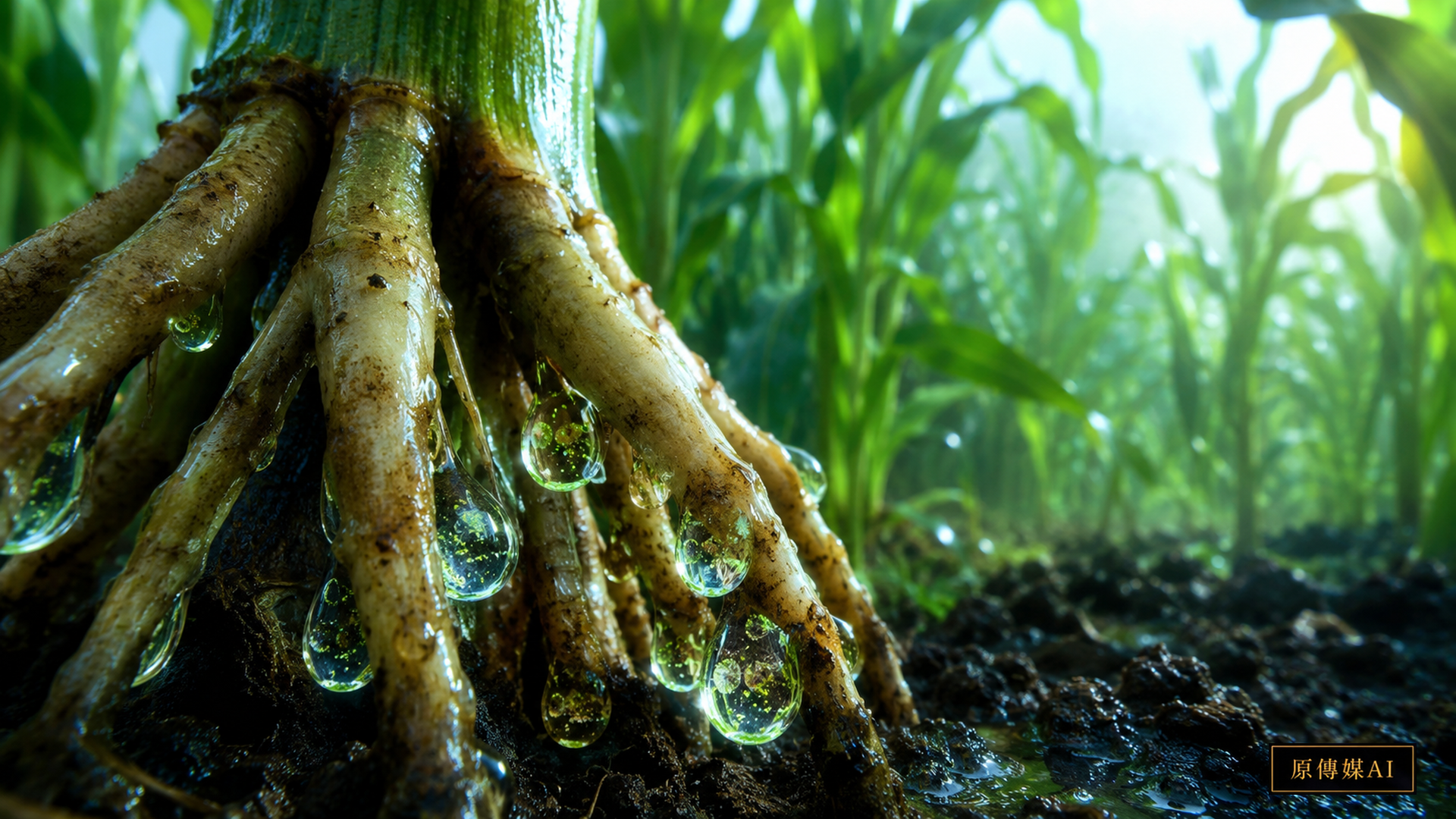
If someone said that a maize plant could support nitrogen-fixing microbes through mucilage secreted by its aerial roots, it might first sound like an agricultural technology story. The deeper story is how one biological mechanism brings together farmers’ long-term stewardship of landraces, Indigenous agricultural knowledge, crop-microbiome research, and international benefit-sharing rules. The science does not stand apart from the history of the seed.
The 2018 PLOS Biology | Nitrogen fixation in a landrace of maize is supported by a mucilage-associated diazotrophic microbiota is an important starting point. Researchers working in the Sierra Mixe region of Oaxaca, Mexico, observed that some tall maize landraces produce abundant carbohydrate-rich mucilage around their aerial roots. The mucilage is not a decorative by-product. It creates a special habitat in which nitrogen-fixing microbial communities can operate and provide the plant with part of its nitrogen supply. For crop physiology, this opens another route to nitrogen. For agricultural history, it suggests that landraces preserved and selected by local farmers may contain traits of great value during a fertilizer crisis.
This is not the usual story of scientists inventing a new seed. Modern molecular and microbial tools are helping explain a phenomenon that already exists in a local farming world. Sierra Mixe maize is not simply a commercial variety newly bred by a research institution; it is a landrace maintained and cultivated by a community over time. The starting point of the knowledge therefore predates the publication date by generations of seed keeping, selection, exchange, and cultivation. Without farmers continuing to maintain these plants, there would be no living material for researchers to analyze.
That history leads to a practical question. When a distinctive trait in a local landrace is shown to have strong application potential, who has a voice in later research and commercialization? If breeders transfer the trait into other maize or cereal lines, or develop a microbial product, low-fertilizer variety, or patent, should the original community be treated only as a sample source? Or should it be recognized as a knowledge and genetic-resource partner? The question becomes especially concrete when a scientific result begins to acquire commercial value.
The Convention on Biological Diversity | Nagoya Protocol text centers on fair and equitable benefit-sharing for genetic resources and associated traditional knowledge. Users should respect national systems and the rights arrangements of Indigenous Peoples and local communities, using prior informed consent and mutually agreed terms to address access and benefits. In the Sierra Mixe example, the principle is straightforward: if a landrace preserved across generations gives global agriculture an important innovation lead, the community should not be excluded after the value becomes visible.
This is also where Two-Eyed Seeing becomes practical. Science can measure sugars in the mucilage, stable-isotope signals, and microbial-community structure. Farmers hold knowledge about landrace traits, cultivation rhythms, field adaptation, seed selection, and the history of preservation. Both are necessary. Laboratory data without the local selection history can turn knowledge into a one-way extraction. Cultural respect without careful field and microbiological testing may fail to produce a useful agricultural or policy conversation. A mature partnership lets the two knowledge systems check and strengthen one another without one replacing the other.
For farmers and nutrient management, the attraction is a possible path toward reducing dependence on synthetic nitrogen fertilizer. Nitrogen fertilizer is deeply embedded in the global food system, while its production and overuse affect energy use, greenhouse gases, groundwater, and farm costs. If a crop can gain more nitrogen through microbes associated with its roots, some fertilizer demand might eventually fall. That does not mean the original landrace will work everywhere. Genetics, soil, weather, microbial communities, and management all matter, so multi-season, multi-site trials and locally governed research are essential.
Data and naming rights are another overlooked issue. Once a local landrace enters an international research system, it may be classified, described, and renamed through academic language. Naming can support exchange, but it can also push the community’s narrative position to the margins. If crops, medicinal plants, fermentation methods, or land-management knowledge from Taiwan’s Indigenous townships enter high-value research chains, communities need the capacity to retain their own conditions, stories, and negotiating position before the value is extracted.
For Taiwan, the lesson is not to copy the Sierra Mixe landrace directly. It is to inventory the value already present in local agricultural knowledge: millet, beans, red quinoa, root crops, and other local varieties carry memories of seed selection and cultivation under particular elevations, rainfall patterns, and soils. Early documentation, community governance, and community-led research agreements can ensure that outside interest does not reduce local partners to passive participants. The most important innovation may be a fairer relationship among science, crops, and communities.
Such an inventory should record conditions of access, who may use samples, how data can be reused, and what happens if a research result becomes commercial. Those details are not administrative obstacles added after the science. They determine whether collaboration remains reciprocal when the value of a landrace becomes clearer.
It should also leave room for communities to reject a proposed use or to keep sensitive knowledge out of public databases. A seed collection can be scientifically important without every associated story, location, or practice becoming openly searchable. Good research design protects both the material and the authority of the people who have cared for it.
Yuan Media AI | Continue Asking Through Your Role
This article provides four role entrances, with five pre-generated questions for each role, for a total of 20 question-and-answer sets. The front end loads the corresponding JSON through `roleQaPath`; it does not call a model in the browser. Answers retain embedded source links so readers can continue checking the evidence.
AI use and content-safety disclosure
This English version is an AI-assisted translation of a Yuan Media AI editorial feature and should be read together with the Chinese source article and cited public references.