Batteries 'Exhale' Before They Burn: How Much Evacuation Time Can Laser Detection of Hydrogen Fluoride Give EVs and Energy-Storage Sites?
Original Chinese title: 電池起火前先「吐氣」:雷射偵測氟化氫,能替電動車與儲能站搶到多少撤離時間?
A KAUST team used tunable diode laser absorption spectroscopy to measure hydrogen fluoride in lithium-battery vent gases. Experiments suggest NMC and LFP cells may provide an early signal roughly one to five minutes before severe thermal runaway.
王振庭
王振庭 | Natural-science educator with long experience in science education, curriculum design, AI education, and media literacy, with particular concern for children's capacity to keep asking questions and develop scientific literacy in technological environments.
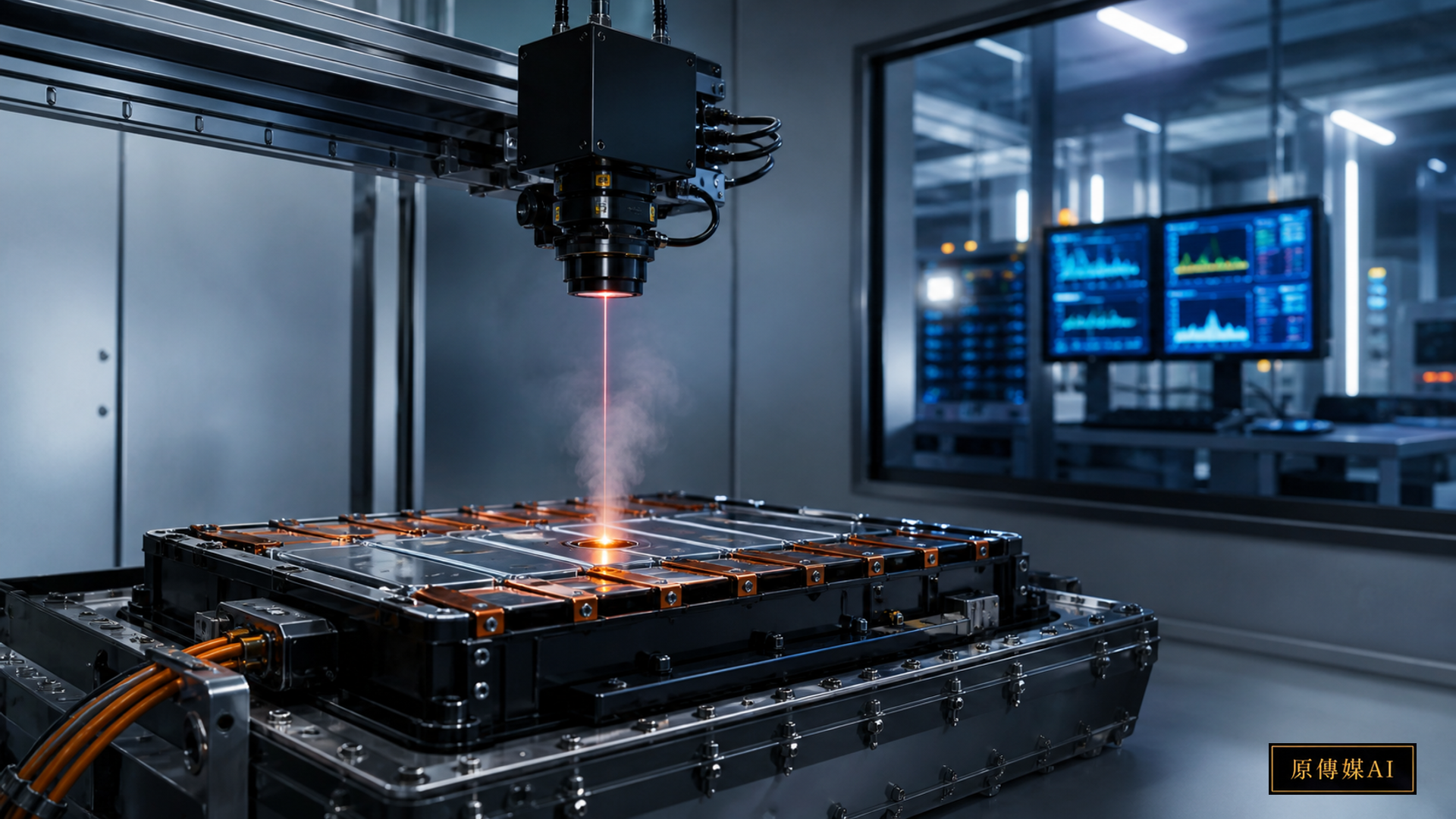
The danger from a lithium-ion battery does not begin when flames appear. Heat, overcharging, internal shorts, or mechanical damage can decompose materials and release gases. Pressure rises and the safety vent opens; if heat and reactions continue accelerating, the cell can enter thermal runaway that ordinary power disconnection cannot stop. For electric vehicles and large energy-storage systems, the precious interval is the short period before flames, when a system might detect the event, isolate it, and move people away.
A KAUST team used tunable diode laser absorption spectroscopy, or TDLAS, to measure hydrogen fluoride above a battery safety vent. Researchers tested common nickel-manganese-cobalt (NMC) and lithium iron phosphate (LFP) cells at 50 and 100 percent states of charge. KAUST Discovery's report on early warning from battery-failure gases explains that both cell types produced hydrogen-fluoride signals of different magnitudes during initial venting and subsequent severe thermal runaway.
In the experiments, NMC cells entered thermal runaway at about 174 to 215 degrees Celsius and LFP cells at about 242 to 249 degrees. More important, the interval between the small initial hydrogen-fluoride peak and the later large peak was about one minute for NMC and about five minutes for LFP. The original Journal of Power Sources study of HF laser-absorption measurement provides the experimental basis for near-field measurement under different cell conditions.
The method does not shine a laser on a battery to read its temperature. It selects an infrared wavelength absorbed by hydrogen fluoride, sends the beam through the vent path, and estimates concentration from changes in absorption. Compared with drawing gas through tubing into an analyzer, near-field optical measurement can reduce underestimation caused by HF adhering to surfaces or being lost during sampling, while following rapid changes. Peaks above 66,000 ppm show that local concentrations can be extremely high at failure, but these near-field measurements along the optical path cannot be treated as exposure concentrations throughout a vehicle cabin or storage building.
Optical measurement has its own failure modes. The beam must cross a representative vent path. If the vent direction, module enclosure, or forced ventilation carries gas away, the sensor may miss the early signal. Smoke, dust, condensation, and window contamination reduce transmission, while vibration may misalign the optical path. Engineering should therefore include optical-power self-tests, window heating or cleaning, beam-interruption alarms, and redundant positions, clearly distinguishing “sensor failure” from “no hydrogen fluoride detected.”
Chemistry and state of charge cannot remain footnotes. NMC and LFP differ in material reactions, vent temperatures, and severity, and 50 versus 100 percent charge changes the signal. Cell size, age, and electrolyte formulation also affect HF formation. A procurement specification that merely requires “HF detection” without naming target cells, module structure, airflow, temperature and humidity, and fault scenarios cannot establish how much warning the deployed system will actually provide.
Hydrogen fluoride is not the only vent gas. Thermal runaway may also release carbon monoxide, carbon dioxide, hydrogen, and volatile organic compounds, creating a combustible mixture. A single HF signal belongs in a multisensor architecture rather than replacing temperature, voltage, current, pressure, smoke, and other gas measurements. A tiered logic may first verify a low-amplitude anomaly and reduce energy input; when several signals agree or rise rapidly, it can escalate to isolation, fire-service notification, and evacuation, while preserving a clear timeline for human review.
The experimental intervals cannot guarantee performance in every vehicle or storage site. A heated single cell differs from a real module with airflow, enclosure, insulation, neighboring cells, cooling lines, and sensor layout. Overcharge, collision, manufacturing defects, and aging may produce another vent sequence. Even within one chemistry, size, electrolyte, state of charge, and ambient temperature change the signal. Deployment requires scenario testing on the target system.
Hydrogen fluoride is itself a hazard. It is highly toxic and corrosive, so a signal means more than “the battery may be heating”; it requires immediate assessment of personnel exposure and ventilation. Sensors cannot be installed only where convenient if representative gas never reaches them, and one sensing point cannot stand for an entire enclosure. Large energy-storage sites need to understand how gases move through cabinets, aisles, air-conditioning loops, and exhaust paths.
A genuine safety architecture must be closed-loop. The first layer cross-checks voltage, current, temperature, pressure, and gas signals. The second automatically stops charging or discharging, isolates modules, and activates appropriate ventilation or suppression. The third gives fire and site personnel location, chemistry, state of charge, and alarm trend. The fourth executes evacuation along predetermined distances and routes. An additional sensor without linked procedures may waste the early warning.
False positives and missed events must be disclosed. HF readings may be affected by environmental background, cleaners, material emissions, or sensor drift; dust, condensation, and installation movement can interfere with the optical path. Engineers need calibration intervals, health self-tests, failure modes, redundant sensing, and explicit combinations of signals that trigger shutdown. A safety system must record not only successful detections but also missed, late, and unnecessary shutdowns.
Validation should report more than an average lead time. Each condition should list initial venting, the first HF signal, vent opening, rapid temperature rise, flame or severe runaway, and the actual completion times for shutdown and notification. If a sensor detects a problem five minutes early but control logic spends four minutes confirming it, only one minute remains for people. Interference tests without thermal runaway are also necessary to estimate the operating cost of false alarms and unnecessary vehicle or site shutdowns.
Vehicles and stationary energy storage need different configurations. Vehicles are compact, vibrate, and may vent unpredictably after collision, so alarms must connect passenger warnings, propulsion isolation, and rescue information. Storage sites have multiple cabinets, recirculating HVAC, and longer fire-service intervention times; they need zoned gas-source location and must avoid sending personnel into concentrated gas. The NFPA resources on energy-storage-system safety place risk management across siting, design, operation, response, and post-incident investigation instead of concentrating responsibility in one alarm.
Post-incident data should remain public-safety evidence. Raw time series, calibration state, alarm thresholds, shutdown commands, and ventilation actions must be protected from overwrite and made available to fire and investigative authorities. Public releases can remove trade secrets and personal information but should not publish only the conclusion that “the system worked normally.” Communities, employees, and regulators need to know whether the warning was timely, which devices failed to respond, whether toxic gas escaped, and when corrective work was completed.
Safety information for people living near storage sites cannot remain only in vendor manuals. Operators should explain battery chemistries, alarm levels, what data fire services receive, when residents may need shelter or evacuation, and how post-incident monitoring will be disclosed. NFPA's Energy Storage Systems Safety resources compile research and education while reinforcing that safety spans the complete life cycle of siting, design, operation, and emergency response.
Procurement can convert research into verifiable requirements. Sensors should demonstrate warning time under specified cell and module conditions; shutdown and isolation must have maximum response times; local alarms should remain available after network or main-power loss; basic information for firefighters should not depend on a cloud login; and every calibration, fault, and alarm should be retained. These requirements reduce risk more effectively than a slogan about “AI smart warning.”
Laser detection of hydrogen fluoride offers a promising early window, not a new safety myth. Whether one or five minutes helps depends on what people and systems can complete in that interval: stopping energy input, isolating the fault, reducing exposure, alerting firefighters, and evacuating. Only when sensing, control, response, and public accountability form one chain does a laboratory signal become public-safety capability.
Sources and Further Reading
- KAUST Discovery | Early warning from dangerous battery-failure gas
- Journal of Power Sources | HF laser-absorption spectroscopy study
- NFPA | Energy Storage Systems Safety
Yuan Media AI | Continue Asking from Your Role
This article provides four role-based entry points, each with five questions, for twenty pre-generated role-based follow-ups. The interface displays the relevant questions and answers for each role. Every answer retains embedded source links, and no model is called live in the browser.
AI use and content-safety disclosure
This English version is an AI-assisted translation based on public research and research-institution materials. It is not battery-system design, firefighting, occupational-safety, or emergency-response guidance; real deployments must follow regulators, manufacturers, and fire-safety professionals.