Before Leaves Turn Yellow, Plants Send Distress Signals: Implantable Sensors Identify Acid and Salt Stress 48 Hours Early
Original Chinese title: 葉子還沒變黃,植物已經發出求救訊號:植入式感測器提前 48 小時辨識酸鹽逆境
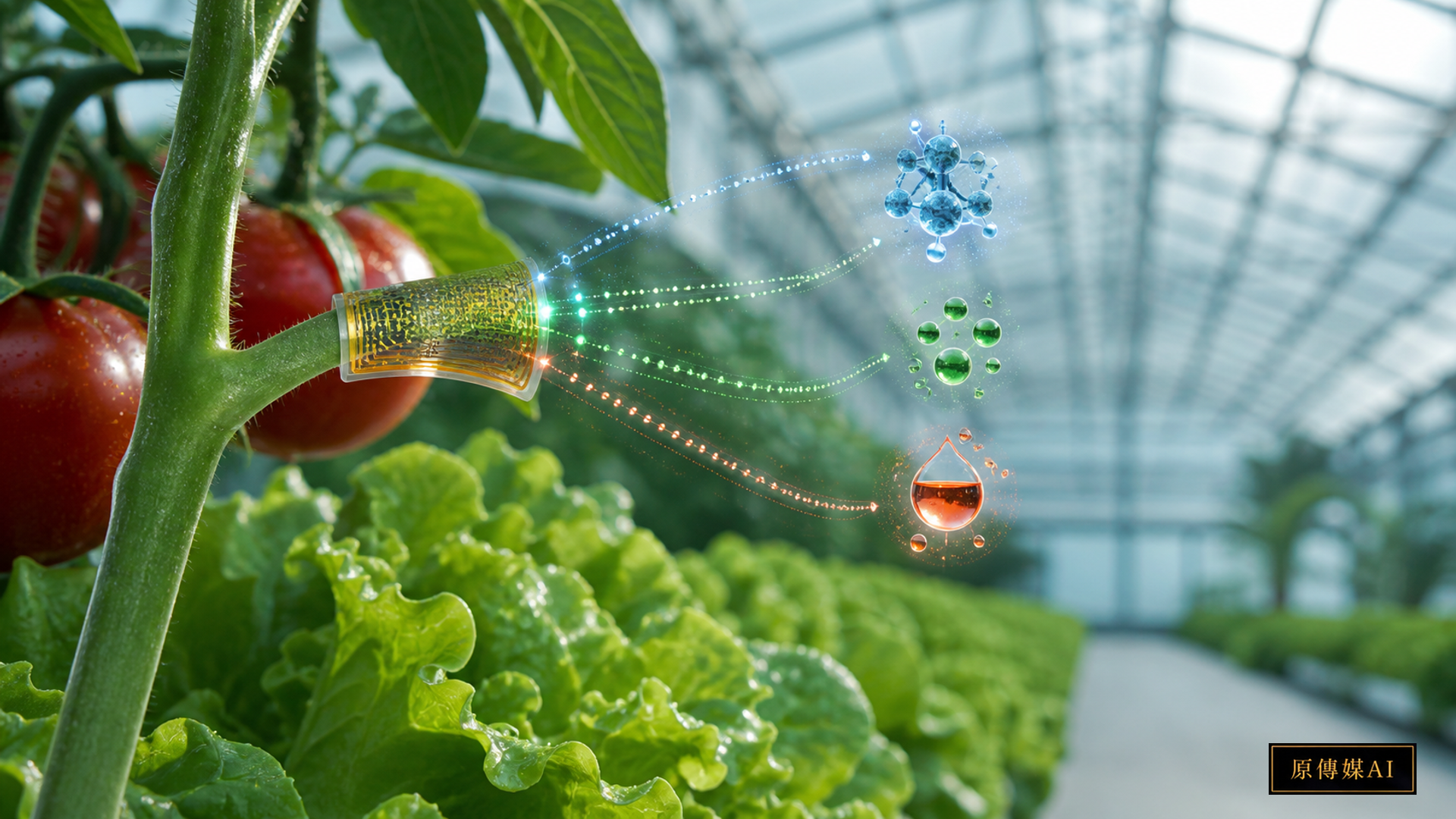
A foldable implantable plant-biomarker sensor measures hydrogen peroxide, potassium ions, and pH together and uses machine learning to classify acid and salt stress. The study reports identification within eight hours, at least forty-eight hours before visible symptoms.
莊溪
莊溪 | Creator of the Knowing Plants website and recipient of an Educational Contribution Award.
By the time a farmer sees yellowing leaves, wilting, or stalled growth, physiological stress may have continued for some time. Soil acidification and salt accumulation disturb ion balance, oxidative stress, and metabolism, yet conventional tests often require samples to be sent to a laboratory or provide only intermittent soil and environmental readings. Continuous signals from inside a living plant could move management earlier, but placing a sensor in living tissue creates new questions about injury, calibration, and interpretation.
A 2026 Nature Communications study introduced an MLIPBS implantable plant-biomarker sensor. Laser-induced graphene forms the electrodes, and a foldable structure conforms to a petiole or plant tissue. It measures hydrogen peroxide, potassium ions, and pH simultaneously, then uses a LightGBM model to distinguish acid from salt stress. The Nature Communications study of an implantable plant-biomarker sensor reports mean classification accuracy of about 90.5 percent.
Researchers validated the system across lettuce, tomato, and aloe. It identified the type and intensity of stress within eight hours after stress began, at least forty-eight hours before visible symptoms. That lead time might let farmers inspect water sources, growing media, fertility, drainage, or environmental controls instead of waiting for leaf damage. But experimental conditions differ greatly from real fields, and accuracy cannot be extrapolated directly to every variety, soil, or mixed-stress condition.
The classification design deserves a closer look. Sixty lettuce plants were divided into six groups of ten: a normal control, two salt concentrations, two acidity levels, and combined acid-and-salt stress. After stabilization, sensors recorded continuously for eight hours at 0.1 samples per second. Data were baseline-corrected, sliding windows summarized means, variation, extremes, and rates of change, and LightGBM performed classification. The model therefore judged the time pattern of three biomarkers together rather than a single instantaneous threshold.
The study did not rely only on random splitting. Each run held out the complete time series from one plant for testing and trained on the others, rotating until every plant had been tested. This plant-wise cross-validation better simulates encountering a new plant than distributing neighboring time points from one plant between training and test sets, reducing overestimation from data leakage. However, all unseen plants still came from the same experimental design; this does not prove that 90.5 percent accuracy will persist across regions, seasons, varieties, and farm practices.
The methods reported for the implantable plant-biomarker study show that acid and salt intensities were chosen to create separable signals, and some concentrations exceed early-management thresholds in ordinary fields. The experiment asks whether sensors can distinguish predetermined stress types and intensities; it does not prove forty-eight-hour yield-loss prediction in every field. Field validation needs milder, repeated, and gradually accumulating pressures, as well as combinations with heat, drought, disease, and nutrient imbalance that may confuse classification.
The three biomarkers provide complementary information. Hydrogen peroxide relates to oxidative-stress responses, potassium reflects critical ion balance, and pH connects directly with acid stress and cellular conditions. Temperature, growth stage, wound response, pests, and disease can affect any single value, so a multiparameter model has a better chance of distinguishing causes than one threshold. Yet a model exposed to too few crops, stress intensities, and environments may mistake dataset traits for universal plant physiology.
Implantation itself must be treated as an experimental variable. An electrode entering tissue can cause a wound, local inflammation, changed transpiration, or a pathogen entry point; petiole thickness and epidermal structure affect contact and attachment. Reported biocompatibility and long-term monitoring are an important start, but field deployment must compare growth, yield, and infection risk in plants with and without sensors, and establish procedures for replacement, disinfection, and material recovery.
Cross-species validation means the device obtained signals from lettuce petioles, tomato stems, and aloe tissue; it does not mean one model can be used unchanged across crops. Baseline potassium, pH, hydrogen-peroxide responses, developmental stages, and circadian rhythms vary. Grafting, pruning, and harvest also change wounds and transport. Practice should establish a baseline for each target crop and include variety, growth stage, irrigation timing, and sensing position in model versions to avoid labeling normal physiology as stress.
Data transmission also determines usable lead time. The prototype can send multichannel signals over low-energy Bluetooth to a phone and export them to a computer for offline features and classification; the paper suggests later moving algorithms to edge hardware. If farm connectivity fails, raw readings should remain stored locally and alarms should not depend entirely on the cloud. Devices need visible battery, connection, calibration, and sensor-health status so users can distinguish a healthy plant from a device that stopped recording.
Representative sampling is another key issue. Implanting every plant may be too expensive and creates more wounds and maintenance; sensing one plant may miss salinity at the end of an irrigation line, a low-lying zone, or localized substrate acidification. A pilot can select representative plants by irrigation zone, topography, variety, and problem history, then cross-check soil electrical conductivity, irrigation water, environment, and field scouting. When signals conflict, the system should request verification rather than automatically overwrite one form of evidence with another.
The public value of a forty-eight-hour warning must be measured by outcomes. Farms should record what low-risk action followed an alarm, whether plant signals recovered, whether yield loss was avoided, and how much extra inspection or input resulted from false alarms. A warning that says only “stress exists” has limited value if it cannot separate drift, acid or salt stress, and other physiology. A useful interface should show likely type, intensity, confidence, trend, and items to verify first, while leaving final treatment to farmers and professionals.
Cost and maintenance belong in agricultural trials. Sensor patches, readers, phones or gateways, calibration fluids, disinfection, replacement, and labor all affect long-term use by smallholders. A subsidy that pays only for the first hardware batch may leave unserviceable equipment after the program ends. Cooperatives or agricultural service organizations could jointly manage readers, maintenance logs, and model updates, but farmers must explicitly choose data permissions; accepting support cannot mean permanent consent to provide complete farm data.
A different route is noninvasive or surface-wearable sensing. KU Leuven's project on wearable early stress sensing for plants uses subtle plant movement to detect abiotic stress and aims to warn greenhouses before visible symptoms. Neither approach is universally superior: implantation can read internal biomarkers directly, while a surface wearable is easier to install and remove. The choice depends on crop value, monitoring period, maintenance capacity, and acceptable injury.
To become an agricultural service, the system must work beyond one demonstration plant. Greenhouses must consider sensor count, representative sampling, wireless communication, power, cleaning, humidity, and collisions during farm work. Open fields add rain, sunlight, wind, mud, animals, and greater spatial variation. Farmers do not need more curves every second; they need to know which zone to inspect, the likely cause, the safest first check, and how uncertain the system is.
The decision loop must also prevent excessive automation. A salt-stress alert does not mean a system should immediately apply large amounts of water. Poor drainage, saline irrigation water, or a crop stage unsuited to heavy watering could make an automatic response worse. A reasonable workflow first confirms the signal through multiple points and human scouting, then makes a small, reversible adjustment and observes whether plant signals recover.
Data rights affect willingness to adopt the service. Plant physiology combined with field location, variety, yield, and management records can create a commercially valuable farm profile. Procurement and subsidies should disclose whether a vendor may train models on the data, whether farmers can export raw records, whether history remains available after a subscription ends, and whether a cooperative may administer it. Otherwise, sensing services can lock farmers into a platform they cannot replace.
Taiwan could begin with high-value greenhouse crops and sites with defined acid or salt risk, sensing a small set of representative plants while retaining soil, irrigation-water, environmental, and human-observation data. The University of Georgia's wearable plant-transpiration sensing technology also shows the growing importance of reading plants directly. Success should not be measured by the number of installed sensors but by earlier detection, fewer mistaken interventions, lower water and fertilizer waste, and farmers retaining final authority.
Sources and Further Reading
- Nature Communications | Implantable plant-biomarker sensor
- KU Leuven | Wearable early stress-sensing project for plants
- University of Georgia | Wearable plant-transpiration sensing technology
Yuan Media AI | Continue Asking from Your Role
This article provides four role-based entry points, each with five questions, for twenty pre-generated role-based follow-ups. The interface displays the relevant questions and answers for each role. Every answer retains embedded source links, and no model is called live in the browser.
AI use and content-safety disclosure
This English version is an AI-assisted translation based on public research and university project information. It is not fertilizer, irrigation, soil-amendment, pesticide, or income advice; farmers and agricultural professionals must validate decisions for each crop and site.