Forests Really Do 'Change Their Perfume' During Heatwaves: When Trees Alter Their Scent, the Chemistry of the Air We Breathe Changes Too
Original Chinese title: 森林在熱浪裡真的會「換香水」:樹木改變氣味後,連我們呼吸的空氣化學都跟著變
New research shows that heatwaves do not merely raise the total amount of forest volatile organic compounds; they alter the chemical composition of monoterpenes. As acyclic compounds increase, they may reshape ozone and hydroxyl-radical reactivity, directly linking forest physiology to atmospheric chemistry.
Lawrence Lee
Lawrence Lee | Technology Journalist, Science Fiction Critic, and Space Science Educator
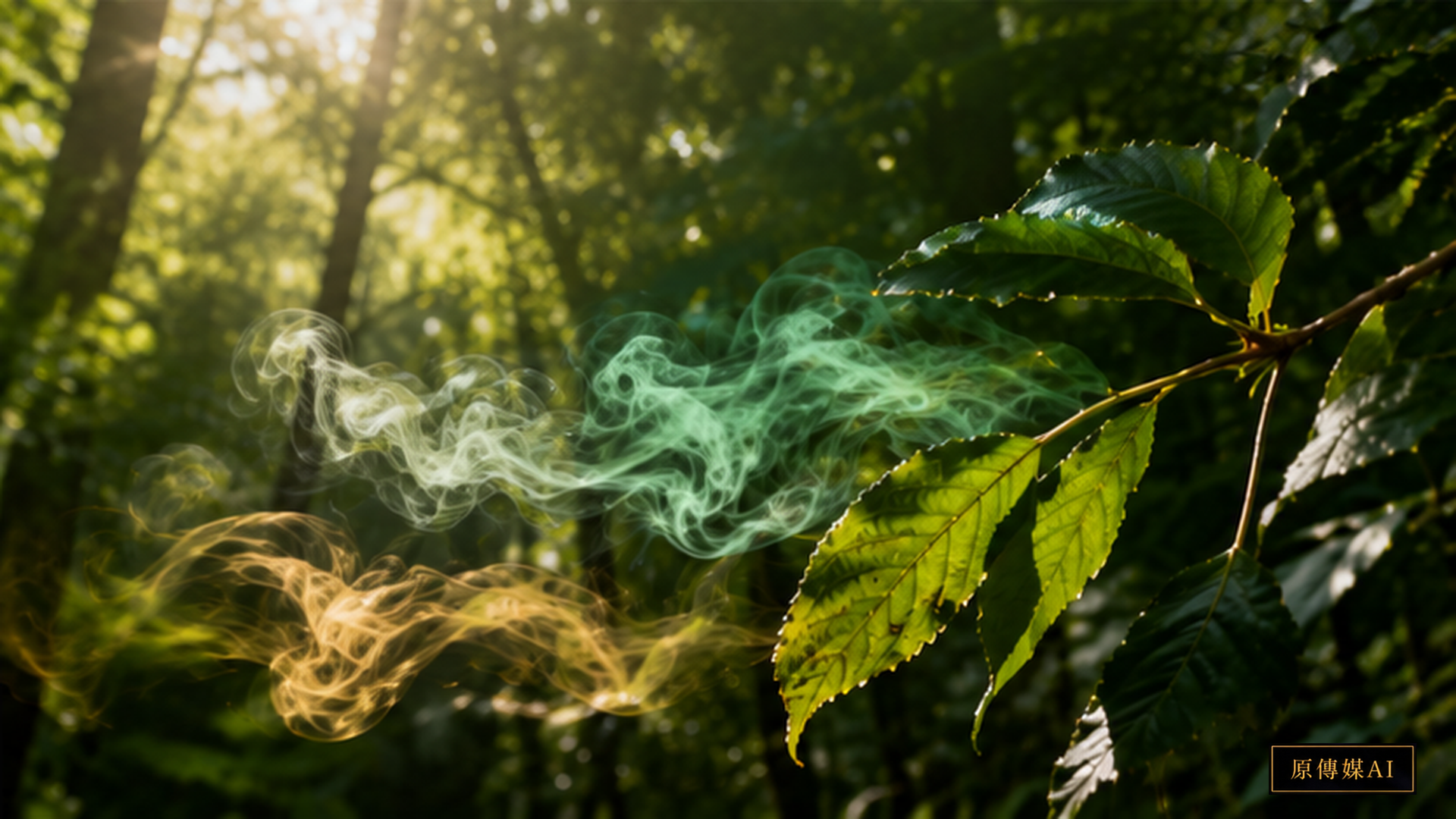
Forest scents are often described as a romantic sensory experience: pine resin, leaves, flowers, and damp soil compose our memory of the forest. Yet from the perspective of plant physiology and atmospheric chemistry, these scents are in fact a highly reactive suite of biogenic volatile organic compounds (BVOCs). They participate in the formation of ozone, hydroxyl radicals, and secondary organic aerosols, so when "the forest smells different," it is sometimes not merely a feeling—it signals that the entire network of atmospheric chemical reactions is shifting.
A study published in Nature Communications on August 21, 2026, addresses this question directly. The research team combined leaf warming experiments, real heatwave observations, and temperature-response modelling to compare how different monoterpenes in tropical trees respond under heatwave conditions. The results show that acyclic monoterpenes have significantly higher temperature sensitivity than their cyclic counterparts; a heatwave therefore does not simply increase total emissions—it pushes the ambient mixture toward a higher proportion of acyclic compounds. Nature Communications|Heatwaves favour acyclic monoterpene emissions in tropical forests
This difference matters because different monoterpenes do not share the same chemical reactivity. In the study, acyclic compounds accounted for nearly half of the measured monoterpenes and dominated the calculations for ozone and hydroxyl-radical reactivity. In other words, if a model treats all monoterpenes as a single class with similar temperature sensitivity, it may underestimate the atmospheric impact of a heatwave shifting the "formula."
This also explains why "the hotter the forest, the stronger the smell" is not precise enough. Under high temperatures, plants reallocate physiological resources; certain VOCs may serve functions in membrane stabilization, oxidative stress response, signalling, or defence. Different compounds increase by different magnitudes, meaning the plant is not simply spraying more of the same perfume—it has switched to a different formula. For the plant, this may be stress physiology; for the atmosphere, it translates into entirely different reaction rates.
Forest workers and long-term local observers may actually notice such changes before instruments do. On scorching afternoons, certain leaves intensify in scent, resin flow increases, insect activity shifts, leaf edges curl, or particular tree species become notably aromatic under specific wind directions—these are sensory and phenological events. They are not a substitute for GC-MS, but they can tell researchers when, which species, and under what conditions sampling is most worthwhile.
The most productive Two-Eyed Seeing entry point for this study, then, is not to romanticize local scent descriptions but to build a three-tier chain linking sensory events, physiological measurements, and chemical analysis. Local observations first flag anomalies: today the scent is different from usual. Plant physiological measurements then examine leaf temperature, stomatal behaviour, water status, and stress indicators. Atmospheric chemistry then identifies which class of BVOC has changed and what the implications are for ozone and hydroxyl-radical reactivity. Each tier answers a different question.
Kao Te-sheng | Tsou ritual ecology expert, hunter school and cultural history practitioner, and author of *The Tsou Book of Plants and Animals*—as the consulting expert for this article—is best positioned to contribute at the level of how long-term forest sensory and phenological observation is organized through cultural experience, rather than simply endorsing laboratory data. For people who spend extended periods in the mountains and forests, plant scents, flowering periods, insects, animal activity, wind, humidity, and season are not separate data fields; they are remembered together as integrated environmental change. This holistic observation can in turn help scientific research select more meaningful sampling times.
However, the article must also avoid claiming that any "different smell" is direct evidence of climate change. Scent is shaped jointly by tree species, flowering period, pests and diseases, injury, humidity, wind patterns, and circadian rhythms. The truly scientific approach is to treat local observation as a hypothesis-generating signal and then verify it through repeatable measurements. That is Two-Eyed Seeing—not forcing experience into a single chemical conclusion.
For air quality modelling, the challenge posed by this research is even more direct. Many regional or global emission models estimate BVOC emissions using variables such as plant functional type, leaf area, temperature, and light. If high temperature is understood only as "more of the same total" without accounting for shifts in mixture composition, the ozone production potential may be misestimated. This is especially critical in areas where NOx is also present, as changes in BVOC composition can be highly sensitive for ozone formation.
The relationship between forests and cities thus becomes all the more interesting. During heatwaves, forests and green spaces on the urban periphery may face heat stress, while urban NOx supplies another set of reactants. This is not as simple as "planting trees causes ozone"; rather, it reminds us that greening, forests, and air quality are linked through complex chemical coupling. Policy should not reject forests on this account but should instead improve species selection, heat adaptation, NOx control, and atmospheric modelling.
For Taiwan's mountain regions, the research worth pursuing in the future is not to replicate values from tropical trees in southern China but to establish long-term local observations: how does the BVOC mixture change across different elevations, tree species, seasons, and heatwave events? Can the distinctive scent moments described by local forestry workers and long-term Indigenous community users be matched with leaf physiology, heat stress, and chemical composition? These questions are far more valuable than simply chasing "forest fragrance."
The core concept this article aims to leave behind is that forests are not a passive green backdrop enduring heatwaves. Trees adjust their physiology under high temperatures and also alter the chemical signals they release into the air; these molecules then participate in the atmospheric chemistry we breathe. Only when local sensory experience, forest physiology, and atmospheric chemistry are brought together can we begin to see: forests in a heatwave may indeed be "switching to a different scent formula."
Tree Species Differences Can Turn the Same Heatwave into Different Chemical Events
A forest is not a single plant species. Different tree species vary in monoterpene storage, biosynthesis pathways, leaf anatomy, and heat tolerance, so under the same heatwave the VOC mixture released by each tree can differ greatly. Some species store large quantities of terpenes, while others rely more on real-time synthesis; some close their stomata rapidly under high temperatures, while others maintain relatively high metabolic rates. These differences ultimately accumulate into canopy-scale emission patterns.
If future atmospheric models are to become more accurate, they cannot treat forest type as a single average emission factor. At least under heatwave and extreme heat scenarios, more species-specific or functional-type responses are needed. This is also an important interface between ecological research and air quality modelling: ecology knows how trees live, while atmospheric chemistry needs to know what they emit, for how long, in what quantities, and what happens when those emissions encounter NOx.
How Does "Smelling Something Different" Become a Scientific Sampling Strategy?
Forest patrol officers, hunters, forestry workers, and long-term gatherers often develop their sensitivity to scent changes through years of repeated experience. They may not be able to name limonene, ocimene, or myrcene, but they can recall that in a certain month, along a certain forest road, under certain weather conditions, "the scent was different from usual." If such descriptions are recorded in full, they can be translated into research sampling designs: when anomalous scents appear, simultaneously measure leaf temperature, sap flow, stomatal conductance, VOC composition, and insect activity.
Kao Te-sheng's consulting role is particularly meaningful here. Long-term Tsou mountain and forest knowledge does not isolate plants as individual species; it often connects them with rituals, ecology, hunting grounds, seasons, and animal behaviour. This holistic observation can prompt scientific research to ask one step further: does the change in scent coincide with shifts in insects, fruiting, animal activity, or seasonal indicators? These relationships may not all be provable in a single experiment, but they can help research formulate better questions.
Heatwaves and Ozone: The Simplistic Story That Forests Are Pollution Sources
When BVOCs coexist with urban or industrial NOx, ozone formation may increase, so research findings can easily be misread as "trees cause air pollution." This claim ignores the fact that atmospheric chemistry requires multiple reactants and overlooks the importance of NOx control. Forests provide biogenic reactants, while anthropogenic emissions determine much of the ozone chemistry context. If policy simplifies responsibility to tree species, it will miss the anthropogenic pollution sources that truly need to be reduced.
A more sound governance approach is to consider urban forestry, species selection, heat resilience, and NOx reduction together. Certain high-BVOC tree species may require more nuanced assessment in specific urban environments, but this does not mean forest greening loses its value. Shade, cooling, carbon storage, biodiversity, and psychological well-being remain important—it is simply that future planning needs a better understanding of chemistry.
Taiwan's Mountains and Forests Can Build Their Own "Scent–Heatwave" Database
Taiwan's mountain regions have diverse tree species, large elevational gradients, and frequent interactions among high temperatures, typhoons, droughts, and monsoons, making them well suited to develop their own forest BVOC observation network. In addition to fixed stations, patrol records can be incorporated: extreme heat days, anomalous scents, leaf fall, resin flow, insects, and plant phenology, forming event-based sampling data.
If in the future these records can be linked with GC-MS, leaf chambers, remote sensing, and meteorology, truly locally meaningful models can be established. Two-Eyed Seeing here does not mean placing cultural narratives in an appendix; it means letting long-term mountain and forest observation determine when scientists go to measure, what they measure, and which anomalies are worth pursuing.
Forests "changing their perfume" during heatwaves is therefore not merely a rhetorical flourish. It represents the convergence of plant physiological strategy, atmospheric reactivity, and local sensory experience within a single event. When we begin to look at total emissions, formula composition, phenology, and sensory changes together, forests cease to be just a green area in climate models—they become a living system that actively responds to heatwaves and alters the chemical environment around them.
Extended resources: Nature Communications: Research Article Index; Nature Communications: Research Articles
AI use and content-safety disclosure
This article was compiled and reviewed through the Yuan Media AI editorial process.