Fertilizer Is Not the Only Culprit: Fungi in Paddy Fields Also 'Exhale Laughing Gas,' and Scientists Have Now Found a Molecular Switch
Original Chinese title: 肥料不是唯一兇手:稻田裡的真菌也會「吐笑氣」,現在科學家找到一個分子開關
A 2026 study shifts the focus of agricultural N₂O mitigation from conventional nitrification further toward fungal denitrification, using structure-guided methods to identify compounds that can inhibit P450Nor. The real question is how molecular mechanisms can be connected to field moisture, fertilization, and farmers' experience.
王振庭
Wang Chen-Ting | Yuan Media AI Technology and Society Observer | Focused on natural science education, the public dimension of technology, climate adaptation, and local public services
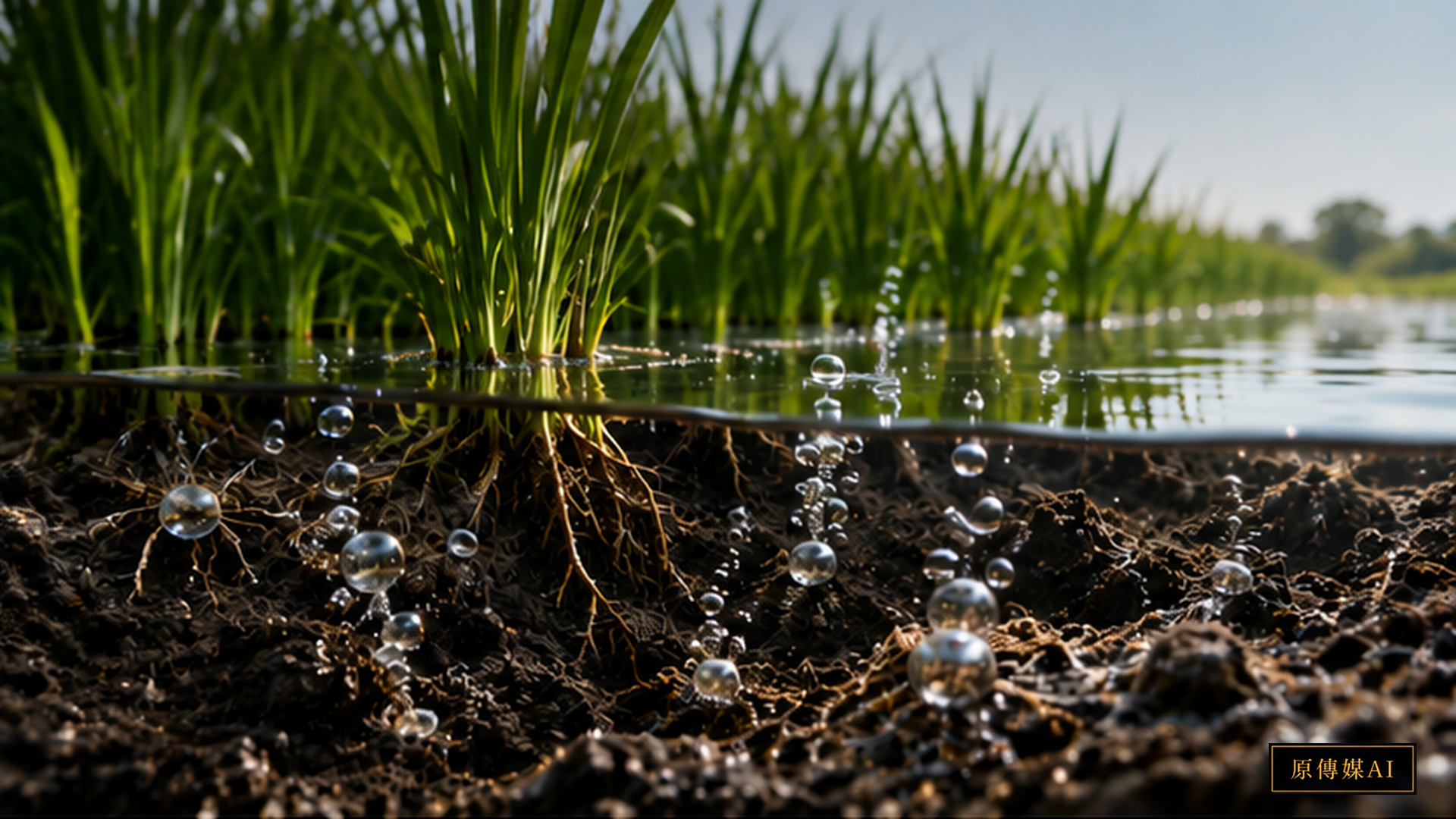
For a long time, the most frequently discussed approaches to reducing N₂O emissions in agriculture have been "avoiding fertilizer over-application," "improving nitrogen use efficiency," and "controlling nitrification." But a study published on August 20, 2026, in Nature Communications shifts the spotlight to another, often overlooked group of actors: fungi involved in denitrification, and the key enzyme they use to produce N₂O, P450Nor. Nature Communications|Structure-guided identification of denitrification inhibitors to mitigate agricultural N₂O emissions
Using a structure-guided approach, the research team identified the ability of triazole compounds to inhibit cytochrome P450. Under laboratory conditions, soil denitrification-derived N₂O was reduced by approximately 85–100%; in subsequent paddy field trials, the emission reduction ranged from about 33–54%. These two sets of figures must be considered separately, precisely because nearly shutting down a biochemical pathway in the lab does not mean all N₂O in the field will disappear together. Real farmland simultaneously hosts bacteria, fungi, oxygen gradients, moisture, temperature, organic matter, fertilizer forms, root activity, and micro-zone differences—any one of these changes can alter emission performance.
This is what "fertilizer is not the only culprit" truly means. Nitrogen fertilizer provides the reactants, but how N₂O is produced depends on which microbial pathway nitrogen follows in the soil. Paddy fields are especially complex, because alternating flooding and drainage rapidly change the redox environment; different soil depths may simultaneously harbor aerobic and anaerobic micro-zones. Studies that look only at fertilizer application rates can easily obscure "which microbe is activated at what time" within averaged numbers.
The UNEP and FAO Global Nitrous Oxide Assessment has already identified agriculture as one of the core sources of global anthropogenic N₂O emissions, with synthetic fertilizer and manure management closely linked to emissions. N₂O is not only a high-global-warming-potential greenhouse gas but is also associated with stratospheric ozone depletion, making it simultaneously a climate and environmental governance issue. UNEP/FAO|Global Nitrous Oxide Assessment
However, this study cannot be translated into "farmers can simply scatter triazole into their fields to reduce carbon." Triazoles are a broad class of compounds that include molecules used in pesticides and pharmaceuticals; any field application must re-examine dosage, non-target microorganisms, residues, crop safety, resistance, soil ecology, and regulations. The real breakthrough of the original study is demonstrating that "denitrification enzymes can serve as a precise intervention point," not announcing an immediately commercializable formula.
This is precisely where Two-Eyed Seeing in agriculture becomes relevant. Molecular biologists know about P450Nor, the heme site, enzyme inhibition, and the denitrification pathway; farmers know which plots have long-standing waterlogging, which corners drain slowly, when fertilizer application is most likely to produce unusual odors, which days after straw incorporation see the greatest soil response, and which seasons carry the highest disease pressure. This field knowledge is not a competitor to molecular research—it is the contextual data that determines whether laboratory mechanisms can be correctly validated.
If such technology is to be integrated into genuinely low-carbon agriculture in the future, the first step should not be large-scale use of inhibitors, but rather combining N₂O flux, soil moisture, redox potential, fertilization timing, field management, and microbial data. Researchers need to know in which time window emission reductions occur; farmers need to know whether management costs will increase; and policymakers need to know whether emission reductions can be measured, verified, and sustained.
An even more important question is "nitrogen use efficiency." If a treatment reduces N₂O but pushes nitrogen toward other loss pathways—such as nitrate leaching or ammonia volatilization—it is not necessarily a complete improvement. Therefore, field evaluations must not focus on a single gas; they must consider crop uptake, soil residues, other nitrogen losses, and yield together. Truly good agricultural carbon reduction does not shift emissions from one outlet to another; it directs more nitrogen into crops and less nitrogen into the environment.
For rice cultivation in Taiwan, the value of this study lies especially in reminding us that irrigation and drainage themselves function as microbial environment controllers. Taiwan already has a research foundation in alternate wetting and drying, fertilizer management, field-level carbon reduction, and water-saving rice cultivation. If future research addresses fungal denitrification, it should be integrated with different soil, climate, variety, and farming practice conditions—not by directly copying overseas field figures.
The inclusion of consulting expert Chen Chen-Yi from the Taitung District Agricultural Improvement and Experiment Station is well suited to bring the article from molecular mechanisms back to the agricultural reality of eastern Taiwan: which field conditions deserve priority measurement? Which aspects of farmer operations are hardest to align? How can emission-reduction technology avoid imposing unnecessary burdens? These questions require joint answers from agricultural experimental research and field experience.
The message truly worth retaining from this article is not "scientists have found a switch to turn off laughing gas," but rather that agricultural greenhouse gas governance is entering a more refined stage: asking not only how much fertilizer is used, but identifying which microbial groups, which enzymes, and under what moisture and management conditions nitrogen is converted into N₂O. Only when molecular mechanisms are genuinely connected to the field-level timing that farmers have long mastered can carbon reduction move from impressive laboratory figures to verifiable farming strategies.
Why Does the Same Field Emit Completely Different N₂O at Different Times?
One of the most difficult aspects of studying paddy fields is how rapidly the environment changes. After irrigation, the soil becomes anaerobic; after drainage, oxygen re-enters; and roots themselves create tiny oxidized zones around them. These changes cause nitrogen transformation pathways such as nitrification, denitrification, and DNRA to alternate in dominance across different times and depths. In other words, the microorganisms dominating N₂O production in the same field may be entirely different in the morning, in the evening, one day after fertilization, and three days after drainage.
Therefore, if management targeting fungal denitrification is to be pursued in the future, it is not sufficient to measure total emissions only once after harvest. A more reasonable approach is to establish high-frequency flux monitoring, combined with soil moisture, Eh, temperature, mineral N, root activity, and microbial markers. Only by knowing when emission peaks occur is it possible to place inhibitors or other management measures within the truly effective time window.
Farmers' Operational Experience Is Actually the Most Important Temporal Information
Farmers have long remembered "after which rain the field was hardest to dry," "which soil drains fastest," and "when topdressing produces the best rice color response." Although this information is not molecular data, it directly corresponds to the environmental conditions of microbial activity. If research teams sample only according to a fixed calendar, they may miss the most important emission events; if farmers help annotate fertilization, irrigation and drainage, torrential rain, straw incorporation, and unusual odors, microbial data can be placed back onto the real agricultural timeline.
This is also why incorporating the consulting perspective of the Taitung District Agricultural Improvement and Experiment Station is important. The soils, irrigation sources, climate, and farming systems of eastern Taiwan's rice cultivation differ from overseas experimental fields; research cannot simply replicate concentrations and dosages. Genuine local validation should first ask: which field types are most prone to denitrification hotspots? Has different moisture management already achieved part of the emission reduction effect? If chemical intervention is added on top, is the gain sufficient to offset costs and risks?
Carbon Reduction Cannot Be Calculated Separately from Food Production
If N₂O emission reduction sacrifices yield or increases farmer risk, it will be difficult to sustain in the long term. Therefore, every new intervention should simultaneously measure yield, nitrogen use efficiency, disease pressure, soil health, and farmer workload. If a measure can reduce N₂O by 40% but requires farmers to make several additional field operations, raises pesticide concerns, or lowers yield, policymakers must reassess whether it truly delivers net benefits.
Conversely, if inhibitor research can be integrated with existing water-saving irrigation, precision fertilization, and soil organic matter management, the effects may be more stable. Emission reduction should ultimately not rely on a single "miracle molecule" but should form a set of complementary measures: appropriate fertilization, correct timing, reasonable irrigation and drainage, reduced nitrogen losses, and then precise inhibition at specific high-emission pathways.
From this perspective, P450Nor is not the endpoint of the answer but a new observational window. It allows us, for the first time, to see more concretely the role fungi may play in agricultural N₂O, and it compels researchers to extend the question "where does the nitrogen come from" further into "who ultimately converts it, under what conditions, and into which gas." The more precise such questions become, the more likely agricultural carbon reduction is to move from policy slogans into genuine field management.
Moving from Single Technologies to "Emission Hotspot Management"
A more practical approach in the future may be not to apply the same treatment to every field, but first to identify high-emission hotspots. If certain field areas are particularly prone to denitrification peaks due to soil texture, irrigation and drainage conditions, or organic matter, monitoring and management can be prioritized there; low-emission fields can maintain simpler farming practices. This layered governance can reduce costs and avoid imposing the same operational burden on all farmers in the name of carbon reduction.
Policymakers should also avoid evaluating effectiveness solely by "how much N₂O is reduced per hectare." To establish a carbon agriculture system, measurement uncertainty, annual climate variation, and farmer implementation costs must be incorporated into calculations. In particular, torrential rain, drought, and abnormal high temperatures can dramatically alter soil microbial activity; single-year trials can hardly represent long-term effects. A truly adoptable emission-reduction plan must undergo repeated validation across multiple seasons, multiple fields, and different management conditions before it can transition from research findings into reliable agricultural public policy.
Extended resources: UNEP: Global Nitrous Oxide Assessment data page
AI use and content-safety disclosure
This article was compiled and reviewed through the Yuan Media AI editorial process.