Medical Electronics Also Need an Exit Strategy: How Can a Dissolving Implant Prove It Is Reliable Before It Disappears?
Original Chinese title: 醫療電子也需要「退場機制」:會自行溶解的植入物,如何證明它在消失前仍然可靠?
A series of August 2026 studies on bioresorbable implantable electronics shifts the question from whether a device can dissolve to whether it can work reliably until the day it should disappear. Reliability, observability, and the fate of degradation products are becoming central to clinical translation.
王振庭
Natural Science Education Teacher | Long-term contributor to science education, curriculum design, AI education, and media literacy, focused on how children maintain the ability to ask questions and scientific literacy in technological environments.
The Ideal Implant May Not Stay in the Body Forever
Many implantable medical electronics are designed around stability, durability, and remaining unchanged for a long time. But some treatments are needed only for weeks or months: postoperative monitoring, wound healing, neural stimulation, temporary electrotherapy, or local drug control. When the treatment window ends, a permanent device may become a burden and may even require a second surgery for removal. Bioresorbable electronics therefore propose an attractive idea: after completing their task, the device's materials gradually degrade and are processed by the body, avoiding a long-term foreign object and another operation.
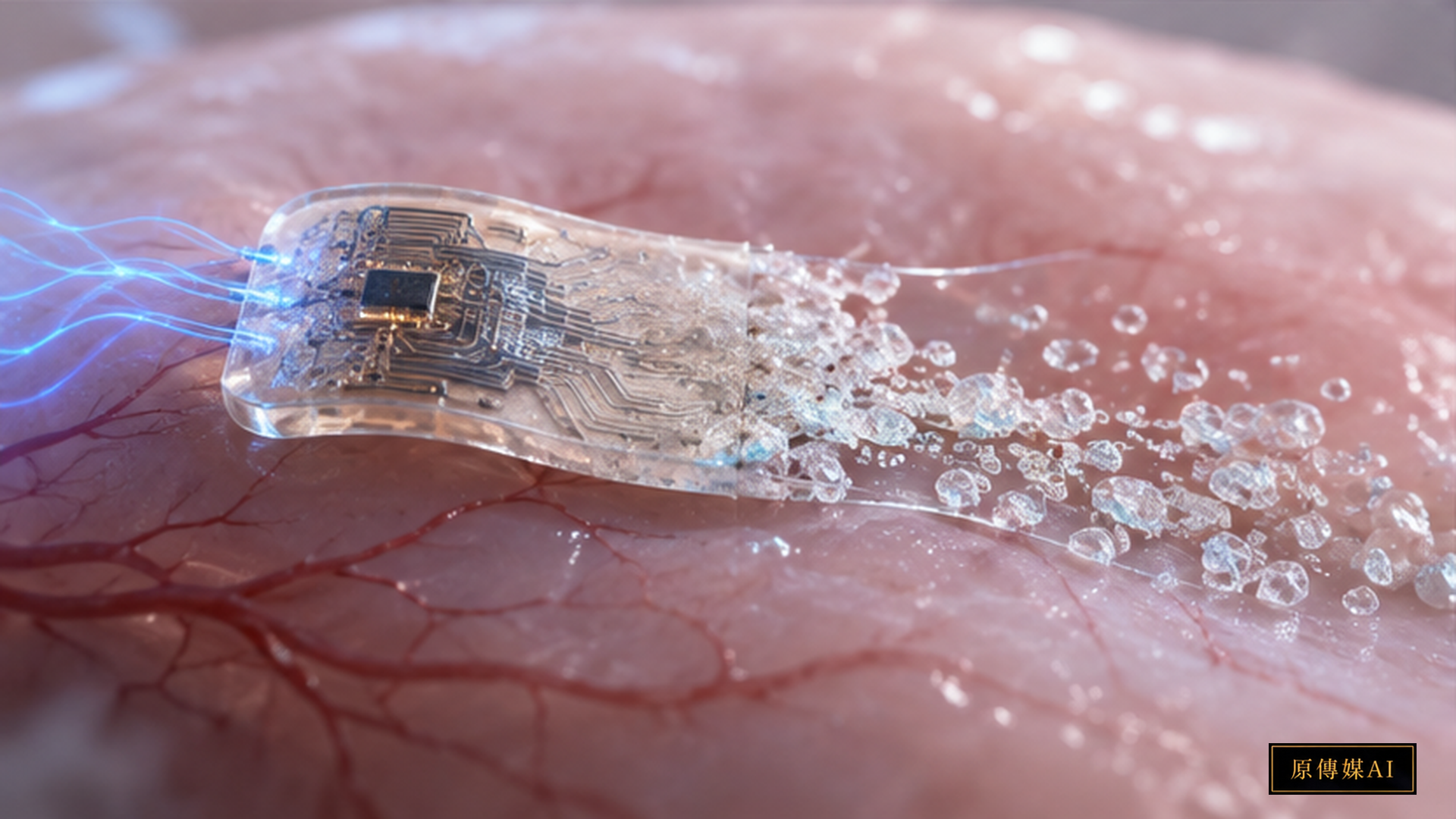
On August 14, 2026, Nature Nanotechnology published a battery-free, bioresorbable triboelectric implant. The device uses ultrasound to generate electrical output and combines it with a phosphorescent signal that can be read optically from outside the body, allowing researchers to observe the implant's location, form, damage, and resorption process. The mouse study followed the implant for as long as 38 weeks. Nature Nanotechnology | Bioresorbable and optically readable triboelectric implants enabled by nanoscale iridophosphors The study is especially interesting because it asks more than “can it work?” It begins to answer another difficult question: after implantation, how do we know that it is still functioning normally?
A Machine That Disappears Needs a Timeline More Than One That Does Not
The reliability of permanent electronics is usually described as keeping performance stable for years. Transient electronics require the opposite: stable performance for a period, followed by a gradual loss of function according to design. The engineering goal becomes a time curve rather than one performance number. If the device degrades too early, treatment may be interrupted. If it degrades too late, the point of avoiding a second surgery is lost. More complicated still, material degradation does not happen with a single switch. Thickness may change first, mechanical softening may appear, conductor resistance may rise, the package may take in fluid, and optical signals may change before complete failure.
A study published in npj Flexible Electronics in July addresses this problem by building a transient simulation that connects degradation kinetics with system-level electrical, mechanical, and electromagnetic performance. It allows engineers to predict how a bioresorbable circuit will change over clinically relevant time scales. npj Flexible Electronics | System-level transient simulation of bioresorbable and flexible electronic circuits This matters because bioresorbable electronics cannot be validated only by testing once before implantation and looking again after complete disappearance. Every intermediate stage may affect treatment.
Another August Direction: Making the Stimulation Itself Programmable
On August 19, Nature Electronics published a wireless stimulation platform built with bioresorbable phototransistors. Light passing through tissue can control the system to provide programmable, multi-site polyphasic electrical stimulation. Nature Electronics | Programmable polyphasic stimulation with bioresorbable phototransistors This moves bioresorbable electronics beyond simple sensors toward more complex therapeutic control.
But the more complex the function, the stricter the reliability problem. Failure of a simple device may mean only one missing data point. If a stimulation device operates at the wrong time, location, or waveform, the risk is greater. Engineering therefore needs to understand not only the normal operating mode, but also whether degradation can create unstable output and what state the system enters when one part of the material fails first. The best exit is not an unpredictable slow decline; the path of performance loss must itself be designed.
“Seeing Whether It Is Failing” May Become a New Safety Feature
The most notable aspect of the Nature Nanotechnology study is not only triboelectric energy harvesting, but also the integration of optical reporting into the device. An implant is usually impossible to observe directly inside the body. If its structure is damaged or its function declines, the problem may not be found until symptoms appear. The study makes the material's optical signal and form readable from outside the body, giving the device something like a health indicator.
This idea can become an important design principle for transient medical devices: if a device is destined to change, it should also provide a way to monitor that change. In the future, doctors may ask not only “How is the patient now?” but also “Which stage of its life cycle is the implant in?” Imaging, optical signals, impedance, wireless returns, or other readable parameters may all become part of the device state.
Degradation Is Not Disappearance; It Is Materials Taking Another Form
The phrase “dissolves” can easily make people imagine that a material vanishes. In practice, polymers, metals, semiconductors, and functional materials break down into smaller molecules, ions, or products that metabolism can process. Local tissue, blood, the liver, kidneys, or other pathways then handle them. Biocompatibility therefore cannot be tested only on the intact device. Researchers must also study the concentration of degradation products over time, local changes in acidity, inflammation, immune responses, and clearance rates.
Moreover, “a single material is safe” does not mean that degradation of the entire device is safe. A multilayer structure may allow some products to accumulate locally, and contact between different materials after package failure may change the reaction. This is why system-level models and long-term in vivo studies matter: safety assessment for transient medical devices must be a process rather than a list of materials.
The Most Practical Clinical Question: What If It Fails Early?
For patients, the most important issue may not be how advanced the material is, but what happens when it fails. If a stimulation device expected to work for six weeks stops in week four, can the doctor know? Is additional treatment needed? If the device breaks apart before it is fully absorbed, is there a way to remove it? If degradation is slower than expected, should follow-up last longer? These questions must be written into failure scenarios before clinical trials.
“No second surgery” cannot therefore become a slogan that simplifies risk. It is a potential advantage, but only if the device completes its task reliably and follows a safe, predictable degradation path. Informed consent should also explain that bioresorbable does not mean risk-free. Early failure, delayed absorption, local reactions, and insufficient treatment remain possible.
Regulation Also Needs New Performance Endpoints
Conventional medical devices are assessed through factory specifications, durability, fatigue, sterilization, and long-term stability. Transient electronics need another axis of time: what range should performance occupy on day 1, day 7, day 30, and day 90? When may decline begin? When should function be completely lost? To what level of degradation can the device still stimulate or sense safely? These may become new validation endpoints.
Post-market monitoring also needs to change. If the device ultimately no longer exists, it cannot be removed for failure analysis like a conventional implant. It becomes even more important to preserve state data during use. Observable implants, digital records, and clinical follow-up will therefore become more important.
Two-Eyed Seeing: Materials Engineering Must Be Designed with Clinical Time
Materials researchers describe systems through degradation rate, modulus, conductivity, and film thickness. Clinicians describe time through wound healing, neurological recovery, pain control, and postoperative risk. A device that can truly translate to care must align these two timelines. The task is not to make a device that “dissolves in three months” and then search for a suitable patient. It is to first understand how many weeks of stable function the clinical need requires, then design materials and packaging in response.
This is the most important shift in bioresorbable electronics: the focus is moving from “disappearing mysteriously” to “exiting reliably.” A good medical device must not only be high-tech when it arrives; it must also know when it should leave. When the working window, observability, degradation pathway, and safety monitoring are designed together, disappearing electronics have a real chance to move from an attractive laboratory demonstration to a trustworthy clinical tool.
The Educational Challenge of Bioresorbable Devices: Do Not Treat “Disappearance” as Magic
This technology is also a useful way to discuss science education. For a general reader, “the implant dissolves by itself” can sound as if a device suddenly vanishes like sugar. The real process involves material hydrolysis, corrosion, molecular-chain cleavage, ion release, tissue responses, and metabolic clearance. Different materials also operate on different time scales: some structures soften first, some conductive paths fail first, and some packages are penetrated by body fluid first. Explaining these processes is necessary to understand why research requires long-term follow-up and system simulation.
For medical-technology communication, this is an important safeguard. If media coverage emphasizes only “no need for another operation,” patients may overlook that the technology is still in research and translation. More responsible storytelling presents benefits and uncertainty together: which findings come from mice, which are approaching clinical needs, and which long-term material-safety questions remain. Scientific literacy is not pessimism about new inventions; it is knowing how much evidence an apparently simple benefit needs before it can become a medical standard.
AI use and content-safety disclosure
This article was organized and reviewed through the Yuan Media AI editorial process.