A Robot That Can Fall and Keep Going: Why a Wheel-less, Leg-less Tensegrity Body May Fit Disaster Zones
Original Chinese title: 摔下去反而還能繼續走:沒有輪子、沒有腳的張力機器人,為什麼可能更適合災區?
The Tribar tensegrity robot reframes disaster robotics around recovery rather than perfect impact avoidance. The key question is whether structural resilience, post-impact autonomy, and first-responder knowledge can be combined into a deployable system.
陳錦瑜
陳錦瑜 | Professor at National Taiwan University of Science and Technology | Teaches courses on chatbots and cultural exploration; focuses on interpreting Taiwan culture and international trends, appreciating cultural diversity, advancing UN SDGs global citizenship, and building sustainable global partnerships.
The Important Part Is Not Merely Surviving a Fall
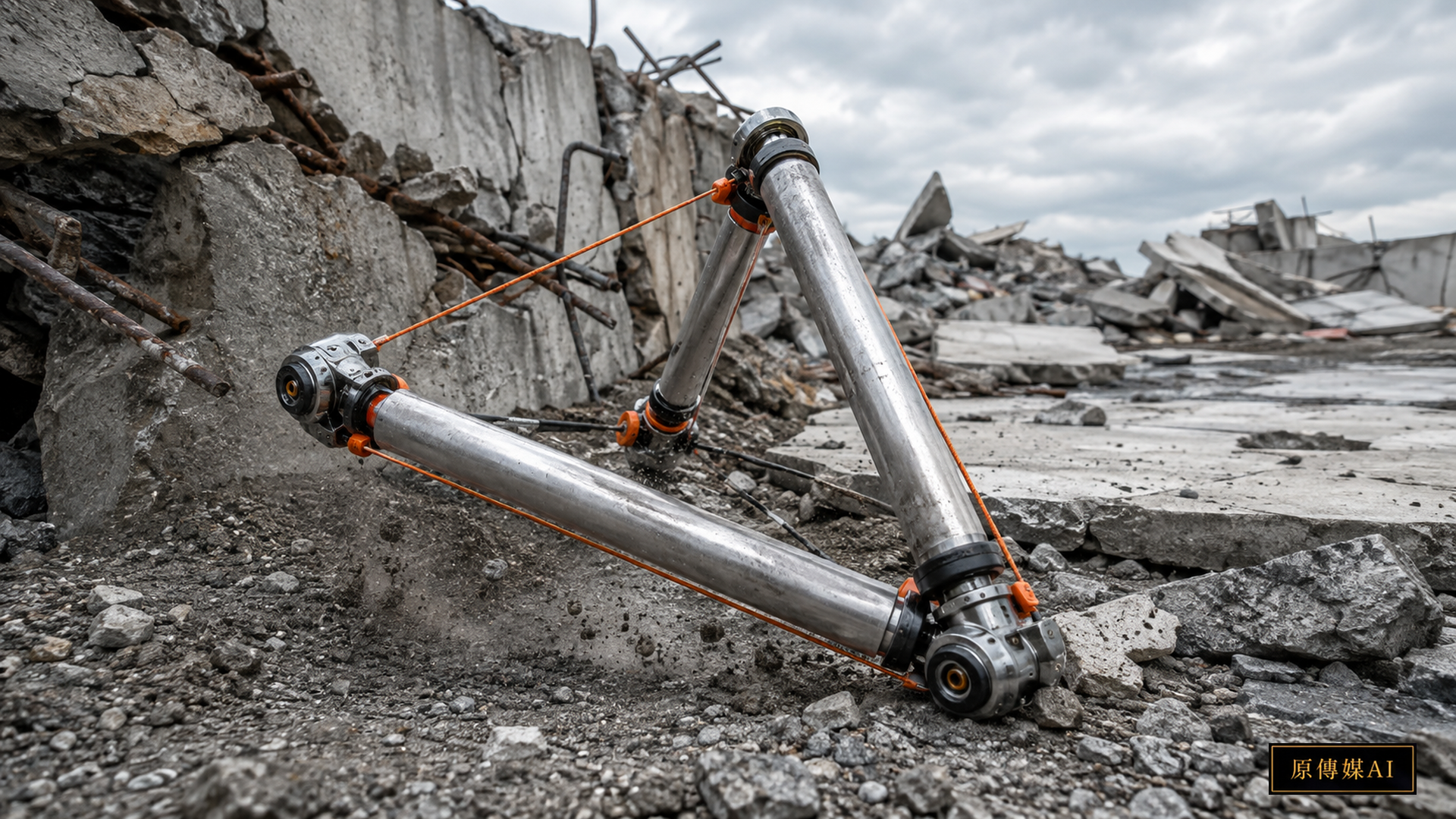
Mobile robots are usually designed around an implicit rule: do not fall. Tribar, published in *Nature Machine Intelligence* on August 10, 2026, asks a different question. If collisions, tumbles, and drops are unavoidable in rubble and damaged terrain, can the body itself be designed to absorb them as ordinary operating conditions? The three-bar tensegrity robot combines rigid struts with elastic tension elements and was demonstrated to survive drops of at least 5.7 meters before continuing autonomous locomotion. Nature Machine Intelligence | Original study
The engineering significance is not a stunt. Conventional rigid platforms often isolate impacts with suspension, armor, cautious trajectory planning, or dedicated landing mechanisms. A tensegrity structure distributes loads across a network. Deformation within its designed range is not necessarily damage; it is part of the mechanism.
A Body That Is Structure, Suspension, and Locomotor at Once
Yale's public hardware documentation describes Tribar as an untethered three-bar tensegrity robot driven by six electric motors, with open hardware resources supporting reproducibility. Yale Tensegrity Robotics | Hardware Overview By changing tendon lengths, the robot shifts geometry, center of mass, and contact points so that the whole structure rolls. Supplementary demonstrations include grass, ice, pebbles, sand, inclines, trajectory following, and post-impact movement.
This changes the meaning of “recovery.” A disaster robot that can fall, reconstruct its state, and continue moving may tolerate routes that would be unacceptable for a rigid vehicle. That could make aerial or edge-of-rubble deployment more practical for early reconnaissance.
Disaster Terrain Is Not a Benchmark Course
Real rubble contains loose slabs, rebar, wires, voids, mud, standing water, dust, heat, and communication shadows. A published drop height cannot answer whether tendons will survive cutting, snagging, fire, or long exposure to abrasive debris. Nor does the study establish that Tribar is a certified search-and-rescue product. It establishes a research platform with a valuable property that now needs mission-level validation.
After Impact, Autonomy Must Reconstruct the Robot's State
Autonomy after impact is especially hard because a deformable robot cannot assume a fixed body frame. It must estimate which struts are up, which contacts are loaded, and how its sensors are oriented after each tumble. Structural robustness therefore matters only if sensing, state estimation, control, power, and communication also recover.
Two-Eyed Seeing: Let First Responders Rewrite the Test
A useful two-way knowledge process here is between laboratory robotics and frontline rescue practice. Researchers can measure slopes, trajectories, impacts, and state-estimation error. Firefighters and rescue commanders know that a thin cable, unstable void, contaminated pool, or fragile survivor space may be more dangerous than a steep incline. Those observations should not be anecdotal add-ons; they should change the benchmark itself.
Tests Must Reflect the Hazards Command Teams Actually Face
Tests should therefore include snag recovery, intermittent communications, low-visibility video, accidental contact with a person, repeated impacts, and operator interpretation of robot state. A robot that can traverse terrain but creates unacceptable cognitive load for the command team has not completed the mission problem.
Deployability Requires More Than Mechanical Toughness
A disaster robot is not useful merely because it survives a dramatic tumble. It must remain powered, connected, interpretable, and recoverable long enough to return useful information. Tensegrity makes those questions unusual because the body changes shape continuously. Batteries, antennas, cameras, and gas or acoustic sensors must remain protected across orientations, while radio performance can change as metallic struts and rubble obstruct the link. A practical system should therefore define what happens during communication loss: whether it can continue a bounded local mission, store observations, and resume transmission when connectivity returns.
Recovery is another mission requirement. A robot that becomes wedged in a void, entangled in wire, or depleted of power should not create a new obstacle for rescuers. Teams need a known way to locate, retrieve, tow, or safely abandon it. Tendons and moving members must also be tested for the possibility of snagging clothing, oxygen lines, rescue ropes, or fragile structures near a trapped person.
A mature acceptance program would therefore test three layers: impact and locomotion, repeated impacts followed by sensing and communications, and finally team-based rescue exercises. Structural resilience becomes mission resilience only when the robot remains understandable, controllable, and recoverable under the same conditions that make the site dangerous to humans.
Taiwan's First Step Should Be a Failure Library
For earthquake, landslide, and mountain-road scenarios, the most useful local investment would be a repeatable database of real equipment failure modes. Each scenario could specify geometry, debris materials, moisture, dust, communication conditions, entanglement hazards, acceptable contact forces, and the actual information the rescue team needs. Different robotic systems could then be compared under the same operational questions.
Tribar's deeper lesson is that failure does not always have to be a terminal state. In a genuinely resilient robot, an impact can become one state in a recovery cycle. The path from an elegant mechanical idea to a disaster tool will depend on whether researchers and first responders jointly define what “still working” really means.
AI use and content-safety disclosure
This article was organized and reviewed through the Yuan Media AI editorial process.