Wastewater Is Not Just Something to Pay to Remove: NTU’s ZEND Cell Links Desalination, Hydrogen, Power, and Resource Recovery
Original Chinese title: 廢水不是花錢處理掉的東西:台大 ZEND 電池竟能同時淡化、產氫、發電與回收資源
The ZEND cell treats acidic, alkaline, and hypersaline industrial streams as sources of chemical potential and recoverable materials rather than only treatment burdens. Its real test is whether the concept survives variable real-world wastewater.
全明正
全明正 | Cultural and visual documentarian from Shuanglong community | Follows energy transition, materials technology, low-carbon supply chains, industrial policy, and local environmental governance.
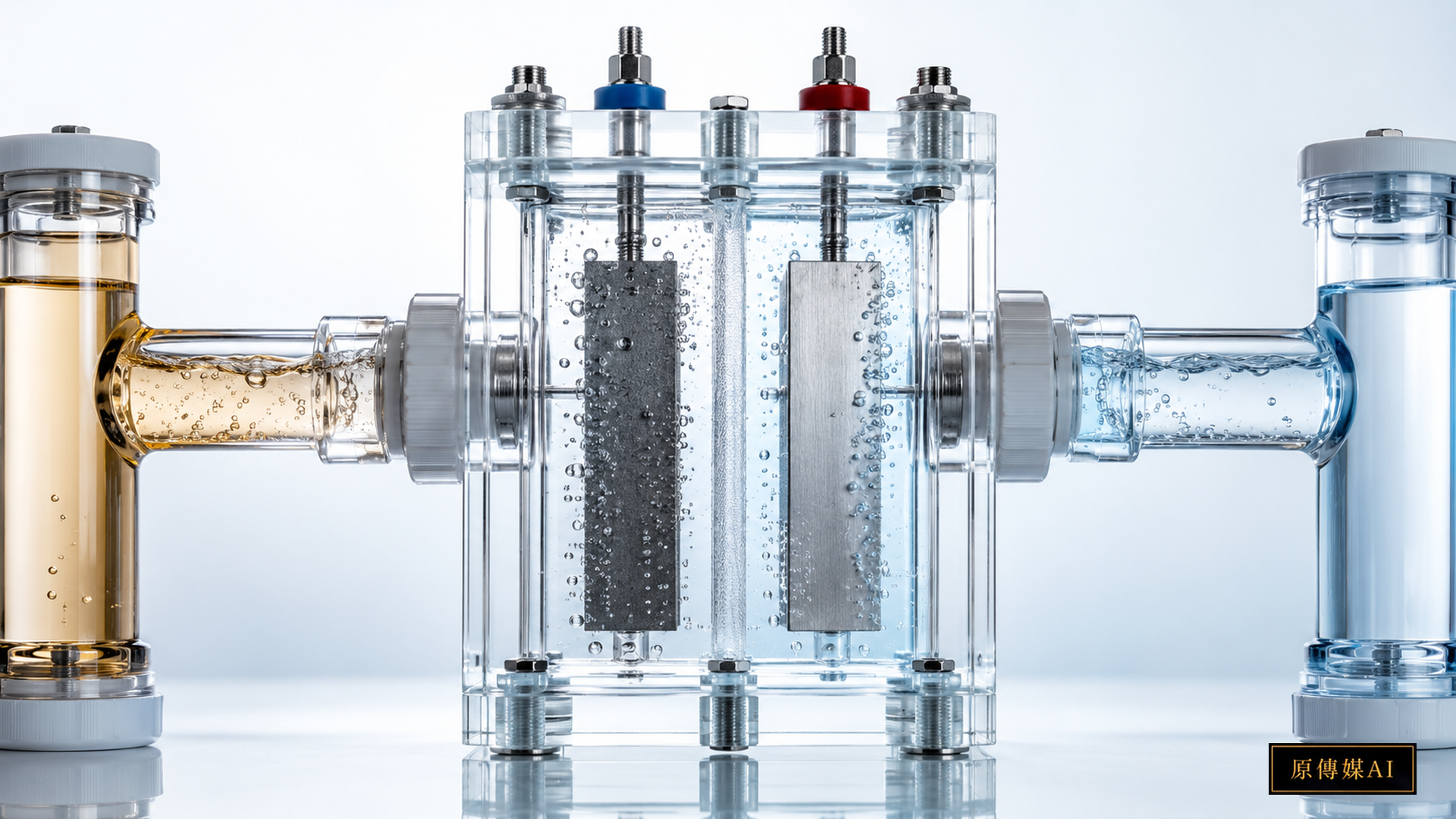
Wastewater Can Contain Water, Salts, Chemicals, and Usable Chemical Potential
Industrial wastewater is usually entered in the cost column: neutralization, desalination, sludge, discharge compliance, and often a difficult concentrate at the end. A study published in *npj Clean Water* on August 12, 2026, reverses that sequence. Researchers from National Taiwan University and the University of Tokyo designed a zinc-based electrochemical neutralization desalination, or ZEND, cell that integrates treatment of hypersaline industrial streams with acidic and alkaline hazardous wastewaters while producing energy, hydrogen, and recoverable chemicals. Under the study conditions, the core electrochemical process is designed to use the chemical potential already present in the waste streams rather than requiring an external energy input for that reaction. npj Clean Water | Original study
That does not mean an entire industrial plant becomes energy-free. Pumps, controls, gas handling, fabrication, pretreatment, polishing, and maintenance still have costs. The more precise point is that acid-base and concentration differences can be treated as energy gradients rather than simply destroyed with added chemicals.
Neutralization Becomes Part of Separation and Energy Conversion
Conventional neutralization often treats acidity and alkalinity only as hazards that must be cancelled. ZEND instead combines zinc electrochemistry and ion transport so that movement toward a more stable chemical state can also support desalination and energy conversion. This fits a broader research direction in water reuse and resource recovery: recover water, matter, and usable work together.
Taiwan's National Science and Technology Council describes Shu-Yuan Pan's research as spanning circular bioeconomy, electrodialysis-based wastewater desalination, chemical and nutrient recovery, energy efficiency, mechanisms, and life-cycle assessment. NSTC | Shu-Yuan Pan research profile ZEND extends that logic by asking whether several difficult waste streams can be coupled rather than treated independently.
The Energy Is Not Magic; It Is Stored in Imbalance
A strong acid, strong base, and hypersaline stream are not thermodynamically equivalent cups of water. They contain different ionic concentrations, acid-base states, and redox opportunities. Electrochemical design tries to harvest part of the work released as those differences are reduced. The hard part begins when laboratory solutions are replaced by real wastewater.
Real-World Variability Is the First Scale-Up Test
Factory streams change by shift, batch, cleaning cycle, and product line. Metals, organics, suspended solids, surfactants, oils, and unexpected contaminants can foul membranes, poison electrodes, trigger precipitation, accelerate corrosion, or redirect reactions. A beautiful laboratory voltage is not a guarantee of a stable industrial process.
The Worst Batch Is the Real Scale-up Test
Scale-up should therefore test variability deliberately: salt concentration swings, contaminant spikes, cleaning events, electrode passivation, hydrogen purity, and the market value of recovered chemicals. Operators know that average water quality is rarely what causes an emergency shutdown. The rare outlier often determines maintenance burden and lifetime.
This is where laboratory and operational knowledge must modify each other. Researchers can model electrochemical potentials and material balances; operators can identify the transient events that determine whether those models survive continuous use.
Circular Economy Also Creates New Responsibilities
Because ZEND is zinc-based, material sourcing, lifetime, recovery, and end-of-life management belong in the environmental balance. Hydrogen is valuable but flammable, requiring ventilation, detection, ignition control, and operating procedures. Recovered water and chemicals must be tested for their intended uses rather than declared safe simply because they have been relabeled as resources.
Life-cycle assessment must ask whether reduced treatment energy is offset by consumables, replacement materials, transport, or low-quality products that cannot displace virgin materials. Conversely, if acid, base, and saline streams can be coupled inside an industrial cluster, the avoided neutralization chemicals, external energy, and water demand could create system value far beyond one treatment metric.
A Demonstration Plant Should Report Availability, Not Only Peak Efficiency
Multi-function electrochemical systems can look impressive at their best operating point, so scale-up should also report availability: how much of the year the ZEND process actually remains inside its design window. Downtime may come from mismatched feed streams, electrode cleaning, separator maintenance, gas-safety checks, or the inability of downstream processes to use recovered water or hydrogen. Those hours directly affect the real cost per unit of treated water and recovered product.
A credible pilot should therefore publish normal, derated, and bypass operation. That makes visible what happens to residual wastewater when the electrochemical unit is not at its optimum, prevents a successful demonstration campaign from being confused with year-round replacement of an industrial treatment train, and gives plant operators and regulators a common basis for judging whether the added equipment truly lowers total pollution and resource use.
For Taiwan, Waste-Stream Matching Is the Opportunity
The most useful industrial question is not whether one ZEND cell can treat everything. It is where chemically complementary streams exist in the same facility or industrial area, when they occur, and whether their flow, concentration, contaminants, and logistics align. Cross-factory exchange may be beneficial in some cases and create hazardous-waste transport burdens in others.
From End-of-Pipe Cost Center to Resource-Exchange Node
ZEND therefore points to a broader change in wastewater engineering: the treatment plant can become an internal resource-exchange node rather than only an end-of-pipe cost center. The technology becomes convincing when the most elegant laboratory feed accepts the messiest real industrial stream and still delivers stable, safe, maintainable, life-cycle benefits.
AI use and content-safety disclosure
This article was organized and reviewed through the Yuan Media AI editorial process.