Printing Bacteria into Circuit Boards: How 24 Colonies Can Perform Addition Without Replacing Silicon
Original Chinese title: 把細菌「印」成電路板:24 個菌落竟然可以做加法,活的電腦為什麼不需要取代矽晶片?
MIT researchers arranged engineered bacterial strains as modular biological logic elements and demonstrated functions including demultiplexers, half-adders, and full-adders. The goal is not to replace silicon chips, but to explore slow, persistent computation embedded directly in biological environments.
王振庭
Natural science education teacher focused on science learning, curriculum design, AI education, media literacy, and helping children preserve curiosity and scientific reasoning in technology-rich environments.
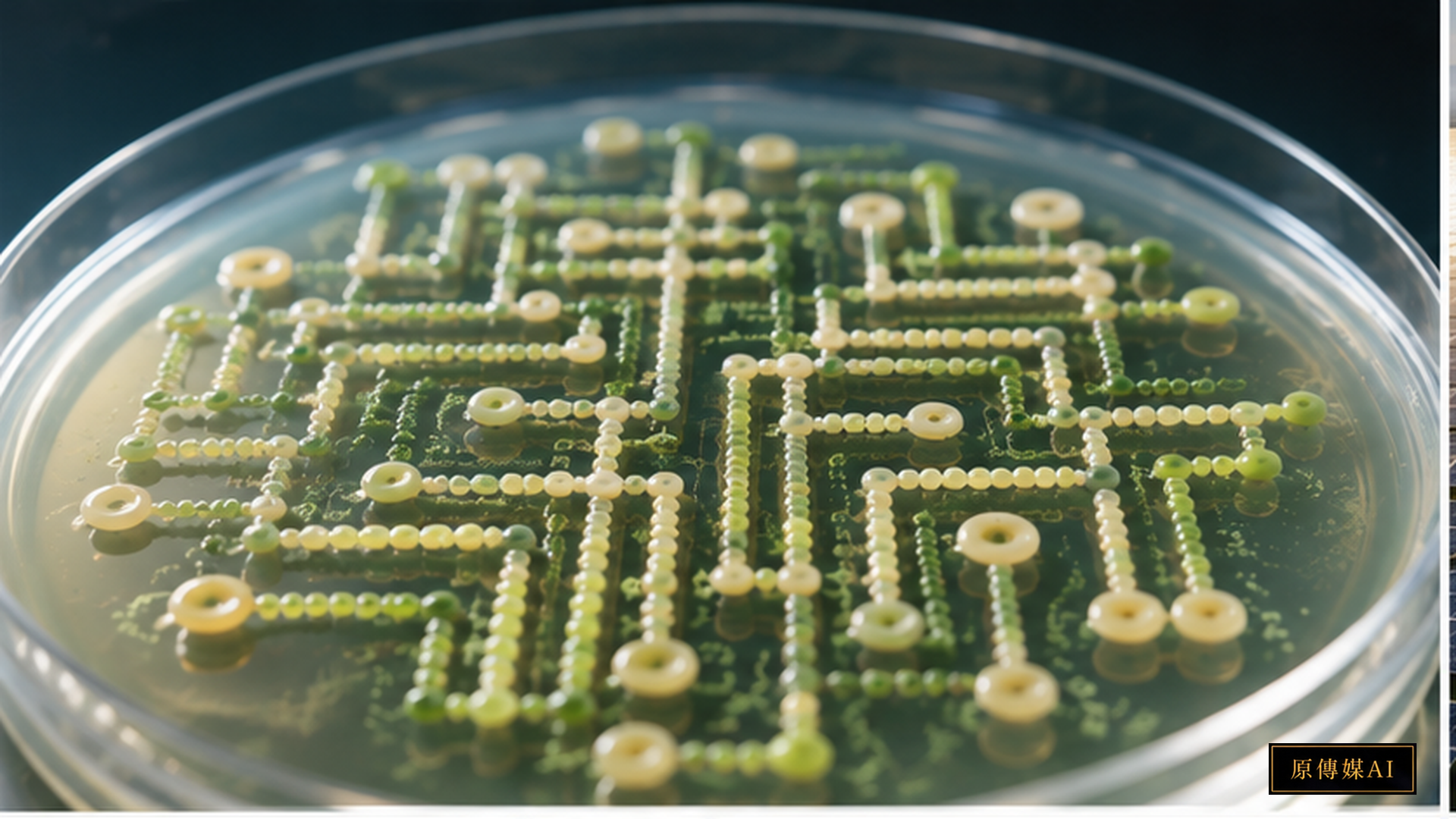
A Circuit Board That Can Grow
On August 17, 2026, Nature Chemical Biology published an MIT-led study that treats engineered bacterial strains as transistor-like biological logic elements and places different strains in deliberate geometric patterns on a solid growth surface. Here, “on” and “off” do not refer to electrons crossing a gate. They refer to whether a small-molecule signal is allowed to propagate downstream. The team also created relay strains that can pass chemical information between components. The central idea is not that bacteria have suddenly become conventional computers. It is that complex logic can be distributed across many simple cellular modules and assembled through spatial organization rather than forcing every function into a single cell.
Spatial Arrangement Becomes Part of the Program
Traditional synthetic-biology circuits often place multiple sensing, regulatory, and output modules inside one organism. Every added regulator can increase crosstalk, transcriptional burden, competition for cellular resources, and instability. The new work borrows from pass-transistor logic: individual strains perform relatively simple roles, while the physical relationship among colonies determines the larger circuit. Repositioning the same limited set of strains can therefore yield different functions. Programming expands from one-dimensional DNA sequence design into two-dimensional spatial design across a living surface.
Twenty-Four Colonies Can Add, but They Will Not Replace a CPU
MIT reported demonstrations of a demultiplexer, half-adder, and full-adder, with the largest example built from 24 bacterial colonies. Those names sound like digital electronics, but the relevant timescale is biological growth and molecular diffusion, so operations can take hours. Comparing such a system with CPU clock speed misses the point. Living circuits may instead be useful for slow, local, long-duration decisions in places where chemistry and biology are the signal source: a material surface, a plant-associated environment, or an environmental sensor that must remain in direct contact with its surroundings.
The Hard Part Begins Outside the Petri Dish
A Petri dish offers tightly controlled nutrients, temperature, moisture, and strain proportions. Real soils and plant surfaces contain competing microbes, predators, ultraviolet exposure, changing pH, wet-dry cycles, root exudates, and many molecules that can consume or distort signals. Once a living circuit enters the rhizosphere, its components are no longer only engineered parts; they are participants in an ecosystem. Researchers must ask whether signals are intercepted, whether colony geometry changes as cells grow, and whether the designed input-output relationship drifts over time. Those are ecological and agronomic questions as much as circuit-design questions.
Two-Eyed Seeing Is Not Inviting Farmers to Review a Finished Product
If living circuits are ever tested in agriculture, Two-Eyed Seeing should not mean asking farmers whether they like a finished prototype. Agronomists and growers know which fields remain waterlogged after heavy rain, when soils shift in acidity, when roots are damaged, and which fertilizer or pesticide practices reshape microbial communities. Such knowledge should change the experimental conditions before a technology is declared robust. The strongest form of two-way knowledge is the ability of field practitioners to rewrite the research question, not merely to comment on a result after laboratory optimization is complete.
Safety Cannot Wait Until Productization
Engineered organisms that leave a closed laboratory require explicit assessment of escape, persistence, horizontal gene transfer, monitoring, and recall. Biological kill switches, nutrient dependencies, or restricted growth conditions can reduce risk, but no single safeguard should be described as zero-risk containment. The attraction of living circuits is precisely that they grow and interact with their surroundings. The same properties that make them useful also create governance obligations that are different from those of a disposable electronic sensor.
The Real Competitor Is Not the Silicon Chip
A misleading question is “When will bacteria become faster than a CPU?” A better question is “Where is a silicon processor an awkward or unnecessary way to place a decision?” If sensing, computation, and material response can be integrated into the same biological interface, a future circuit board may not be a rigid board at all. It may be a living layer that persists, responds chemically, and carries state through molecular signals. The engineering breakthrough would not be greater speed; it would be computation that can inhabit a biological environment rather than sitting outside it.
Designing Uncertainty into the System
This remains a research prototype. Scaling complexity requires careful measurement of signal range, growth-rate differences, long-term drift, and batch-to-batch reproducibility. Failure modes matter as much as successful demonstrations: when does overgrowth blur circuit boundaries, which background molecules produce false activation, and which strains lose ecological competition? A mature biological-computing platform will need to state not only that it once performed addition, but also the conditions under which it fails and the mechanisms by which those failures can be detected.
Turning a Research Result into a Publicly Verifiable Question
Any new study entering public discussion needs a clear separation between direct measurement, proposed mechanism, and policy or application inference. Direct results can be rechecked; mechanisms require additional environments and time; deployment claims require costs, institutions, field conditions, and rights to be considered. For Taiwan, the useful next step would usually be a small, traceable local validation with a documented baseline, explicit failure cases, alternative designs, and frontline users who can modify the performance criteria. Uncertainty should remain visible rather than being erased from the story.
From Being Alive to Being Reliable Is a Long Engineering Journey
Electronic engineers expect components to behave within a specified tolerance across temperature and manufacturing batches. Living components are harder because cells grow, divide, die, adapt, and evolve. A useful specification therefore has to include colony density, signal diffusion distance, growth phase, nutrient state, and the surrounding microbial background. If a living circuit behaves differently on day one, day three, and day seven, that change is not merely noise; it may be part of the system state that must be measured and managed.
The Most Interesting Application May Be Sensing, Deciding, and Responding in One Living Layer
Conventional sensing architectures separate sensor, processor, and actuator. Synthetic biology may sometimes compress those stages into one interface. Bacteria can detect a chemical condition, integrate multiple signals through community communication, and then produce fluorescence, pigment, odor, or another molecular output. That makes a future “sensor” potentially more like a responsive ecological layer. But the closer such systems move toward farms and natural environments, the less defensible it becomes to treat ecosystems as blank experimental surfaces. Ecologists, agronomists, microbiologists, and local users must help define acceptable behavior.
It Also Redefines What We Mean by a Computer
We usually imagine a computer as a screen, CPU, memory, and printed circuit board. Yet computation is fundamentally about states, rules, and transformations of information. Living systems already perform those operations in different media and at different speeds. Cells decide whether to express genes, microbial communities coordinate collective behavior, and plants allocate resources in response to multiple signals. Calling these systems computational does not turn life into an electronic gadget. It expands the engineering imagination about what materials, timescales, and locations can host a decision process.
Main References
AI use and content-safety disclosure
This article was organized and reviewed through the Yuan Media AI editorial process. AI-assisted translation was used with human editorial responsibility for factual accuracy and source fidelity.