The Ozone Layer Is Recovering—So Why Could Natural Bromine and Iodine Delay Antarctica’s Natural Seasonal Recovery by Nearly 50 Years?
Original Chinese title: 臭氧層明明正在復原,為什麼自然溴、碘還可能把南極「自然季節循環」的恢復往後推近五十年?
A Nature Communications study published on 25 August 2026 suggests that natural bromine and iodine make a larger contribution to lower-stratospheric ozone loss than many projections have represented. This does not negate the Montreal Protocol; it sharpens the distinction between controllable anthropogenic emissions and natural background chemistry.
山海資料庫
Co-authors: ["李文驤"]
山海資料庫;co-author: 李文驤 | Geography Teacher at Catholic Ta Jen High School.
Put two apparently contradictory facts on the table at the same time
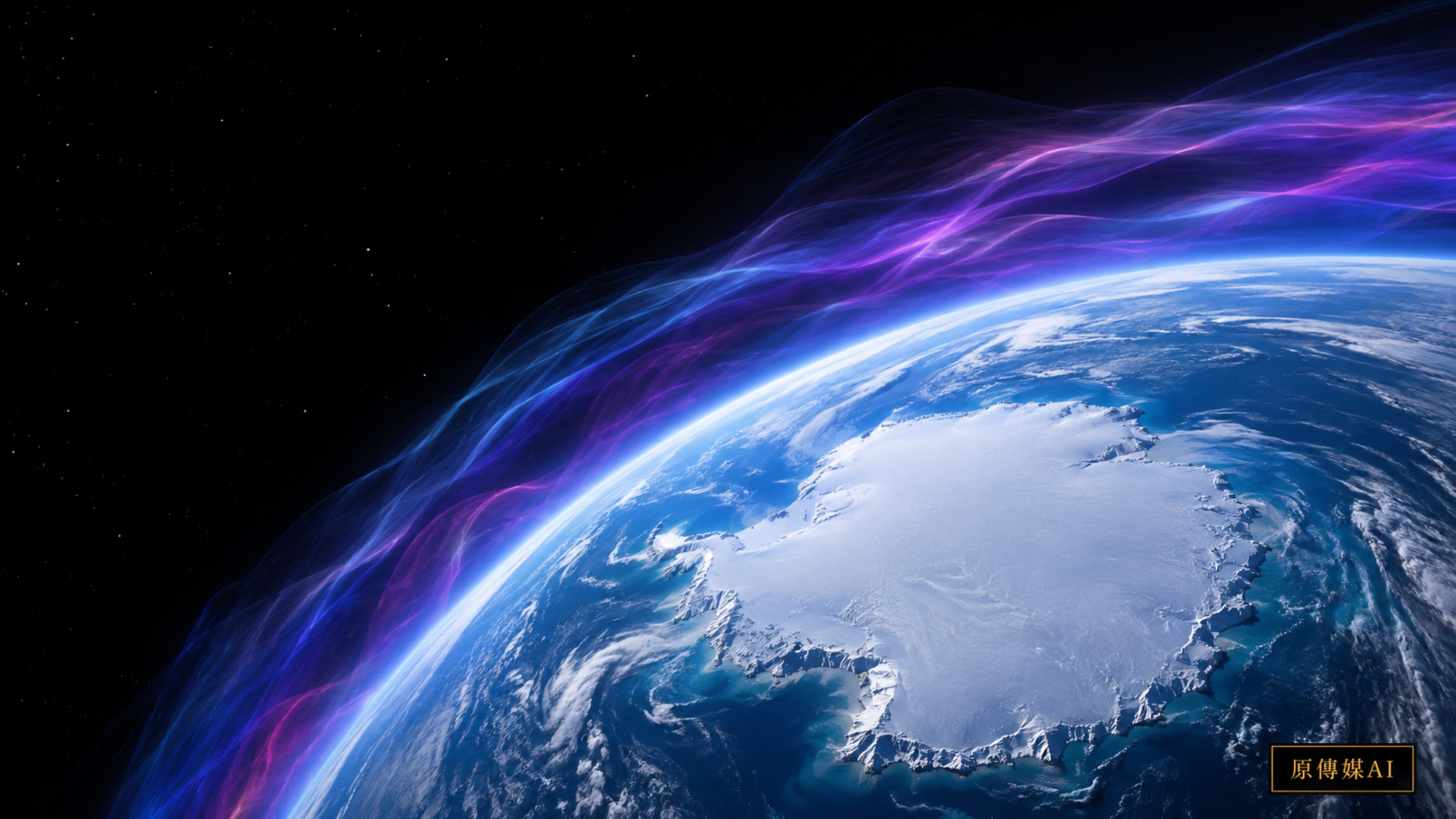
The ozone layer is recovering, and the newest research does not overturn that conclusion. The Montreal Protocol has sharply reduced regulated chlorofluorocarbons, halons, and other ozone-depleting substances, while long-term observations by the World Meteorological Organization still describe an overall recovery trend. At the same time, a *Nature Communications* paper published on 25 August 2026 argues that naturally sourced bromine and iodine may play a larger role in lower-stratospheric ozone loss than many earlier model configurations represented, and their relative importance may increase later this century.
Those findings are not contradictory. Once policy succeeds in reducing controllable anthropogenic emissions, natural background mechanisms that were partly masked by the larger human signal can account for a larger share of the remaining variation. The useful question is therefore not “Did the Montreal Protocol fail?” but whether models now represent natural halogens accurately enough as anthropogenic sources decline.
Ozone is not destroyed by chlorine alone; bromine and iodine are chemically active too
Stratospheric ozone is a crucial shield against harmful ultraviolet radiation. The best-known chemistry of the twentieth-century ozone hole involves manufactured CFCs and halons reaching the upper atmosphere, where they release chlorine and bromine radicals that catalytically destroy ozone. That mechanism is exceptionally well established and provided the scientific basis for international controls. The atmosphere, however, also contains naturally produced halogen compounds from the ocean, biological activity, and very short-lived substances that can transport bromine and iodine into the upper troposphere and lower stratosphere.
The new study used chemistry-climate simulations covering 1910–2100 to re-evaluate those natural halogens. For 1990–2020, when anthropogenic halogen loading was near its peak, natural halogens could account for as much as roughly half of halogen-driven ozone loss in the extratropical lower stratosphere. Around Antarctica, the model indicates that natural halogens can enhance ozone depletion by about 35 percent. That does not mean nature is “more responsible than CFCs.” It means that at particular altitudes and latitudes, natural chemistry can no longer be treated as a negligible background term.
What does “delayed by nearly fifty years” actually mean?
The easiest result to misread is the statement that natural halogens could delay recovery of Antarctica’s natural seasonal ozone cycle by nearly five decades. It does not mean every estimate for the closing of the ozone hole moves fifty years later, and it does not mean controls on human-made ozone-depleting substances have failed. The comparison concerns simulations with and without a more complete representation of natural halogen chemistry and asks when the seasonal Antarctic ozone cycle returns to a modelled natural baseline.
In other words, the paper reminds us that “recovery to what?” is itself a scientific definition. If earlier models simplified the natural background too strongly, the year assigned to a return to that background can also be biased. This is a baseline problem, not the disappearance of a policy achievement.
Why natural halogens become more important as policy succeeds
As anthropogenic chlorine and bromine regulated under the Montreal Protocol continue to decline, total halogen-driven ozone loss should decline as well. Natural sources do not disappear under the same treaty. By the end of the century, the study projects that natural halogens could represent more than 80 percent of halogen-induced ozone loss in parts of the extratropical lower stratosphere. Much of that rising *share* reflects a changing denominator: the anthropogenic component is becoming smaller because policy worked.
That is precisely why environmental monitoring cannot stop after a successful intervention. Once the largest human driver is reduced, interannual variability, volcanic effects, stratospheric water vapour, climate change, and natural very short-lived substances become easier to see. Without observations that are long enough, vertically resolved, and globally distributed, natural variability can be mistaken for policy reversal—or a new anomaly can be dismissed too quickly as background noise.
Why WMO still says the ozone layer is recovering
WMO’s 2025 *Ozone and UV Bulletin* continued to report a long-term recovery trajectory, while noting that the 2024 Antarctic ozone hole was smaller than in several recent years. WMO also stresses that individual years are strongly influenced by natural atmospheric conditions, so recovery must be assessed with long records rather than a single season. In 2026, WMO’s discussion of the next phase of the Montreal Protocol likewise emphasized expanded observation—not only of regulated substances, but also of emerging compounds, very short-lived species, and the effects of climate change on ozone.
The new *Nature Communications* result and WMO’s policy narrative therefore complement rather than cancel each other. The paper tells models that natural halogens may be too important to omit; the monitoring institutions show that the reduction of human emissions remains a measurable policy success. Mature science has to retain both levels at once.
A model is not a crystal ball; it is a world in which assumptions can be tested
Chemistry-climate models combine atmospheric circulation, temperature, radiation, chemical reactions, and emissions. Their value is not merely a number for 2100. They allow counterfactual questions: What changes without natural iodine? What if anthropogenic halogens remain high? What if convection or temperature shifts? These controlled comparisons help researchers decompose the total change observed in the real atmosphere.
Every decomposition still depends on inputs. Emission rates of natural halogen compounds, air-sea exchange, the efficiency with which convection lifts short-lived substances, and chemical reaction rates all carry uncertainty. A statement such as “natural halogens account for 80 percent” is therefore not a timeless constant; it is a projection for a specified model and scenario. Its importance lies in elevating a previously underestimated mechanism into a target for denser observation and inter-model comparison.
Two-Eyed Seeing here does not mean attaching traditional observation to molecular chemistry by force
The most misleading way to invoke Two-Eyed Seeing would be to claim that a local knowledge system “already knew” the bromine-iodine catalytic cycle. Without evidence, that claim should not be made. A more productive dialogue concerns observational scale and method. Global atmospheric science relies on satellites, sondes, ground-based spectrometers, and chemical models. Long-term local observation may record changes in seasonality, sunlight, clouds, ice and snow, plants, and bodily experience. These systems do not measure the same variable, but each can record environmental rhythms at a different resolution.
A genuinely reciprocal system requires the scientific side to specify which signals can be checked from the ground and which require instruments, while local observers can identify times, places, and lived impacts that official networks miss. The value of Two-Eyed Seeing is not that one knowledge system impersonates another; it is that both know the boundaries of what their evidence can establish.
In public communication, “natural” must never become an excuse for avoiding responsibility
The growing relative importance of natural halogens can easily be mistranslated into “ozone depletion is natural anyway, so regulation was unnecessary.” The evidence points in the opposite direction. The reason researchers can now discuss a larger natural share is that the Montreal Protocol has already changed the trajectory of anthropogenic halogens so profoundly. Policy governs risks that societies can control; natural chemistry determines how much variation remains after successful governance.
This case is also a useful exercise in scientific literacy. When a headline says “recovery delayed by fifty years,” ask four questions: What baseline defines recovery? Which ozone metric is being delayed? What scenarios were compared? Does the result actually change the existing policy conclusion? Those questions prevent new complexity from being misreported as the failure of an old policy.
Ozone recovery is not the end point; it is the beginning of a new monitoring phase
The Montreal Protocol demonstrated that a global environmental treaty can alter the long-term chemistry of the atmosphere. Success, however, makes the next stage more demanding: the human signal becomes smaller, natural variability becomes relatively more important, and climate-ozone coupling becomes more complex. Future ozone science will have to do more than measure the size of the “hole”; it must attribute changes by altitude, season, latitude, and mechanism.
The important message today is therefore not that “the ozone layer is in trouble again,” but that model baselines are being recalibrated. Human emissions can be governed through institutions; natural halogens have to be represented correctly by science. Putting both in the same accounting framework is what the next generation of ozone governance requires.
Sources retained from the Chinese original
AI use and content-safety disclosure
This article was organized and reviewed through the Yuan Media AI editorial process. AI-assisted translation was used with human editorial responsibility for factual accuracy and source fidelity.