Reindeer Need Quiet Pastures Too: Why Cumulative Pressures on Sámi Herding Cannot Be Reduced to Occupational Burnout
Original Chinese title: 鹿也需要「放牧的平靜」:當冰封牧場、林業、風電與法規一起擠進冬天,Sámi 牧鹿人的壓力為何不能只叫「職業倦怠」?
Recent research reframes the strain on Sámi reindeer herding as cumulative impacts: snow and ice conditions, forestry, wind power, mining, infrastructure and regulation interact to reduce flexible access to grazing landscapes. The resulting pressure is cultural, territorial and institutional as well as occupational.
王莉如
王莉如 | Counseling Psychologist Supervisor; long-term focus on trauma recovery, couple and family relationships, professional ethics in helping professions, and social-emotional support.
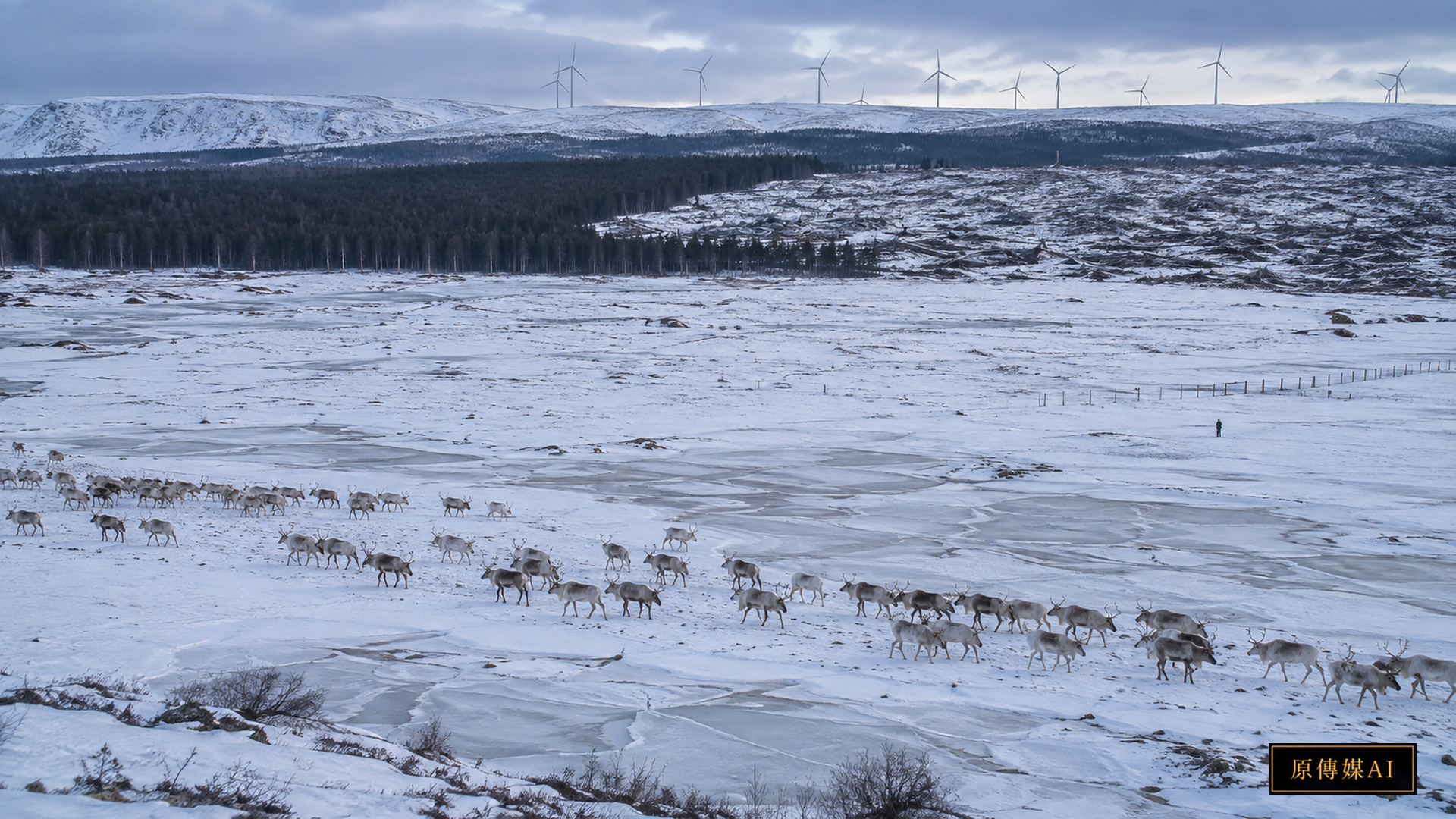
Winter is narrowing more than the pasture
From the outside, Sámi reindeer herding can look like a job that follows a herd across the landscape. For herding families, however, it is also a land-use system, a network of kin cooperation, a way of transmitting knowledge, a source of income, and a cultural identity. That is why the word “stress” becomes too small if it is treated only as an occupational-psychology problem. A 2025 study in *Regional Environmental Change* compared the concerns reported by reindeer herders in Sweden and Norway: climate change, forestry, wind power, mining, large predators, roads, borders, prices, government regulation, and majority-society attitudes toward Sámi people do not arrive as separate items. They accumulate and can intensify one another.
Winter makes those interactions especially visible. Warmer conditions can increase rain-on-snow events, thaw-refreeze cycles, and hard ice layers. Reindeer may stand on terrain where lichen is present and still be unable to dig through the snow and ice to reach it. Herders then need more room to adapt: detours, earlier migration, backup grazing areas, or forests with more arboreal lichen. Yet the same backup space may already be fragmented by roads, logging, mines, or wind farms. Climate therefore does not act alone; it compresses a landscape in which options have already been reduced.
*Guohtun* is not simply a patch of pasture on a map
A 2026 article in *Forest Policy and Economics* on Swedish forest governance highlights an important Sámi concept: *guohtun*. It cannot be reduced to the English word “pasture.” Edible lichen is only one condition. Snow depth, ice hardness, wind redistribution of snow, the shelter provided by trees, and whether reindeer can penetrate the snow to reach food all help determine whether grazing is actually available. A place may remain visible in GIS while losing the function that made it usable to herders and reindeer.
This is exactly where conventional project-by-project environmental assessment can miss cumulative impacts. A wind farm may be measured in hectares and a road in kilometres, but reindeer herding depends on seasonal substitution among routes and grazing areas. A development with a relatively small footprint can still sit at a migration bottleneck or remove a reserve area that becomes essential during a difficult snow year.
New 2026 evidence separates “land still exists” from “reindeer are willing to use it”
An EcoEvoRxiv preprint released in April 2026 analysed GPS data before, during, and after construction at four wind farms and placed mining, wind power, and other infrastructure in a cumulative-impact framework. The study reports avoidance responses to mines and wind facilities at different scales. At landscape scale, effects may extend roughly 5–10 kilometres, with especially clear responses during calving. Wind farms may also act as semi-permeable barriers: reindeer cross them less often, and during construction animals near turbines can move faster and in more directed paths.
The study is still a preprint and has not been peer reviewed, so its distance estimates cannot be treated as universal constants or copied to every Sámi herding district. Its structural lesson is nevertheless important: assessment must estimate how much *usable* space is lost after animal behaviour changes, not only the ground occupied by infrastructure. Counting direct footprint alone can systematically underestimate functional loss.
Why this cannot be reduced to “occupational burnout”
Burnout language usually assumes a person has a work role in which demands rise, control falls, feedback weakens, and exhaustion follows. Reindeer herders often face pressure across the boundary between work and life. Whether the herd can find food affects family income; whether a migration route is severed affects whether knowledge inherited from previous generations can still be used; and abrupt policy changes affect whether young people can imagine a viable future in herding. When changes to the land are simultaneously changes to family, identity, and continuity, the psychological consequences exceed ordinary workplace management.
Earlier research in Sweden has linked work-related pressure among reindeer-herding Sámi with anxiety and depressive symptoms. A 2026 report produced through cooperation between Norway’s NKVTS and Sámi professional environments also places external land conflicts, histories of assimilation, and community experiences in the same frame. Together these studies warn against a support system that teaches relaxation, time management, or resilience while leaving land conflict, discrimination, policy uncertainty, and rights procedures untouched. That approach can shift a structural burden back onto individuals.
Psychological support needs cultural safety—and an institutional exit
Effective support therefore needs at least two connected tracks. One is culturally safe psychological and community support: practitioners need to understand herding seasons, family roles, attachment to land, and Sámi history rather than forcing experience into the vocabulary of an urban office. The other is an institutional route for action. When the source of distress lies in permits, environmental assessment, land-use decisions, or compensation rules, counselling cannot become a container that substitutes for political and legal processes.
This does not mean every herder will experience the same distress, and Sámi communities should not be pathologized. Reindeer herding itself involves sophisticated knowledge, cooperation, and adaptive capacity. The question is whether room for adaptation still exists. If every new disturbance requires herders to become more “flexible” while outside land uses are not required to adjust to their cumulative effects, resilience is turned into an obligation to endure without limit.
Wind power is not simply green or not green: the question is who bears the transition cost
The Nordic low-carbon transition has increased pressure for wind power and mineral development, but a green target does not automatically produce a just outcome. Research on Norwegian wind-power permitting in 2026 shows that cumulative impacts can be an important reason for rejecting some projects, while formal consultation does not necessarily guarantee that Sámi participants can materially shape the result. This forces policy makers to confront a harder question: if national decarbonization is achieved by concentrating disproportionate costs on Indigenous traditional lands, on what terms can that transition be called fair?
A serious cumulative-impact assessment therefore cannot merely add up the “incremental impact” of each project. It has to start with the herding system: seasonal grazing areas, migration corridors, emergency areas for bad snow years, calving grounds, and key lichen forests. Only then can decision makers ask whether a new development pushes the system across a functional threshold. Herders’ landscape knowledge must be able to change assessment boundaries and decision metrics, not sit in an appendix after the key parameters have already been fixed.
The core of Two-Eyed Seeing is letting two evidence systems decide what “usable land” means
GPS can show where reindeer moved, how quickly they travelled, and which facilities they avoided. Herders can explain why a route fails under a particular snow condition, why a forest used only in certain years can be a life-saving reserve, and when the herd needs low-disturbance space. Neither source replaces the other. GPS cannot show every historical route that was no longer selected, and it may not reveal that an area is unused precisely because disturbance has already displaced animals. Long-term local experience, meanwhile, can be tested, refined, and documented through repeated spatial observation.
Two-Eyed Seeing becomes meaningful when disagreement between these evidence systems is turned into the next research question rather than resolved by selecting whichever answer is most convenient for a permit. The same governance principle is relevant in Taiwan: forestry, renewable energy, roads, and conservation projects that affect Indigenous traditional territories should examine cumulative effects across projects, seasons, and generations rather than treating every land cut as an isolated event.
The “quiet” reindeer need is also the predictability people need
Quiet in reindeer herding does not mean a landscape with no turbines, roads, or climate change. It means herds and families still have enough room to choose. If a winter suddenly produces hard ice, another grazing area remains available; if one corridor is disturbed, an alternative route still exists; if government rules change, communities participate early enough to influence the outcome. Together, those conditions create predictability.
That is why the pressure experienced by Sámi reindeer herders cannot be abbreviated as “work is too exhausting.” It is a signal produced when multiple forces squeeze the same living system at once. The appropriate response is not simply to ask people to tolerate more. Land governance, psychological support, and Indigenous self-determination have to answer the same question together: how many real options must remain if the next generation is to have a meaningful possibility of continuing to herd reindeer?
Sources retained from the Chinese original
AI use and content-safety disclosure
This article was organized and reviewed through the Yuan Media AI editorial process. AI-assisted translation was used with human editorial responsibility for factual accuracy and source fidelity.