The Sun Is Not a Smooth Pot of Fire: Highest-Resolution Images Capture Kelvin–Helmholtz Vortices on the Photosphere
Original Chinese title: 太陽表面不是一鍋平滑的火:最高解析影像第一次把 Kelvin–Helmholtz 渦旋「抓個正著」
The Daniel K. Inouye Solar Telescope resolved the solar photosphere at roughly 19 km and enabled the first direct identification of magnetized Kelvin–Helmholtz instabilities at magnetic-flux boundaries, supported by MURaM simulations.
Lawrence Lee
Lawrence Lee | Scholar at the University of Leeds; Yuan Media AI science and nature writer focusing on the deep sea, space, and how humans record worlds that are difficult to reach.
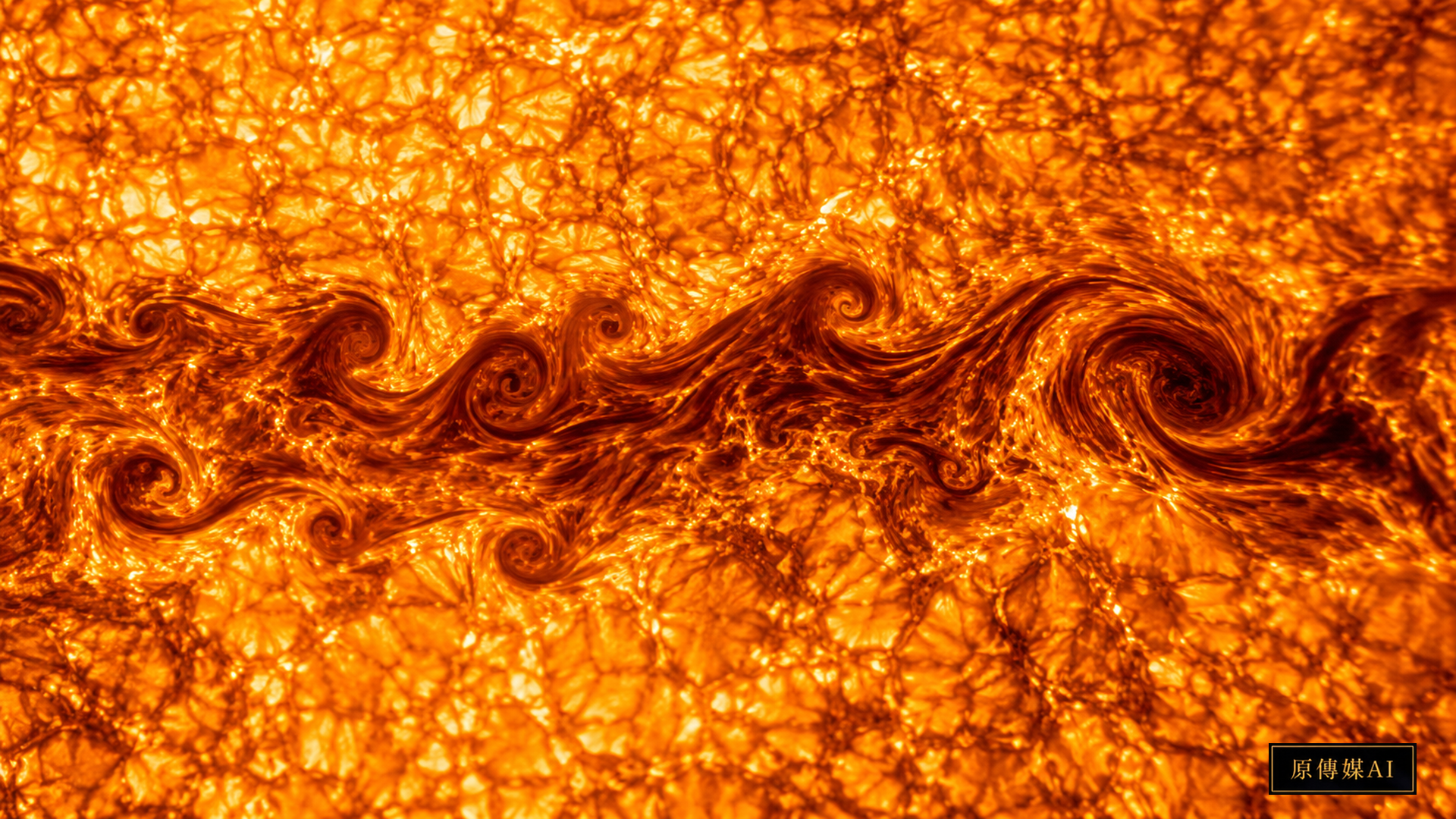
The solar surface was never smooth; we simply could not see it finely enough
To the naked eye and in ordinary images, the Sun looks like a bright disk. At higher resolution, the photosphere breaks into convection-driven granulation. In 2026, the Daniel K. Inouye Solar Telescope pushed that scale much further. A *Nature* paper published online on 5 August used the four-metre-class solar telescope to observe a magnetic active region at roughly 19-kilometre spatial resolution. Researchers saw numerous striated, rippled, and curling features and identified them as magnetized Kelvin–Helmholtz instabilities, or KHI.
The name is familiar in fluid dynamics. When two layers of fluid slide past one another at different velocities, small disturbances at their interface can grow and roll into a train of vortices. Similar structures appear in terrestrial clouds, oceans, atmospheres, and planetary magnetospheres. The Sun adds a crucial complication: the medium is electrically charged plasma, so velocity shear is coupled to magnetic fields.
The breakthrough is not that the theory is new, but that the instability was directly resolved
The possibility of Kelvin–Helmholtz instability at solar magnetic boundaries has been discussed in theory and simulation for years. The obstacle was scale: many predicted structures were smaller than previous observing systems could resolve. The Inouye telescope’s aperture, wavefront correction, and high-speed imaging allowed researchers to directly identify the expected ripples and vortices at the edges of photospheric magnetic-flux concentrations.
The study used observations of active region NOAA 14060 obtained on 14 April 2025. The high-resolution time series mattered as much as any single spectacular frame because it showed structures forming, moving, and curling with time. The team then used MURaM radiative magnetohydrodynamic simulations to produce synthetic observables for comparison, and the simulations generated similar striations and vortices. Agreement between the evolving observations and the model is what made the KHI interpretation persuasive.
Is 19 kilometres really small? On the Sun, it is extraordinary
The Sun is about 1.4 million kilometres in diameter. Resolving 19 kilometres on that scale is like distinguishing exceptionally fine texture on a gigantic sphere. Many interactions between photospheric convection and magnetic fields were previously averaged into a single pixel. Researchers knew complex processes might be hidden there, but could not resolve the details. Once the spatial threshold moved downward, apparently smooth boundaries turned into jagged shear layers, striations, and vortices.
This is a reminder that discovery often occurs because an instrument moves an observational threshold, not because nature suddenly starts doing something new. Crossing a critical resolution can turn a mechanism that previously existed mainly in equations and simulations into something that can be measured directly.
Why would a row of tiny vortices matter for our understanding of the whole Sun?
KHI is an efficient mixing mechanism. The *Nature* paper and numerical simulations show that these vortices can mix magnetized and relatively weakly magnetized plasma at the boundaries of concentrated magnetic flux, altering downflows and convective energy transport. The instability also continually distorts magnetic fields, may excite magnetohydrodynamic waves, and can feed a cascade in which larger vortices fragment into smaller turbulent structures.
These processes matter because photospheric magnetic fields do not end at the visible surface. Spicules, prominences, coronal loops, and other structures in the outer solar atmosphere are rooted in photospheric magnetism. If surface magnetic flux is repeatedly twisted, mixed, and transported, that activity can influence how energy moves upward and how free magnetic energy becomes available for later release.
Has this solved the problem of why the corona is so hot? Not yet
The National Solar Observatory notes that KHI may help researchers understand coronal heating and magnetic-energy accumulation, while the Max Planck team emphasizes the possible role of small vortices in magnetic-flux transport and diffusion. “May contribute,” however, is not the same as “has solved.” Coronal heating is a long-standing problem involving magnetic reconnection, wave heating, nanoflares, turbulence, and other mechanisms; one new observation is unlikely to close the case.
What the study adds is direct evidence for a mixing and energy-transfer channel that previously lacked comparable observational confirmation. The next questions are quantitative: How often do these vortices occur under different magnetic conditions? How much energy do they transport? Is that flux large enough to matter for the coronal energy budget? Only occurrence rates and energy accounting can establish their weight in the larger heating problem.
The distance from this discovery to operational space weather must also be stated clearly
Solar flares and coronal mass ejections can affect satellites, power grids, communications, and high-latitude aviation, so any mechanism related to magnetic-energy accumulation attracts attention from space-weather researchers. At present, however, the KHI result is primarily a finding in fundamental solar physics. It is not yet a single indicator that can be inserted directly into tomorrow’s flare forecast.
Operational forecasting requires a feature that can be measured before an event, that has a stable statistical relationship with event probability across many active regions, and that adds predictive information beyond existing indicators. Whether KHI can become such a feature requires much longer time series and much larger event samples. Calling these vortices a new tool for predicting solar storms would go beyond the evidence now available.
The instrument itself is half the story
The Inouye Solar Telescope’s four-metre primary mirror makes it one of the world’s most powerful solar telescopes, but a large aperture does not automatically produce a sharp image. Turbulence in Earth’s atmosphere distorts and blurs the view, so advanced adaptive optics, wavefront correction, and image reconstruction are required. The time series used in the study also has to remain stable on very short timescales so that real solar dynamics are not confused with reconstruction artefacts.
“Highest resolution” is therefore not a single hardware specification but a full measurement chain: optics, sensing, correction, reconstruction, magnetic diagnostics, magnetohydrodynamic simulation, and physical interpretation. That is why a scientific image should not be treated as photography alone. The more compelling the picture, the more important it becomes to know how it was processed, what each pixel represents, which features are directly observed, and which are inferred with help from simulations.
Why observations and simulations have to be read against one another
With an image alone, a set of striations may have more than one physical explanation. With a simulation alone, similar vortices may simply be products of a particular model setup. The research team compared observations with MURaM simulations to ask whether vortex shape, wavelength, temporal evolution, and magnetic structure were mutually consistent. That reciprocal test makes the mechanism identification stronger than pattern recognition from a single image.
Simulation also supplies three-dimensional information that the two-dimensional photospheric image cannot directly show. The paper reports that KHI vortices in the model can form vertically extended rolls and exhibit different growth behaviour with depth. This helps researchers infer a richer three-dimensional magnetofluid structure from the visible surface, while still leaving those subsurface details as model-based inferences that future observations must continue to test.
Two-Eyed Seeing can discuss observational scale; it cannot pretend older sky knowledge already described KHI
People have observed sunspots, shadows, seasonal sunlight, and ecological timing for generations, creating many local systems of temporal knowledge. The Inouye telescope, by contrast, resolves plasma and magnetic fields at scales of tens of kilometres. These are different questions. Without evidence, traditional sky knowledge should not be claimed to have already described Kelvin–Helmholtz instability.
A productive Two-Eyed Seeing dialogue starts by acknowledging what each observational scale is good at. Long-term ground-based records can describe seasonal rhythms, environmental responses, and intergenerational variation. Modern telescopes can resolve microphysical processes invisible to the unaided eye. If researchers want to connect solar activity with ecology or cultural timekeeping, they need measurable intermediate variables rather than assuming two knowledge systems are equivalent because both use words such as “rhythm” or “vortex.”
One image changes what we mean by the word “surface”
The photosphere is called the Sun’s visible surface, but it is not a solid skin. It is a layer in which plasma becomes increasingly transparent and photons can escape. By resolving shear flows, magnetic boundaries, and small vortices in that layer, the Inouye telescope reveals the “surface” as a dynamic interface continuously exchanging mass, energy, momentum, and magnetic flux.
The most striking part of the discovery is this reversal of scale: processes that may influence the Sun’s much larger magnetic atmosphere can be hidden in vortices only a few tens of kilometres across. The universe does not always reveal its mechanisms through its largest explosions. Sometimes an answer remains hidden inside what used to be a single unresolved pixel.
Sources retained from the Chinese original
AI use and content-safety disclosure
This article was organized and reviewed through the Yuan Media AI editorial process. AI-assisted translation was used with human editorial responsibility for factual accuracy and source fidelity.