When Everyone Has a TV Station: Who Is Responsible for Proving That a Viral Story Is True?
Original Chinese title: 每個人都有一台電視台之後,誰還負責證明「這是真的」?AI、短影音與創作者正在重新定義公民新聞
The Reuters Institute Digital News Report 2026 shows that news creators are now a routine part of many people’s information diets. As news, commentary, entertainment and AI-generated material converge in the same feed, media literacy increasingly depends on rebuilding an evidence chain rather than trusting appearances or brands alone.
Liyu Chiu
Liyu Chiu | Civics and AI information-technology media-literacy educator | AI lesson-plan award recipient | AI Education Institute | Focuses on civic literacy, media literacy, AI education, information verification, social trust and digital citizenship in platform environments.
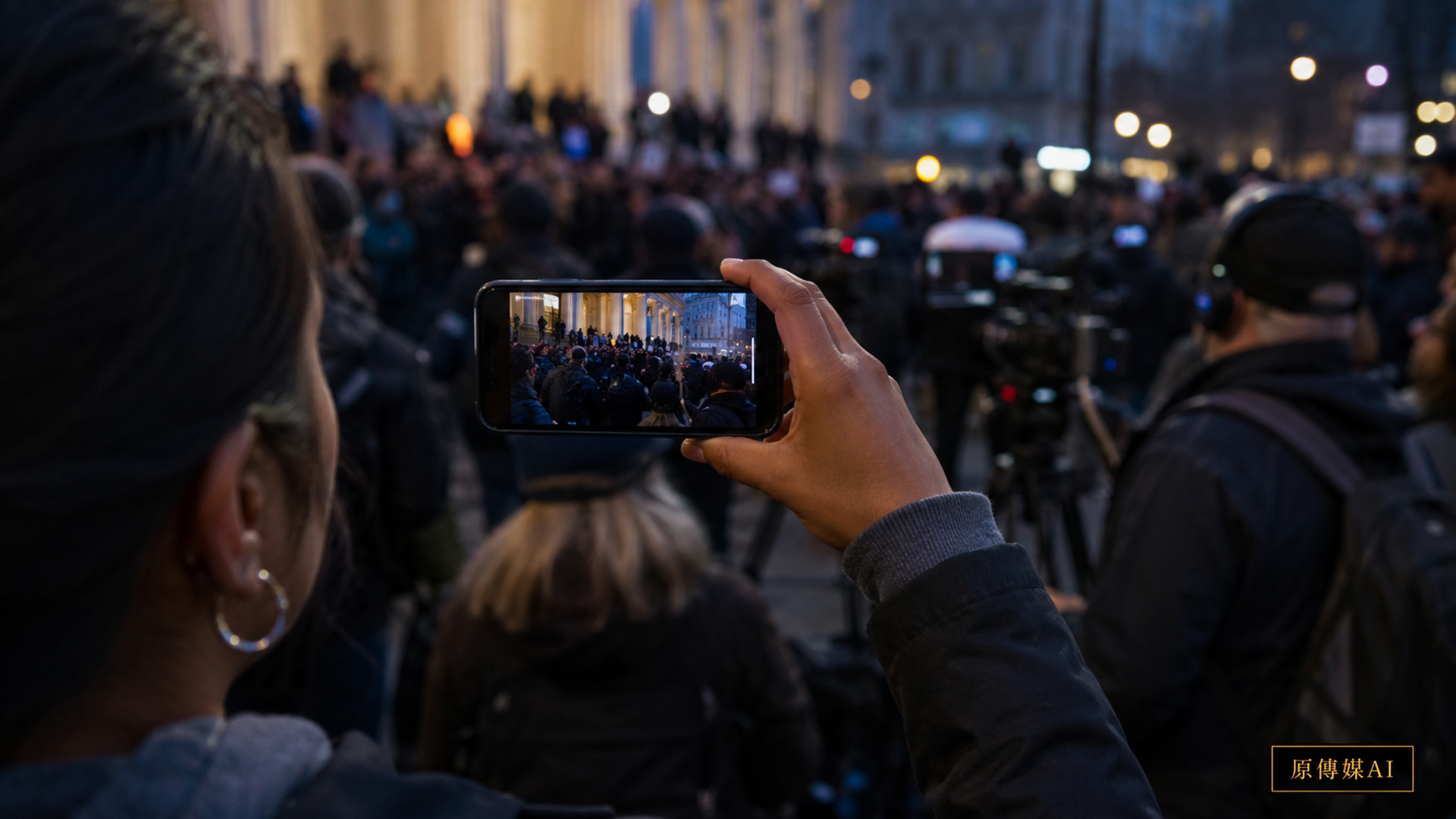
Everyone Has a Camera, but Not Every Image Comes With an Evidence Chain
Smartphones allow almost anyone to record, livestream, comment on and publish an event within minutes. Short-video platforms can then carry the material across neighborhoods, cities and national borders before a conventional newsroom has finished its first verification call. That speed is one of citizen journalism’s greatest strengths because people at the scene no longer have to wait for a large media organization to decide that their experience deserves attention.
The same technology creates a harder problem. A clip in a feed may be eyewitness documentation, commentary, advertising, satire, political persuasion, synthetic media, an old video reposted as new, or genuine footage stripped of the context that explains it. Seeing a convincing image therefore does not automatically mean that the viewer knows what happened, where it happened, when it happened, or what can reasonably be concluded from it.
The Reuters Institute Digital News Report 2026 found that about 27% of respondents across surveyed markets used news-focused creators or influencers for news in a typical week, while the share rose to 46% when all types of creators were included. Audiences often value creators for accessibility, personality and ease of understanding, yet those advantages do not erase concerns about trust, impartiality or accountability. The emerging information environment is not simply a transfer of authority from newsrooms to influencers; it is a mixed-source system in which evidence has to travel across different institutions and platforms.
Citizen Journalism’s Greatest Strength Is Also Its Greatest Risk
Self-media can provide speed, proximity and personal connection. During disasters, protests, policing incidents, local service failures or sudden public events, the first useful image may come from a resident rather than a professional reporter. That local presence can make invisible problems visible and can supply information that a distant newsroom would otherwise miss.
Speed, however, compresses the time available for verification. Platforms reward novelty, emotional intensity and early engagement, so creators face a real trade-off between publishing immediately and waiting for enough evidence to reduce the chance of error. The pressure is structural: a careful creator can lose attention while checking a claim, whereas an unchecked dramatic clip may already be spreading through thousands of accounts.
Traditional newsrooms at least attempt to distribute responsibility through editors, reporting notes, legal review and correction procedures. Independent creators may have none of that infrastructure, but this does not mean that individuals are inherently less trustworthy. It means that trust must be built through visible practices. A useful standard for the next generation of public-interest creators is not simply “Are you a journalist?” but “Can another person reconstruct how you reached this claim?”
Trustworthy Citizen Journalism Needs to Preserve Four Things
The first is source. Was the image recorded by the person posting it, sent by a friend, copied from a group chat, or downloaded from another platform? The second is time. When was the material actually recorded, and is the upload time being confused with the time of the event? The third is place. Can landmarks, street signs, weather, shadows, maps or official records independently support the claimed location?
The fourth is status: what has been confirmed, what is a reasonable inference, and what remains an allegation or open question? These distinctions sound basic, but many misleading posts are not fabricated from nothing. A real image can be attached to the wrong date, a real event can be assigned to the wrong place, or an accurate observation can be stretched into a conclusion that the evidence does not support.
Media literacy therefore needs to move beyond a binary judgment about whether a media brand is trustworthy. Students and audiences should learn to decompose a post into specific claims and ask what evidence would confirm or falsify each one. The quality of a public-information item should be visible in its traceability: where the material came from, how its context was checked, what remains uncertain and what would change the conclusion.
AI Can Help, but It Cannot Replace the Question “Where Is the Evidence?”
Research presented at ACM FAccT 2026 examined how professional fact-checkers are beginning to use generative AI. The reported practices show both opportunity and restraint. AI can help organize large amounts of text, suggest search directions, transcribe media, classify material or compare claims, but high-stakes judgments remain constrained by concerns about factuality, fairness, transparency and accountability.
For ordinary users, that distinction is crucial. A weak workflow asks an AI system, “Is this true?” and treats the fluent response as a verdict. A stronger workflow asks the system to identify the claims that need checking, propose likely primary sources, surface inconsistencies and help organize the evidence. A person then opens those sources, checks dates and context, and decides whether the available evidence is enough.
AI is most useful when it expands the human capacity to investigate rather than taking over final responsibility. A model can accelerate the search for contradictions, but it cannot make a missing primary record exist. If a claim cannot be traced to material that can be inspected, the correct answer may remain “not verified” even when the generated explanation sounds polished and complete.
“It Sounds Convincing” Is Becoming a More Dangerous Signal
One of the defining risks of generative AI is its ability to produce errors in a highly coherent form. In earlier internet eras, misleading content could often be associated with obvious visual defects, exaggerated typography or clumsy prose. Today a synthetic article can resemble a research brief, an AI voice can sound natural, an image can look documentary, and fabricated citations can be formatted in a way that appears professional.
That change weakens intuition as a verification method. Visual polish is no longer a reliable proxy for credibility, and poor production quality is not proof that a claim is false. Media literacy must therefore rely less on whether something “looks fake” and more on provenance: who produced the item, what source it cites, whether the cited source exists, whether the original material supports the claim, and whether independent evidence points in the same direction.
The cheaper content generation becomes, the more valuable provenance becomes. Verification should follow the chain backward from the viral output to the earliest accessible source, while noting every transformation along the way. A viewer should be able to tell whether a sentence is observation, quotation, interpretation, model-generated synthesis or unresolved speculation.
Creators Are Not Simply Replacing News Organizations; They Often Mix With Them
Reuters Institute reporting also shows that many people who obtain news from creators continue to use traditional media. The common pattern is not complete substitution. Instead, audiences move among creator accounts, news sites, search engines, video platforms, messaging groups and AI tools, often within the same information-seeking episode.
A person may first see a clip on a short-video platform, then watch a longer commentary video, search for reporting, open an official notice and finally ask an AI system to summarize what the sources disagree about. Each step can add context, but each step can also introduce distortion. The practical skill is therefore not choosing one eternally trustworthy gateway; it is knowing which source is suited to which question.
Professional media, creators, public agencies, researchers and eyewitnesses have different strengths and blind spots. A newsroom can verify context but arrive later. A resident can document the scene but may not know the wider pattern. An official source can provide authoritative operational facts while also presenting an institutional perspective. Responsible civic information use means moving across those sources deliberately rather than collapsing them into a single confidence score.
Civics Education Should Teach Verification Workflows, Not Simply “Do Not Trust the Internet”
Banning students from social media or AI does not build durable media literacy because students will use those tools outside the classroom. A more useful approach is to turn verification into a repeatable practice. Give students a viral clip and ask them to formulate checkable questions before deciding whether the post is true or false.
They might ask where the event occurred, when the footage was made, who first uploaded it, whether the earliest copy has a different caption, and what information exists outside the frame. Students can then combine search, reverse-image tools, maps, primary records and AI-assisted claim decomposition. The learning objective is the structure of the inquiry, not merely arriving at the teacher’s preferred answer.
Assessment should also reward transparent uncertainty. A student who concludes that the present evidence is insufficient, and can explain exactly what is missing, may demonstrate stronger media literacy than one who makes a confident guess. The habit of documenting search paths, rejected evidence and unresolved questions turns verification into a skill that can be reviewed and improved.
The Ability to Correct Errors Will Become Part of a Creator’s Credibility
Traditional media credibility does not depend on never making a mistake; it also depends on whether errors are acknowledged and corrected. Independent creators need a comparable correction culture. When a widely viewed post turns out to contain the wrong time, location or interpretation, silently deleting it can erase the learning trail without reaching the people who saw the original claim.
A transparent correction can preserve the original version, mark what was wrong, explain the new evidence and, where a platform permits, push the correction back toward the original audience. This may feel costly in the short term because it displays a mistake, but over time it creates a visible record of accountability. Credibility becomes something that can accumulate through behavior rather than something granted once by verification badges or follower counts.
Platforms could support this by making correction histories easier to see and by connecting corrected posts with the audiences that received the original. A correction system should not become a punishment mechanism; it should make knowledge revision normal. In a fast information environment, the willingness to update a claim when better evidence arrives is a positive reliability signal.
Platforms Cannot Put All Responsibility on Individual Users
Recommendation systems determine what receives attention. If emotionally extreme, misleading or unverified material consistently earns more distribution, even highly media-literate users will spend their time inside a distorted information environment. Individual verification skills matter, but platform design shapes the volume and sequence of claims that people have to evaluate.
Platforms can help by exposing source context, edit histories, AI-generation disclosures, repost chains, timestamps and clearer correction mechanisms. For public-interest events, interfaces can make it easier to reach original material or related fact-checks rather than forcing users to reconstruct the history of a clip manually.
Labels, however, are not truth machines. A notice that content was generated or modified by AI does not mean that the content is false, and the absence of such a label does not make it true. The more useful design goal is traceability: help users understand how an item came to exist and where its supporting evidence can be inspected.
Citizen Journalists in the AI Era Need to Learn to Say “I Do Not Know Yet”
Platform culture often rewards certainty. Fast, emotional and categorical statements travel well, while careful qualifications can look weak. Journalism works differently at its best: a core professional skill is distinguishing what is known, what is inferred and what remains unknown.
The same discipline is necessary when using AI. When a model produces an answer, the user should ask whether the response reflects cited data, a defensible inference or a plausible synthesis assembled from patterns in the model’s training and retrieved material. If the supporting evidence cannot be checked, confidence in the wording should not be confused with confidence in the claim.
The future competition in citizen journalism should therefore not be only about who is fastest. A more valuable competition is who can build the most transparent evidence chain quickly: who can show the source, establish time and place, separate observation from interpretation, and state the remaining uncertainty before the audience mistakes a provisional claim for a settled fact.
From Media Literacy to Evidence-Chain Literacy
Traditional media literacy asks who the author is, what interests or biases may shape a message, and whether the source has a reliable record. Those questions remain important, but the 2026 information environment requires another layer: evidence-chain literacy. Users need to investigate how content was created, reposted, edited, summarized and recommended.
Evidence-chain literacy also clarifies where AI belongs. A model can support discovery, transcription, comparison and organization, but a human or accountable institution must decide how much evidence is enough for publication. The boundary between tool assistance and responsibility should remain visible so that an attractive synthesis does not erase the underlying uncertainty.
When everyone effectively carries a small broadcasting station, society cannot require every person to become a professional reporter. It can, however, encourage minimum standards for public claims: sources that can be traced, dates and places that can be checked, facts separated from opinion, corrections that remain visible, and uncertainty that can be acknowledged. Those practices are the civic infrastructure of a platform age.
Sources
- Reuters Institute | Overview and key findings of the 2026 Digital News Report
- Reuters Institute | How news creators are impacting politics and media around the world
- ACM FAccT 2026 | Fact-Checkers Navigating Generative AI: Practices, Boundaries, and Design Implications
- Reuters Institute | AI and the Future of News 2026
AI use and content-safety disclosure
This English translation was prepared with AI assistance for organization, drafting and language editing. Human editorial review remains responsible for viewpoint, factual verification and publication.