Not Alive, Yet Already Forming, Moving and Disappearing: Electricity Pushes Protocells Into Dynamic Motion
Original Chinese title: 還不是生命,卻已經會「出生、移動、消失」:電流讓原始細胞模型開始跑起來了
A Nature Communications study published on 27 August 2026 used an electrical potential to drive a coacervate system in which droplets repeatedly form, move and disappear. It is not artificial life and does not prove that life began at electrodes, but it advances protocell models from static droplets toward sustained non-equilibrium dynamics.
Lawrence Lee
Lawrence Lee | Scholar at the University of Leeds, United Kingdom | Yuan Media AI science and nature observer | Focuses on the deep ocean, space and how humans document worlds that are difficult to reach.
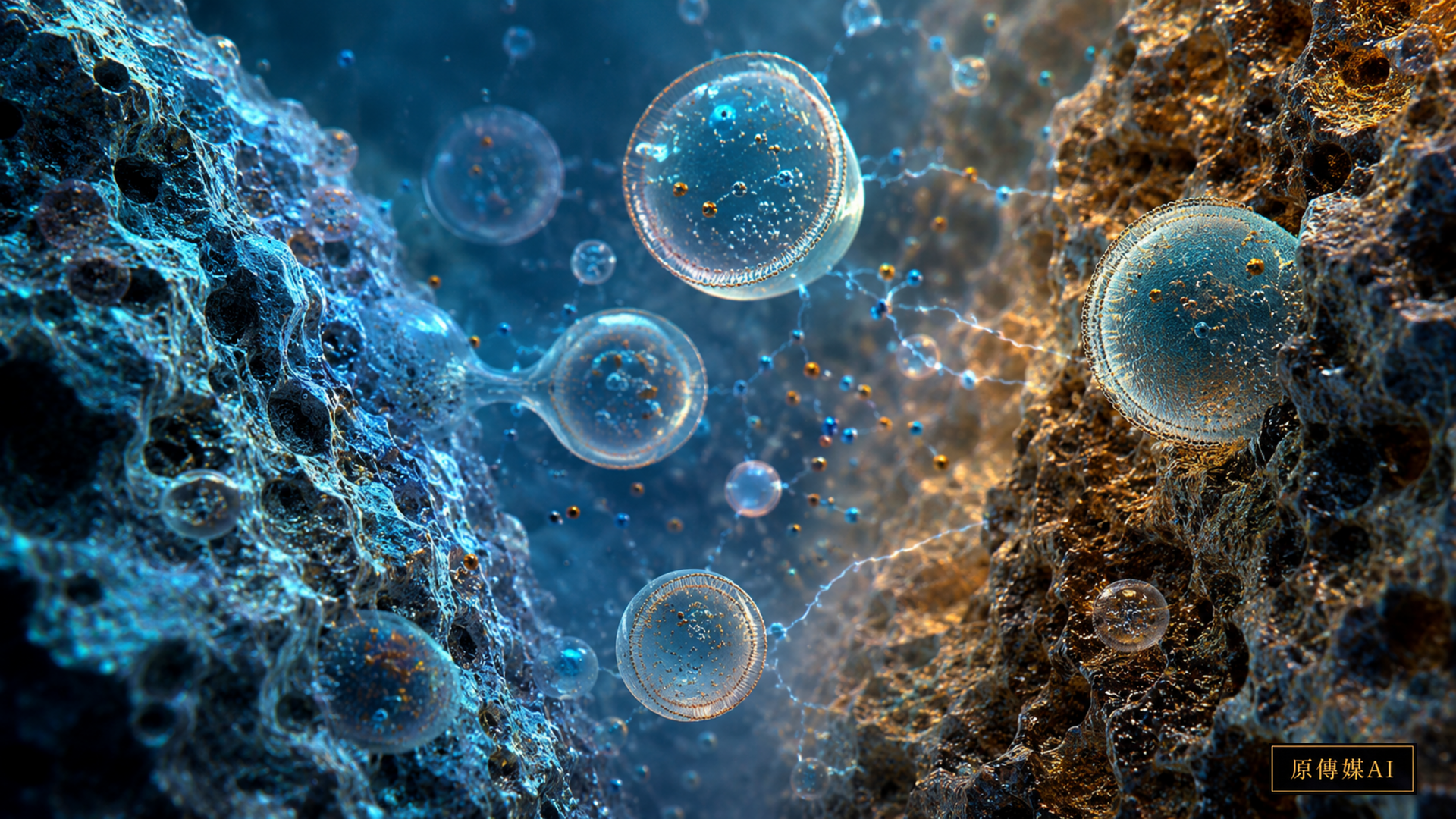
It Is Not Alive, but It Is No Longer Just a Passive Droplet
Origins-of-life research faces a persistent problem: it is comparatively easy to make structures that resemble parts of a cell, yet much harder to make them display the sustained dynamics associated with living systems. Lipid vesicles, coacervates and protein-rich droplets can create boundaries or concentrated phases, but a living cell does more than maintain a shape. It continuously exchanges matter and energy while preserving organization far from equilibrium.
A Nature Communications study published on 27 August 2026 describes a system in which an electrical potential supplies sustained energy to peptide-containing coacervates. Droplets form near one electrode, move through the system under the imposed electrochemical conditions, and then dissolve near the other electrode as the relevant chemistry changes. The cycle can repeat rather than ending after a single pulse of reagent is consumed.
The important result is not that researchers created life. They did not. The significance is that a protocell-like compartment can be made to participate in a persistent formation–movement–destruction cycle under continuous energy input. That moves the experimental question away from static “cell-like” droplets and toward the dynamics that make non-equilibrium systems interesting.
What Is a Coacervate?
A coacervate is a concentrated liquid phase produced when molecules separate into different liquid environments through interactions among their charges, sequences or other chemical properties. Unlike a conventional cell, the droplet is not necessarily enclosed by a lipid membrane. The boundary emerges from liquid–liquid phase separation and can concentrate selected molecules inside one phase.
Such droplets are important in origins-of-life research because early chemistry would have faced a dilution problem. If every reactant remained uniformly dispersed through a large body of water, many reactions would occur too slowly or too rarely. A condensed droplet can create a local environment in which molecules meet more frequently and chemical conditions differ from the surrounding solution.
Concentration alone is not life, however. A droplet can sit in a test tube for a long time without metabolism, heredity or evolution. The central challenge is to couple compartment formation with an ongoing energy flow so that the compartment changes, reorganizes and performs repeatable work instead of merely existing as a stable material phase.
What This Study Really Adds Is a Sustained Energy Difference
The experimental design uses the redox state of a cysteine-containing peptide to control coacervation. Near the anode, oxidation favors conditions in which the molecules form concentrated droplets. The droplets then move through the field and associated chemical gradients. Near the cathode, reduction changes the molecular state and the droplets dissolve back into the surrounding phase.
The same molecular system can therefore occupy different states at different positions. Instead of relying only on a one-time addition of a chemical fuel, the apparatus maintains an electrical potential between electrodes. As long as the driving conditions are maintained, the system can continue to create spatially organized chemical turnover.
That feature resembles a broad principle of living matter without making the system itself alive. Life is not a structure sitting at the lowest-energy state available to it. Cells remain organized because energy and material continually pass through them. The coacervate experiment offers a controllable way to study how sustained gradients can maintain dynamic compartments.
Why “Birth, Movement and Disappearance” Matter More Than a Beautiful Static Droplet
A static droplet can look striking under a microscope, but appearance alone says little about life-like behavior. Living structures are continuously rebuilt. Molecules enter, react and leave; membranes turn over; proteins are replaced; and spatial organization persists even though the material components are changing.
The coacervates in this experiment are likewise not permanent objects. They form under one chemical condition, travel through space, and disappear when they reach another condition. That turnover is more informative for non-equilibrium research than producing one durable artificial compartment that remains unchanged after preparation.
Even so, forming, moving and disappearing do not amount to metabolism, heredity or evolution. The words “birth” and “death” are useful visual metaphors for the cycle, not biological classifications. A scientifically careful description keeps that boundary explicit so a dynamic physical-chemical system is not transformed into a claim about synthetic life.
This Is Not “Scientists Created Life”
A dramatic headline could easily describe a moving protocell as artificial life, but that would go beyond the evidence. The coacervate system has no demonstrated DNA or RNA heredity, no autonomous metabolic network, no reproduction and no Darwinian evolution. Its motion and turnover are controlled by an engineered electrical and chemical environment.
A more precise description is that researchers created an out-of-equilibrium protocell-like system in which compartment formation, motion and destruction can be sustained by energy input. That formulation sounds less sensational, but it identifies the mechanism that can actually be tested and reproduced.
Scientific progress often comes from separating a grand question into smaller experimentally tractable capabilities. Rather than asking whether a test tube is “alive,” researchers can ask how compartments form, how energy gradients move material, how chemical states switch and which additions would be necessary before heredity or selection could emerge.
Electrodes Are Not Proof of the Environment in Which Life Began
Another tempting leap would be to say that because electricity can drive a protocell model, early life must have originated through electrodes or a comparable electrical device. The experiment does not show that. Laboratory electrodes provide a highly controlled way to impose redox and electrical gradients, while the early Earth was a complex geochemical environment with no obligation to match the apparatus.
The historical question requires separate evidence. Researchers would need to ask whether natural settings could supply persistent free-energy gradients with relevant chemistry, concentration, duration and spatial organization. Mineral surfaces, hydrothermal systems, pH differences and naturally occurring redox gradients are among the kinds of environments discussed in origins-of-life research, but none is proven merely by this laboratory result.
The broader principle is more valuable than a literal analogy. A molecular system can remain dynamic when an environment supplies a sustained energy difference. The experiment gives scientists a controllable model for that principle; it does not identify the actual place or mechanism from which life historically emerged.
Another 2026 Coacervate Study Asked a Different Question: Where Do Components Go?
A separate Nature Communications study published in 2026 examined programmable spatial demixing in prebiotic coacervates. That work illustrates a broader shift in the field. Researchers are no longer asking only whether molecules can condense into compartments; they are increasingly asking how compartments organize internally, occupy different spatial regions, move and interact.
Space matters because real living systems are not homogeneous test tubes. They exist in environments with gradients, interfaces, resources and constraints. The location of molecules can determine whether a reaction occurs, whether a catalyst meets its substrate, and whether one compartment gains access to a resource before another.
When spatial organization is added to protocell research, a droplet begins to function more like a chemical individual embedded in an environment rather than merely a material-science sample. That still does not make it a living organism, but it creates experimental models for studying some of the organizational problems that life has solved.
Non-Equilibrium Is One of the Central Ideas in the Study of Life
Thermodynamic equilibrium describes a condition in which there is no sustained net flow driving large-scale change. Living systems cannot remain alive at equilibrium. Cells continuously consume energy, exchange matter and maintain gradients; when those processes cease permanently, the organized state eventually breaks down.
One major origins-of-life question is therefore how ordinary chemistry could become coupled to a network that remains away from equilibrium for long enough to build and preserve structure. The electrically driven coacervate provides a relatively simple demonstration: maintain a potential difference and the droplets can repeatedly switch states at different places.
The next scientific challenge is coupling that compartment dynamics to other functions. Can a moving or turning-over droplet support reactions that feed back on its own persistence? Can catalysis, information-bearing molecules or resource competition become linked to the energy-driven cycle? Those questions are more demanding than making a droplet move, but the present system creates a platform on which they can be asked.
From an Engineering Perspective, It Also Resembles a Soft Microscopic Transport Machine
The experiment does not have to matter only to origins-of-life research. From the perspective of soft matter and microfluidics, a droplet that can appear, move and disappear under controlled conditions can also be imagined as a programmable transport element. A compartment could in principle collect selected molecules at one location and release them at another.
If loading and release could be made selective, electrical or electrochemical gradients might help control where micro-scale cargo is concentrated, moved and discharged. Such ideas could connect with reaction engineering, sensing, materials fabrication or microfluidic process design.
That engineering possibility remains speculative and far from a practical device. Useful systems would need reliable control of speed, stability, selectivity, energy consumption, droplet size and performance in chemically complicated media. The point is not that an application is ready, but that life-origin experiments and materials engineering can illuminate some of the same non-equilibrium design principles.
“When Does It Count as Life?” Cannot Be Answered by a Microscope Alone
As protocell systems acquire more life-like capabilities, the classification question becomes harder. Is movement enough? What about metabolism without heredity, replication without autonomous energy use, or adaptation without a nervous system? Biology can measure mechanisms, but the category “life” also depends on which properties scientists and philosophers treat as essential.
Viruses already demonstrate that the boundary is not trivial. Synthetic cells and minimal-cell research make the question even more concrete. A system may reproduce one feature associated with life while lacking several others, so declaring it alive on the basis of a visually compelling behavior can hide more than it explains.
Cross-cultural knowledge can deepen reflection on concepts such as life, relation and agency, but it should not be used as experimental proof of a molecular mechanism. Likewise, a coacervate experiment cannot be presented as scientific proof of a creation account or cultural cosmology. Different knowledge systems can ask different questions without being forced into an artificial equivalence.
The Value of Two-Eyed Seeing Is Letting Different Knowledge Systems Keep Different Questions
Experimental science is especially strong at asking what conditions make droplets form, how electrical potential changes chemistry, how fast compartments move and which parameters cause the system to fail. Those are questions that can be operationalized, measured and reproduced. They are indispensable for evaluating the mechanism described in the experiment.
Philosophy and cultural knowledge may ask different questions: why certain forms of dynamic organization are called life, whether relation should be part of a definition of living beings, or whether agency necessarily requires a nervous system. Two-Eyed Seeing does not require those questions to be converted into biochemical measurements before they can be meaningful.
A mature dialogue keeps the evidence boundaries visible. Chemical measurements should not erase conceptual or cultural questions, and cultural concepts should not be recruited to certify a reaction mechanism. The productive exchange occurs when each perspective reveals assumptions in the other while retaining the methods by which its own claims can be challenged.
The Next Step Is Not Simply “Make It More Alive,” but Add Testable Complexity
Future experiments can ask whether compartment dynamics can be coupled to reaction networks, autocatalysis, competition for resources or persistent state selection. A stronger protocell model would not merely move because an external field pushes it; its internal chemistry would influence its persistence, resource use or ability to generate new compartments.
A particularly difficult threshold would be the combination of energy use, self-maintenance, information copying, heritable variation and selection. If a chemical system could sustain those processes together, arguments about the boundary of life would become much more challenging. Reproducing one behavior at a time is the careful route toward that question.
For now, the conclusion remains clear. The electrically driven coacervate system is not life. It is a controlled and unusually dynamic model that allows researchers to study sustained compartment turnover under energy flow. Its value lies precisely in not skipping from an elegant mechanism to a much larger claim that the data do not establish.
Sources
- Nature Communications | Sustained formation movement and destruction of coacervates in a waste-free system driven by electricity
- Nature Communications | Programmable Spatial Demixing in Prebiotic Coacervates
- Nature Communications | 2026 Research Articles index
Editorial Note: Separate a Good International Case From a Reproducible Policy or Practice
An international case can be worth reporting without being directly transferable to Taiwan. Responsible comparison has to account for law, resources, population scale, geography, history and governance institutions rather than treating a successful example elsewhere as a ready-made local solution.
The scientific lesson is similar: a controlled electrode system is useful because it isolates a mechanism, not because it recreates the early Earth. If related research or applications are developed in Taiwan, local researchers and affected stakeholders should define success, failure, risk and stopping conditions under their own circumstances, while preserving an evaluation process that can be revised when new evidence arrives.
AI use and content-safety disclosure
This English translation was prepared with AI assistance for organization, drafting and language editing. Human editorial review remains responsible for viewpoint, factual verification and publication.