A flying fruit fly cannot directly sense the true wind direction: how does its brain calculate the answer by turning itself?
Original Chinese title: 一隻正在飛的果蠅,其實「感覺不到真正的風向」:牠的大腦怎麼靠自己轉彎,把答案算出來?
The study presents wind estimation as an active sensorimotor problem. By changing its own direction and speed, a fruit fly makes otherwise ambiguous airflow more observable, offering a useful pattern for neuroscience, robotics and science education.
王振庭
A natural-science teacher focused on science education, curriculum design, AI education, media literacy and protecting children's capacity to ask questions in technological environments.
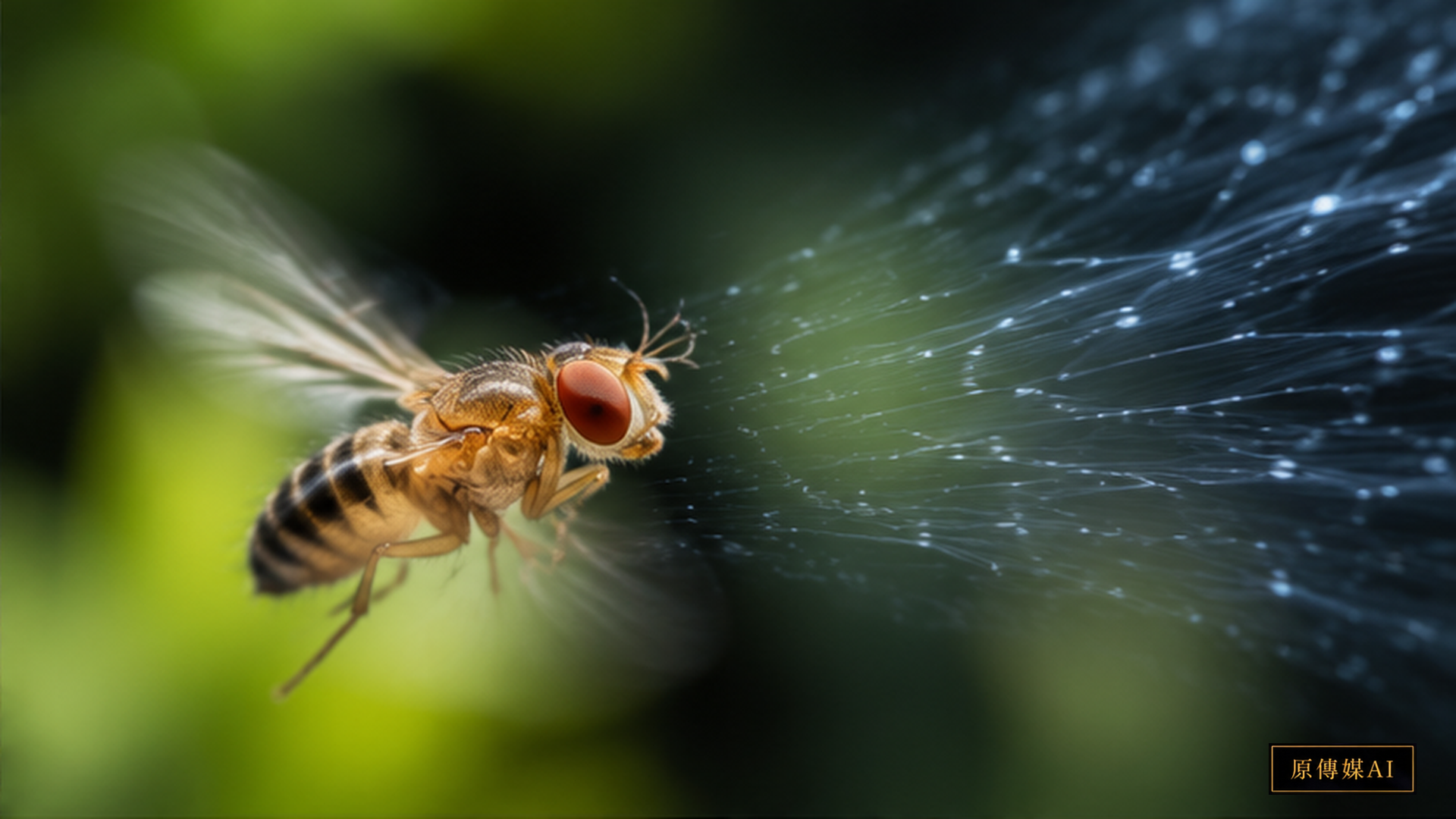
For a person standing on the ground, sensing wind direction seems intuitive: moving air touches the skin and suggests where it came from. A flying fruit fly faces a different problem. The animal is moving at the same time, and its wings and body continuously change the relative airflow. The airflow sensed by its antennae is therefore not identical to the ambient wind in the environment.
May et al.'s bioRxiv preprint separates this problem into its components, and a 2026 Zenodo record provides the associated data and code. How can a fruit fly estimate true wind direction during flight? The result is not a single wind-direction sensor. Instead, the fly combines its own movement, optic flow, airflow and a self-motion representation in the central complex. Active changes in direction and speed help it infer the external wind field. Perception is not simply passive reception; the animal acts in ways that make otherwise difficult information more measurable.
Consider a person in a fast-moving car who puts a hand outside the window. The dominant sensation may come from the car's motion rather than the weather station's ambient wind. A fruit fly in flight has the same geometry problem. It experiences relative airflow, which is a combination of environmental wind and its own flight velocity. Without an estimate of self-motion, the two components cannot be separated directly.
The nervous system must therefore estimate speed and direction while interpreting the airflow that remains. The useful variable is not simply where air appears to arrive at a sensory organ. It is the direction from which the external wind is most likely to come relative to the animal's current motion. This turns wind estimation into a problem of geometry, neural computation and behavioural control.
The research focuses on the central complex, a region already associated with navigation, direction, speed and spatial behaviour. Using two-photon neural imaging, the researchers observed PFN-class neurons and found activity patterns related to self-movement. When optic flow and airflow changed, these neurons did not merely register one isolated stimulus. Their activity formed an integrated motion representation that could provide a shared reference frame for navigation.
Active sensing means that an animal does not always wait for information to arrive. It may make a movement that creates a more informative sensory pattern. Bats emit sound, mice move their whiskers and people turn their heads when a scene is unclear. The fruit-fly result adds another example: changing flight direction or speed changes the relationship between optic flow and airflow. A turn is therefore not only locomotion; it is also a measurement.
Many insects use wind to locate an odour source. Odour plumes are carried by air, so knowing only the strength of a smell is not enough to decide where to fly. Wind estimation is part of olfactory navigation itself. If a fruit fly can infer ambient wind from its movement estimate, it can translate an odour signal into a more reliable directional behaviour.
The finding also challenges the intuition that the brain first receives fully measured sensory facts and then makes a decision. Ambient wind direction has no dedicated sensory line that simply reports the answer during flight. The brain combines several signals to construct a latent variable, an internal state inferred from measurements that are each incomplete or affected by self-motion.
Engineers designing a small drone often respond to uncertain sensing by adding another sensor. Small aircraft have limits on weight, power, cost and space, so that strategy cannot continue without limit. The fly suggests a different approach. When an external state is difficult to observe directly, a vehicle can make a short side-slip, turn or speed change, compare inertial, optical and airflow signals, and infer the external wind. This is active perception: sensing and control are designed together.
Biological inspiration still needs a careful boundary. The fruit-fly study does not present a commercial drone controller, and it does not show that the same neural mechanism can be copied into a machine without modification. What transfers is the structure of the problem. If an external variable is contaminated by self-motion, deliberate movement may help separate the sources. Engineering benefit would still require new models, sensor calibration, control experiments and safety testing.
The study also offers a useful lesson for science education. Senses are often taught as if eyes see, ears hear and noses smell while the body remains outside the process. In practice, turning the head, moving to judge distance, touching a surface and walking to locate a sound all change the information available to the brain. This makes embodied cognition, robotics and neuroscience part of one question: how does intelligence arise from a loop between sensing and acting?
The fruit fly has a small brain, but navigation requires the integration of heading, speed, direction of travel, wind, vision, odour and memory. The central complex is increasingly understood as a structured navigation network rather than a simple relay. Small nervous systems are valuable experimental models because researchers can follow a computational chain from individual neurons to behaviour more completely than in a large brain.
The deepest engineering and cognitive lesson can be stated simply: when the world provides insufficient data, do not always add another sensor first. Change the action that produces the data. For an animal, this is an evolved sensorimotor strategy. For a robot, it may become an efficient control method. For human cognition, it is a reminder that understanding is never one-way input. The fly calculates wind direction not only inside its neurons, but also through the turn it makes in the air.
International research can inspire Taiwan, but a biological result is not an automatic field solution. A responsible translation must recheck hardware, terrain, weather, regulation, safety and the people affected by deployment. A robot that actively moves to sense wind still needs limits on where it can fly, what data it stores and how operators review uncertainty. The value of the study is a design principle, not a promise of immediate transfer.
This perspective also changes how performance should be measured. A system should not be judged only by the final wind estimate. Evaluation should examine whether the action improved observability, how much energy it used, when the estimate became unreliable and whether the controller can explain its uncertainty. Such measures connect biological insight with accountable engineering rather than turning a fascinating animal behaviour into a slogan.
Evidence and applications
The broader message is that perception can be an active relationship with the world. A movement can separate signals, expose a hidden variable and reduce ambiguity. That pattern matters for insects, autonomous vehicles, classroom experiments and any public technology that must operate with incomplete information.
Sources:
- bioRxiv preprint | A compact multisensory representation of self-motion is sufficient for computing an external world variable
- Zenodo | Central Complex representations of self-movement are sufficient to compute wind direction in flight (data and code)
- Current Biology | Navigation circuits: Calcium spikes know which way the wind blows
AI use and content-safety disclosure
This English edition is an AI-assisted translation of the Chinese article, checked for source parity and evidence boundaries. It distinguishes the reported fruit-fly findings from possible engineering applications and does not claim that a biological mechanism is ready for commercial deployment.