Must Computers Always Calculate Exactly? A Nanoscale Magnetic Vortex Turns Chaos Into Probabilistic Multiplication
Original Chinese title: 電腦一定要精確算嗎?一顆奈米磁渦旋把「混沌」變成乘法,機率運算開始拿隨機性當資源
A 2026 Scientific Reports study uses chaotic polarity switching in a single magnetic vortex to generate a tunable probabilistic bitstream and demonstrate probabilistic multiplication.
Lawrence Lee
Technology policy observer focusing on digital governance, AI regulation, and Indigenous community data sovereignty.
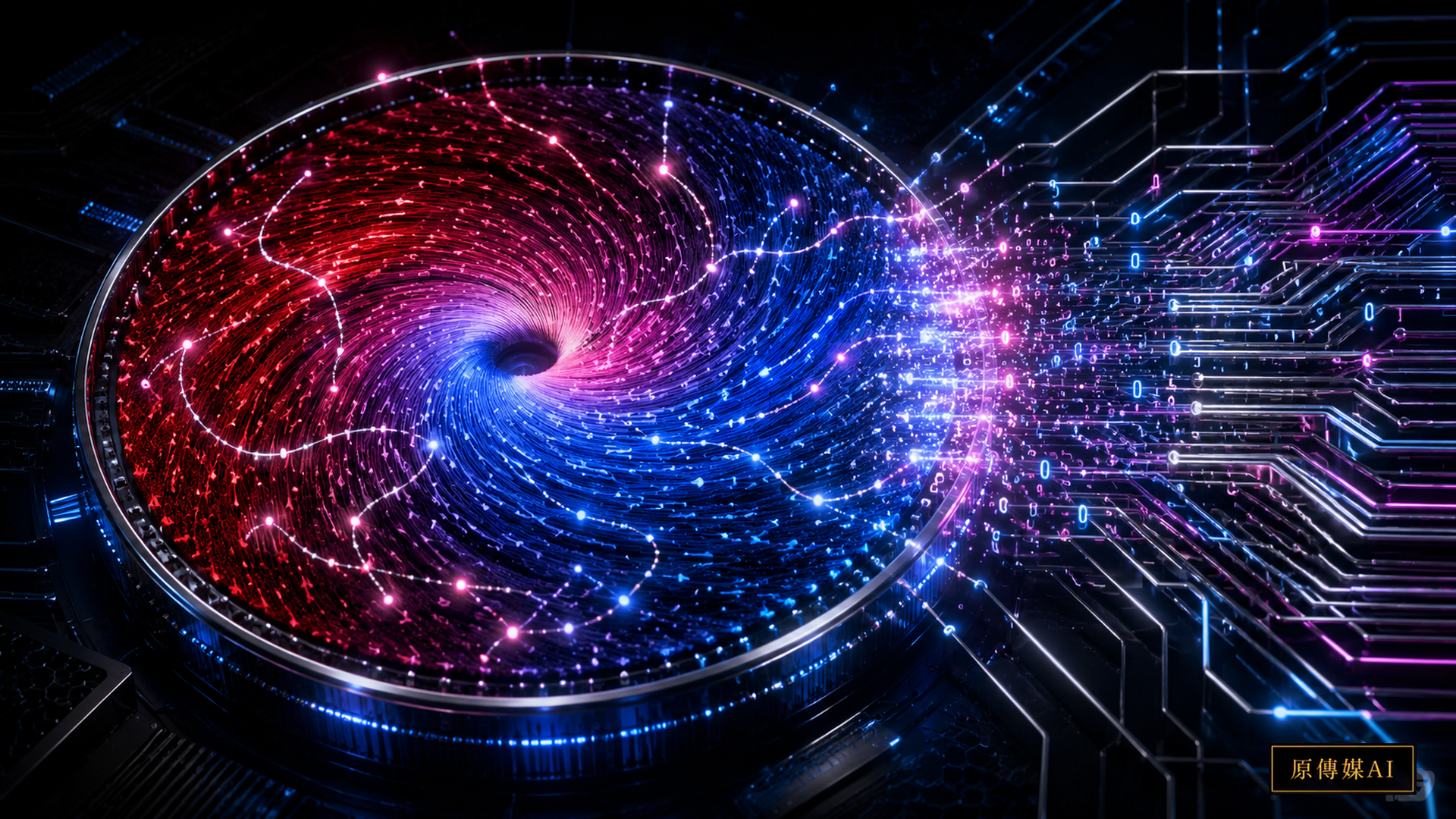
The basic promise of conventional digital computing is that a zero should be a zero and a one should be a one. Engineers suppress noise and stabilise states because an uncertain bit looks like a malfunction. Probabilistic computing starts from a different question: if some computations depend on probability distributions, sampling, and uncertainty, must deterministic circuits always simulate randomness, or can physical uncertainty become part of the computation itself?
A study published on August 31, 2026 in Scientific Reports | Probabilistic multiplication operation via chaotic polarity switching in a single magnetic vortex uses a nanoscale magnetic-vortex system driven into a chaotic regime. The researchers exploit switching of the vortex-core polarity to generate a tunable probabilistic bitstream and demonstrate probabilistic multiplication. This is not a commercial CPU. It is a proof of concept showing how instability can become a computational resource.
What is a probabilistic bit? Not a broken zero or one, but a controllable bias
A conventional bit is designed to remain stably at zero or one. A probabilistic bit, or p-bit, fluctuates between the two states, but an input can bias the probability toward one state. When the proportion of states over time represents a probability, sampling, inference, optimisation, and stochastic-computing tasks can be expressed differently from conventional Boolean logic.
The Scientific Reports work is interesting because the probability source comes from chaotic polarity switching in a single magnetic vortex. The engineering goal is not to eliminate every fluctuation, but to make its statistical behaviour measurable, controllable, and useful.
Why "chaos" and "randomness" are not the same thing
A chaotic system may be governed by deterministic physical equations yet be extremely sensitive to initial conditions. Randomness usually refers to outcomes described probabilistically. In engineering, a nonlinear chaotic dynamic that produces a stable statistical distribution under controlled conditions can still be useful.
A related 2026 paper in Physical Review Applied | Magnon-driven stochastic spin Hall nano-oscillators examines stochastic behaviour associated with transient chaos in spin Hall nano-oscillators and demonstrates nanosecond-scale true random-number generation. The mechanism differs from the magnetic-vortex experiment, but both studies suggest that nonlinear spintronic dynamics do not always have to be engineered away.
The real p-bit challenge is not that it fluctuates, but whether it can connect to the chip world
Many unconventional-computing ideas face the same bottleneck: a device may be scientifically interesting but difficult to scale if it cannot connect to CMOS, readout, interconnects, programming models, and fabrication. A 2026 NIST result, 130-nm CMOS-Integrated Superparamagnetic Tunnel Junction-Based p-bit, demonstrates another path by integrating a superparamagnetic tunnel junction with 130-nm CMOS.
This is not the same architecture as the single magnetic vortex. Its relevance is system-level: a physical source of randomness must be driven, read, calibrated, and connected by standard electronics before it can become a useful processor.
Why unconventional computing is attractive for AI and optimisation
Machine learning and optimisation frequently deal with uncertainty. Bayesian inference uses sampling, generative systems need stochastic sources, combinatorial optimisation explores huge solution spaces, and some Ising-machine or Boltzmann-style approaches are inherently probabilistic. Hardware that provides fast, tunable probabilistic bits may reduce some overhead required when deterministic circuits imitate stochastic behaviour.
But potential suitability is not the same as proven energy savings. NIST | Metrics for spin-based computing stresses task-relevant metrics such as energy, speed, accuracy, area, scalability, and system integration. Comparing one device’s switching energy with the wall-plug power of a GPU server would be meaningless.
One magnetic vortex performing multiplication is not yet a "chaotic AI chip"
The result demonstrates a computational primitive, not a replacement for tensor cores, CPUs, or GPUs. Large arrays would still have to deal with manufacturing variation, temperature, calibration, interconnects, error control, software mapping, and end-to-end workload performance. The work matters because it adds another possible physical primitive to computing, not because it has already displaced conventional hardware.
From "eliminating noise" to "designing useful uncertainty"
Conventional digital design tries to isolate physical uncertainty before computation begins. Probabilistic computing asks whether some tasks can use controlled physical uncertainty directly. The key word is controlled: a device whose distribution cannot be measured, biased, reproduced statistically, or calibrated has little computational value.
Probabilistic computing is therefore not anti-precision. It shifts the object of precision from every instantaneous bit state to the statistical behaviour and task-level output.
A Two-Eyed Seeing angle: mathematical ideals and physical materials correct each other
This article does not need an Indigenous framing. Its useful Two-Eyed Seeing perspective lies between mathematical models and material reality. Algorithms define how an ideal p-bit should fluctuate and interact. Real devices answer back with noise, delay, chaos, process variation, and energy costs. Engineers can then revise the model rather than forcing the material to imitate a perfect digital abstraction.
The next milestone is a system, not another isolated device
If magnetic vortices or other spintronic p-bits are to become practical computing components, the next questions are system questions. Can large numbers of devices be calibrated consistently? How are they coupled? What energy do readout and peripheral circuits consume? Does an end-to-end algorithm actually outperform a digital implementation? How are drift and errors detected? How does software map a problem onto the hardware?
The useful conclusion today is not that chaos has defeated the GPU. It is that computer engineering is reconsidering what counts as useful physical behaviour. When the unpredictability of a nanoscale magnetic vortex can be organised into a controllable probability, something once treated as unwanted noise begins to look like a possible computing resource.
AI use and content-safety disclosure
This English edition is an AI-assisted translation of the reviewed Chinese feature. The translation preserves source links, factual qualifications, and author identity safeguards and does not add new factual claims.