An Alert Is Not Finished When It Is Sent: Bringing Indigenous Knowledge and Community Communication Into Early-Warning Governance
Original Chinese title: 警報不是「發出去」就算完成:UNDRR 開始把鳥況、水色、雲形與社區通訊納入原住民族早期預警治理
UNDRR’s 2026 work on Indigenous knowledge and early warning highlights understandable communication, community-used channels, local environmental observation, governance participation, and after-event learning.
全明正
Bunun cultural and visual-media practitioner from Shuanglong community; long involved in community cultural documentation, visual storytelling, and local-knowledge organisation, with a focus on respecting and preserving soundscapes, ceremonial contexts, and community narratives during digitisation.
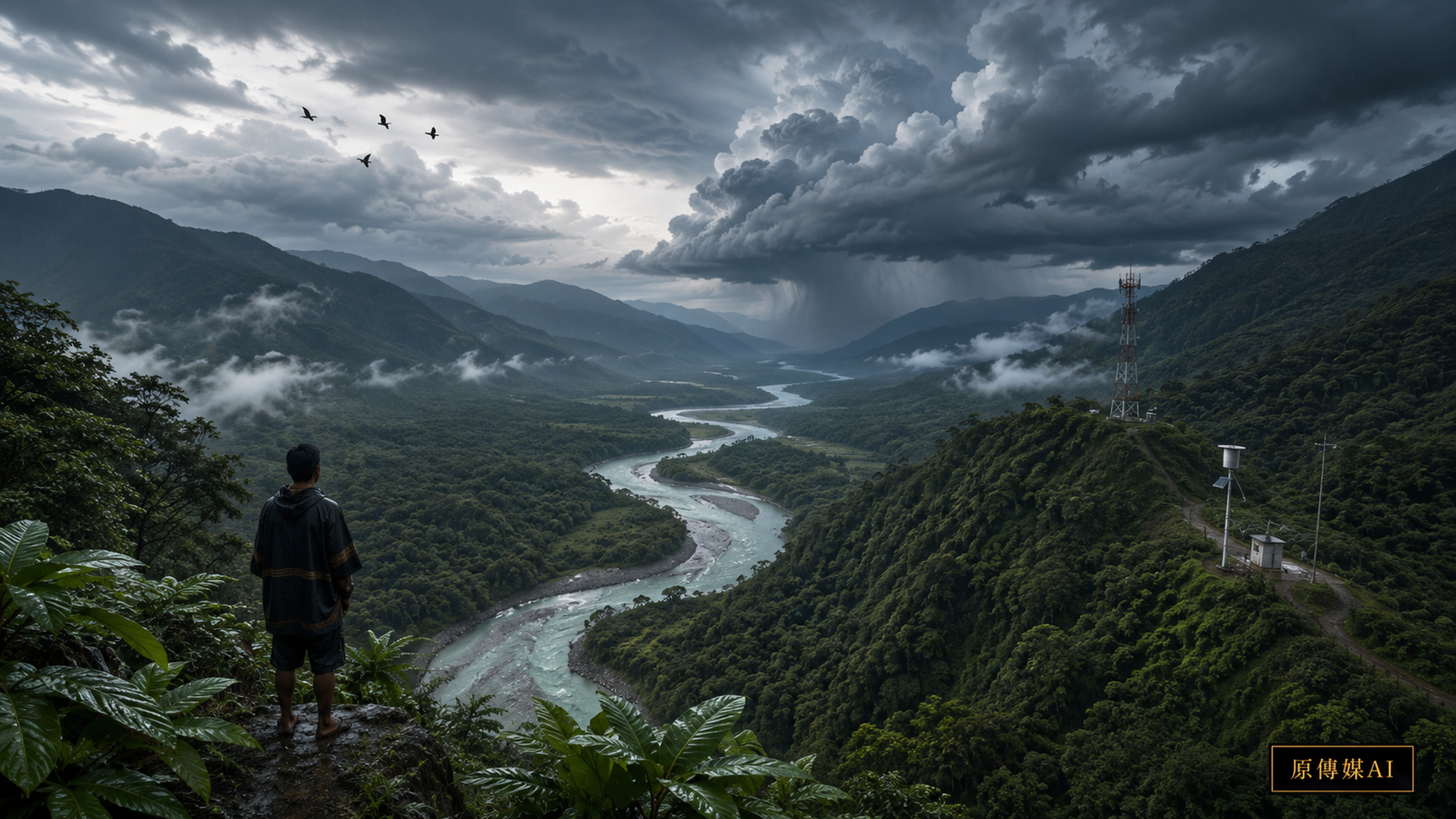
Disaster early warning is often imagined as a straight line: a weather or water sensor detects danger, an agency issues an alert, a phone receives the message, and the task is complete. The August 18, 2026 article UNDRR | Voices for resilience: integrating Indigenous knowledge into early warning systems makes a more demanding point. A technically accurate warning only protects people when it arrives in time, can be understood, travels through channels people actually use, and leads to action.
UNDRR’s August 11 event on Indigenous Knowledge and Early Warning Systems highlighted community observation of climate patterns, animal behaviour, hydrological cycles, historical memory, and local communication and organisation. The issue is not whether a technical system should add a small amount of traditional knowledge. It is whether Indigenous knowledge holders are recognised as participants in risk governance.
"Bird behaviour, water colour, and cloud forms" are not a fixed UNDRR checklist
The words in the title are narrative examples that make local environmental observation easier to picture. UNDRR uses broader concepts such as bioindicators, animal behaviour, climate patterns, hydrological cycles, historical memory, and community communication and organisation. It does not prescribe the same three indicators to every community.
That distinction matters because Indigenous knowledge is place-specific. The same species, river colour, or cloud pattern can carry different meanings in different ecosystems and seasons. Local knowledge is not a shortcut to certainty; its value lies in long-term observation of how changes tend to occur together in a particular landscape.
The point where technical warnings most often fail is the "last mile"
A warning can fail if it is not communicated in language recipients understand, if it does not use channels the community relies on, or if it does not connect to existing forms of organisation. Early warning is therefore not only a meteorological or hydrological engineering problem. It is also a public-service design problem.
A resilient system uses redundant paths: cell broadcast, messaging groups, local radio, community leaders, churches, fire services, road authorities, schools, and community organisations. If one base station fails, another channel should still carry the warning. If an official message is too abstract, a trusted local coordinator can translate it into information about a bridge, stream, road section, household, or evacuation sequence.
Instruments and local observation are not competitors; they are sensors operating at different scales
Radar, rain gauges, water-level stations, satellites, and numerical models are valuable because they are standardised and comparable across large areas. Local observation offers dense context: which slope starts seeping under a certain type of rainfall, which tributary changes first, where rockfall often begins, or whether the present pattern resembles a past event.
Both systems can be wrong. A strong Two-Eyed Seeing warning system therefore establishes cross-checking rather than declaring one source superior. Official observations quantify hazard; local networks provide ground confirmation, place-name translation, and information about whether proposed actions are feasible.
The harder problem is governance: who has the authority to say that a signal means danger?
If institutions treat local knowledge only as data but do not allow knowledge holders to participate in defining alert levels, communication language, or response procedures, the system remains extractive. This is also a cultural data-sovereignty issue. Hunting routes, ceremonial places, water sources, ancestral areas, or species information may be sensitive and should not automatically become open coordinates or AI training data.
A more mature design uses access levels. Some indicators can be public, some can remain within the community, and some can be translated only into a general risk signal without exposing the underlying knowledge.
For Indigenous townships in Taiwan, the practical priority is connecting the process, not building another app
Taiwan already has multiple monitoring and alert systems operated by the Central Weather Administration, Taiwan, the Agency of Rural Development and Soil and Water Conservation, the Water Resources Agency, the Highway Bureau, and local governments. The gap is often not the absence of data, but whether information can be understood locally and converted into action. For a community, "heavy rain during the next three hours" may still need to become: which road should not be used, which bridge requires attention, which households should be contacted first, and how schools, elders, people with disabilities, or long-term-care users will be supported.
One practical design is a dual-evidence warning record: official source, release time, and measurement; local observation; whether the two agree; action taken; and the later outcome. This makes local experience part of an auditable process without stripping away context.
After an alert, the next question is: where did the system fail this time?
UNDRR’s 2026 After-Event Review methodological guidance emphasises learning and improvement rather than blame. Early warning is a chain involving risk knowledge, monitoring and forecasting, institutional coordination, dissemination, preparedness, and response. A technically accurate forecast can still fail if any link breaks.
For Indigenous communities, an after-event review can also ask what local people already knew that never entered the decision process. Recording such gaps makes it possible to improve the next procedure rather than repeat the same failure.
Images, soundscapes, and local narratives can also become disaster memory
The perspective of author 全明正, a Bunun cultural and visual-media practitioner from Shuanglong community, adds another layer. Disaster knowledge does not exist only in tables. Photographs of slopes across seasons, changing stream sounds, or oral histories of former evacuation routes can also preserve local risk memory.
Digital preservation should not mean universal upload. Images may contain sensitive locations, people, or cultural context. Access controls and community consent are therefore part of archive design.
The endpoint of a warning is not the phone; it is people actually beginning to move
The success of early warning should not be measured by how many messages were sent. It should be measured by whether people received understandable information in time, whether action was possible, and whether remote or vulnerable residents were included. Integrating Indigenous knowledge matters because it changes the answer to a fundamental question: who counts as a producer of warning knowledge?
When radar, water-level stations, satellites, local environmental observation, language, communication networks, and community decision-making are treated as parts of the same system, a warning can move from being something that was merely issued to something that actually makes people safer.
AI use and content-safety disclosure
This English edition is an AI-assisted translation of the reviewed Chinese feature. The translation preserves source links, factual qualifications, and author identity safeguards and does not add new factual claims.