Lead-Free Perovskites Clear an Old Hurdle: Tin Solar Cells Are More Stable, but How Far Are They from Twenty Years on a Roof?
Original Chinese title: 無鉛鈣鈦礦跨過一個老難題:錫做的太陽能電池更穩了,但離屋頂二十年還有多遠?
Stability research marks important progress for lead-free tin perovskites, but a 1,000-hour, 55°C laboratory test cannot be converted directly into twenty years of rooftop life.
山海資料庫
Co-authors: 李文驤
Mountain-Sea Database; co-author 李文驤 is a geography teacher at 天主教達人高中.
# Lead-Free Perovskites Clear an Old Hurdle: Tin Solar Cells Are More Stable, but How Far Are They from Twenty Years on a Roof?
By Mountain-Sea Database; Co-author: 李文驤 | Geography teacher, 天主教達人高中
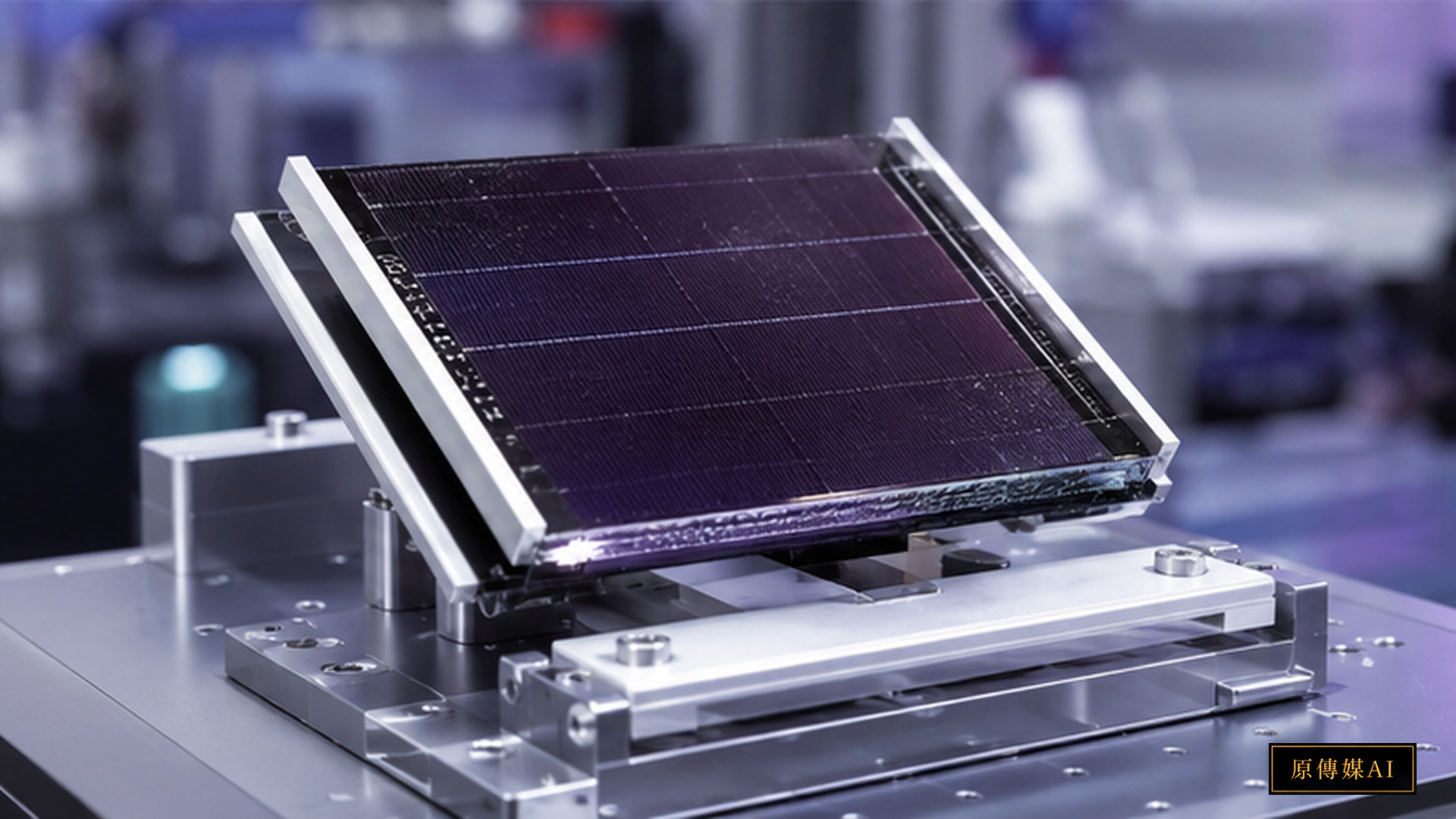
News about perovskite solar cells is often dominated by two numbers: how much conversion efficiency has increased and how soon a “next-generation” technology might replace silicon. A study published in *Nature Materials* on 1 September brings attention back to a harder and more commercial question: can the material survive long enough? The researchers addressed air instability and crystallization problems in tin-halide perovskites by designing new 2D/3D tin-iodide structures based on the 4-chloro-phenethylammonium (4ClPEA) cation. The resulting devices reached 16.2 percent power-conversion efficiency and demonstrated operational stability for more than 1,000 hours at 55 °C.
Why does tin matter? Many high-efficiency perovskite devices use lead-containing materials, raising concerns about toxicity, manufacturing controls, leakage after damage and end-of-life management. Tin perovskites are an important lead-free or lead-reducing direction and offer narrower bandgaps and additional design possibilities. The trade-off is chemical vulnerability: tin is readily oxidized, and these materials can be much less tolerant of oxygen and moisture than a commercial module needs to be. Replacing lead therefore does not finish the materials problem; it changes the problem and requires new control of oxidation, defects, crystallization and interfaces.
The new work is not simply another external barrier layer. By comparing phenethylammonium-type cations with different halogen substitutions, the researchers found that 4ClPEA produces tighter interlayer packing and stronger π-stacking interactions, impeding oxygen and water diffusion while improving the crystallinity and orientation of 2D/3D tin-perovskite films. The materials lesson is important: durability can be engineered not only by packaging a fragile absorber from the outside but also by modifying molecular organization so that degradation pathways are harder to access from within the crystal structure itself.
The phrase “more than 1,000 hours” must nevertheless be read correctly. One thousand hours is roughly forty-two days. Continuous operation at 55 °C is a meaningful stress condition that helps compare material designs, but it cannot be translated directly into “twenty years on a roof.” Real modules experience daily temperature cycling, humidity changes, ultraviolet light, wind, mechanical stress, edge-seal leakage, electrical bias and long-term diffusion between layers. Connecting a laboratory stress test to real service life requires validated accelerated-aging models, standardized protocols and long outdoor datasets.
The U.S. Department of Energy is explicit about the commercialization challenge. Moisture, oxygen, light, heat and applied voltage can all contribute to perovskite degradation. For mainstream solar-power generation, the agency says operational lifetime must reach at least twenty years and preferably more than thirty. That scale difference belongs beside every headline about a laboratory breakthrough. A 16.2 percent device and more than 1,000 hours of stability are meaningful steps through a materials bottleneck, but they represent one segment of the evidence chain from chemistry to bankable product.
Technology readiness should therefore be examined at four scales. At the materials scale, researchers ask whether oxidation is suppressed, defect densities are controlled and crystal structures remain stable under light and heat. At the device scale, they must examine reactions between electrodes, transport layers and the perovskite. At the module scale, coating uniformity, interconnection, encapsulation and yield have to survive area scaling. At the system scale, the questions become multi-decade outdoor degradation, maintenance, recycling, warranties and levelized cost of electricity. Many materials look excellent at the first scale and encounter their most difficult barriers at the third and fourth.
“Lead-free” should also not be used as a synonym for “green.” Reducing lead-related risk is a real advantage of tin-based approaches, but a full environmental assessment includes precursor synthesis, solvents, additives, process energy, encapsulation materials, manufacturing waste and recycling. If a lead-free module lasts too short a time and has to be replaced frequently, part of its material and energy advantage can be lost. The stronger green-chemistry question is therefore not simply whether lead is present, but how risk and resource use add up across the whole life cycle.
Efficiency records need the same discipline. Small laboratory cells are excellent for testing formulations rapidly; commercial products need large and uniform modules. As area increases, pinholes, thickness variation, electrical resistance and encapsulation defects can turn into yield problems. A materials change that improves stability and process tolerance may ultimately be more valuable to manufacturing than an isolated increase of a few tenths of a percentage point in champion-cell efficiency. The indicators to watch are reproducibility, batch variation, module-scale performance and outdoor durability—not only the next world record.
Energy policy should also avoid swinging between “silicon is mature, so perovskites are unnecessary” and “perovskites will immediately replace silicon.” Thin-film materials may create value in lightweight or flexible products, building integration, low-temperature processing, or tandem architectures with other absorbers. Different markets tolerate different trade-offs among lifetime, weight, efficiency and cost. The realistic question is which performance combination reaches a reliable and manufacturable threshold first in a particular application.
The significance of this tin-perovskite advance is therefore twofold. It pushes lead-free photovoltaic chemistry toward greater durability and shows that molecular packing can be used to slow the entry of oxygen and water. At the same time, it offers a useful discipline for technology reporting: one thousand hours is not twenty years, laboratory durability is not a field warranty, and lead-free is not a complete life-cycle verdict. Once those scales are kept separate, the breakthrough can be understood neither as hype nor as disappointment, but as one important step on a long path that materials science, engineering, testing standards, manufacturing and policy must complete together.
Primary sources
Role-Driven Inquiry
Yuan Media AI | Guided Questions by Role
Select a role first, then review the complete questions from that perspective; clicking a question will display Yuan Media AI’s response in real time.
Select a role
Tin-perovskite materials researcher
Examine the article's evidence, governance boundaries, data rights, and actionable steps from the perspective of a Tin-perovskite materials researcher.
Choose a question
AI use and content-safety disclosure
This English edition is an AI-assisted translation of the Chinese article, reviewed for source parity and evidence boundaries.