El Niño Is No Longer Merely “Possible”: When Global Models Approach 100%, What Can Indigenous Seasonal Calendars Still Tell Us?
Original Chinese title: El Niño 已經不是「可能來」:當全球模型說接近 100%,原住民族季節曆還能告訴我們什麼?
In early September 2026, the World Meteorological Organization stated that El Niño was firmly established and expected to intensify.
雙向知識實驗室
Consulting member: 高德生 — Tsou ritual ecology specialist, hunter-school and cultural-history practitioner; author of The Tsou Book of Animals and Plants.
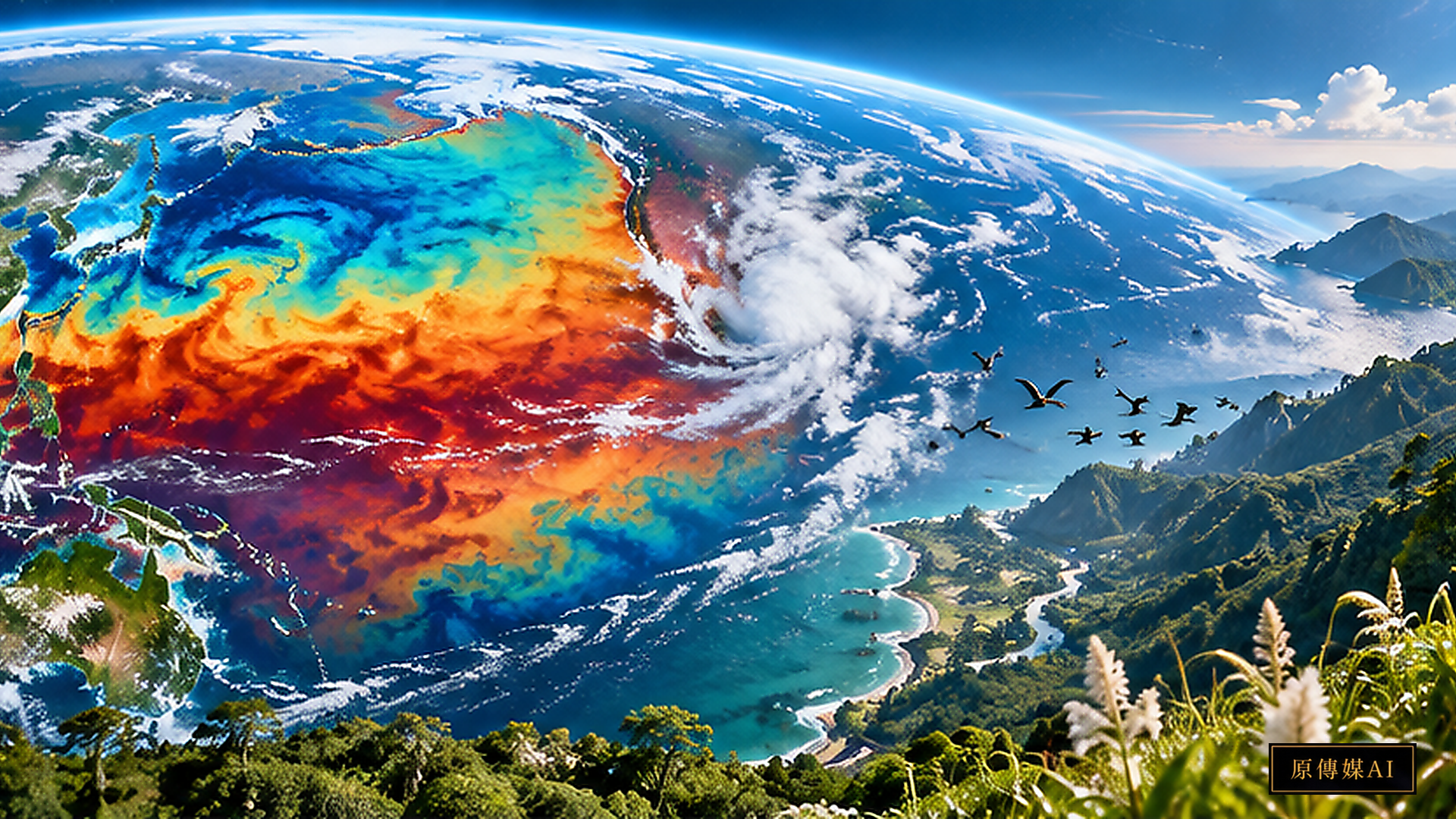
A near-100% forecast is not a village-level prophecy
In early September 2026, the World Meteorological Organization stated that El Niño was firmly established and expected to intensify. WMO forecasts showed a nearly 100% likelihood that the event would persist through February 2027, while NOAA’s August diagnostic discussion indicated a greater than 90% chance of a very strong El Niño during the 2026–27 Northern Hemisphere fall and winter. These are unusually strong signals, but they do not mean every locality will experience the same drought, flood, heat wave or crop loss.
ENSO is a basin-scale coupled ocean-atmosphere phenomenon. Its influence is mediated through rainfall belts, circulation, sea-surface temperatures and heat distribution. A global forecast therefore changes the background probability of hazards; it does not specify the exact outcome in one watershed, village or farm.
What global models do well
WMO and NOAA combine standardized observations of sea-surface temperature, subsurface heat, winds, convection and model ensembles. This gives governments a shared framework for planning water supply, agriculture, electricity, heat-health, wildfire and food-system risks months ahead.
The communication problem begins when probability language is flattened. “Nearly 100%” refers to the persistence of El Niño, not to the probability that a specific community will suffer a particular disaster. “Very strong” describes the ENSO event, not the guaranteed severity of every local impact.
A responsible preparedness system therefore treats the global forecast as a trigger for closer local attention rather than as a deterministic village forecast.
Indigenous seasonal calendars are not alternative ENSO models
The Australian Bureau of Meteorology’s Indigenous seasonal calendars show a different way of organizing environmental time. Many calendars recognize seasonal transitions through combinations of wind, clouds, flowering, animal breeding, insects, water conditions and the availability of foods and materials. Seasons are not simply fixed blocks on a twelve-month calendar; they emerge from relationships among ecological signals.
This knowledge does not compete with ENSO science. Global models answer a basin-scale question: how is the Pacific climate system changing? Seasonal knowledge answers a place-based question: what changes are actually appearing here, now?
For Indigenous communities in Taiwan, the productive question is not whether traditional knowledge is “more accurate” than climate science. It is how the two scales can correct and inform one another. Official rainfall, streamflow, soil moisture and heat indicators can be examined alongside locally meaningful phenology such as flowering dates, insect emergence, low-flow timing and crop development.
From cultural documentation to public-service infrastructure
Place-based knowledge becomes especially valuable when it is recorded in ways that support action without stripping it of cultural governance. A local seasonal dashboard could have three layers. The first contains official observations such as rainfall, temperature, drought indices and stream levels. The second contains repeatable local indicators. The third records impacts and responses: water restrictions, road failures, wildfire events, crop disease or harvest shifts.
AI can help organize timelines, detect co-occurring anomalies and translate technical forecasts into accessible language. It should not decide which culturally sensitive knowledge becomes public. Some ecological indicators may have ritual, family or knowledge-holder restrictions; digitization must follow community decisions about access and granularity.
The goal is action, not another alert
A strong El Niño bulletin matters only if it changes preparedness. Agriculture can examine irrigation backup, planting windows and pest surveillance. Water managers can review small-system resilience. Road and disaster teams can examine dry-to-wet transitions, slope conditions and wildfire exposure. Schools and community groups can build local phenology observation into everyday learning.
The most resilient system is therefore a feedback loop: global forecast, local observation, administrative action, post-event review. It gives each knowledge system a clear role rather than forcing one to validate or erase the other.
Make observation schedules and responsibility explicit
A local pilot could record the same stream, plant and farming activity at a fixed weekly interval. Missing observations, equipment failures and confirmed normal conditions should be separate entries. Changes in observer, location or method must remain visible when comparing years. This is a proposed local workflow, not a forecasting model validated in Taiwan. Responsibility, available resources and review dates should be agreed before observations trigger irrigation adjustments or additional inspections.
The risk of disconnected records
Climate, water, agriculture, transport and health agencies often maintain separate records. Local knowledge may remain in notebooks or oral accounts. When an event affects several systems at once, those divisions can hide changes that are occurring together.
A shared timeline should therefore record not just conditions but responses and their outcomes. After an event, participants can examine which signals preceded an actual impact and which did not. This helps distinguish a useful indicator from a coincidence without treating either model output or local observation as infallible.
Three starting points for local preparedness
First, identify systems whose failure would immediately affect daily life, such as drinking water, roads, irrigation and heat protection. Second, choose a small set of observations that people can sustain. Third, agree on a shared chronology across agencies so that impacts can be compared with earlier conditions.
Seasonal forecasts offer time to adjust. A modest system that residents can maintain and use may serve a small community better than an expensive platform dependent on an outside team.
Traditional knowledge is not a free sensor network
Recognizing phenology should not reduce knowledge holders to unpaid suppliers filling gaps in official observations. Communities need a role in setting research questions, deciding fields and access rules, and receiving useful results.
Indicators connected to ceremony, harvesting or family knowledge may be recorded only as trends, without precise locations. Potential commercial reuse should be addressed before collection. Two-Eyed Seeing requires reciprocal relationships as well as combining observations.
For example, a community using stream irrigation could record available water, upstream rainfall and crop demand in one weekly log. Falling supply and rising demand are different problems. Rain concentrated in a few days may not sustain a water source throughout the interval. This example illustrates a way to make discussion concrete; it does not establish predictive performance. Knowledge holders can describe earlier changes in water access while water managers examine infrastructure capacity. The joint record should preserve reasons and subsequent observations rather than average different judgments into one score or require disclosure of restricted knowledge.
Yuan Media AI | Continue by role
- Climate forecasting researcher: How should communicators distinguish the probability of El Niño persistence from the probability of local hazards?
- Indigenous seasonal-knowledge practitioner: Which phenological indicators can be publicly recorded, and which require cultural governance?
- Rural disaster and water manager: How can ENSO forecasts be converted into thresholds for drinking water, roads and wildfire readiness?
- Farmer, forester, fisher or pastoral worker: Which local observations are most useful for changing planting, irrigation, pest control and harvest decisions?
Sources
Role-Driven Inquiry
Yuan Media AI | Guided Questions by Role
Select a role first, then review the complete questions from that perspective; clicking a question will display Yuan Media AI’s response in real time.
Select a role
Climate forecasting researcher
Examine the article's evidence, governance boundaries, data rights, and actionable steps from the perspective of a Climate forecasting researcher.
Choose a question
AI use and content-safety disclosure
AI-assisted editorial illustration and English text based on the supplied feature package.