Why Does This Titanium Float? RMIT’s Foam-Filled Lattice and the Limits of Damage Tolerance
Original Chinese title: 鈦明明比水重,為什麼這塊金屬會漂?RMIT 把泡棉藏進 3D 列印骨架,做出「裂了也不立刻沉」的浮體
RMIT’s titanium–foam lattice allows water through its external openings while retaining buoyancy after some damage. Water-excluding volume is crucial; scale-up and long-term marine performance remain unproven.
Sulangal|卑南族/資深文化與影像工作者
Sulangal is a senior Puyuma cultural and visual-media practitioner focusing on image ethics, community narratives, cultural data sovereignty, and technology’s influence on memory, identity and public trust.
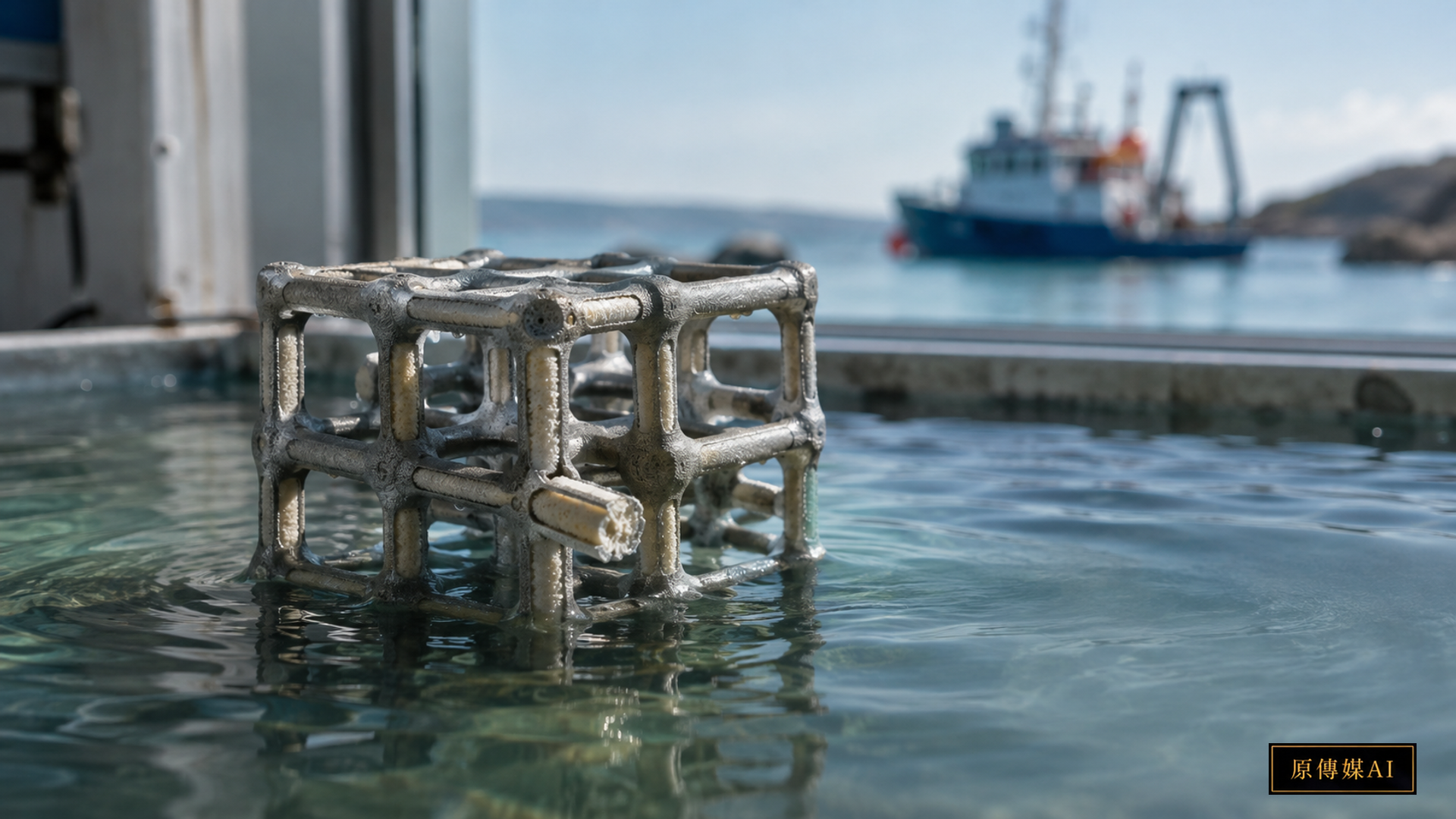
How a heavy metal can form a floating structure
Solid titanium sinks, and making it into a lattice does not necessarily make it float. Water can enter open pores, so apparently lightweight spaces may not displace water. Research introduced by RMIT on September 3 addresses this distinction by filling hollow, 3D-printed titanium struts with polyurethane foam while keeping the lattice's external openings accessible to water.
Published in Advanced Materials, the work combines metal and polymer in a hybrid lattice. Titanium has not acquired new physical properties; the design rearranges the relationship between metal, foam and water. The structural questions are which parts carry loads, which displace water and which functions remain after damage.
Density depends on which volume is counted
Density divides mass by volume, but defining volume matters for an open lattice. Its outer envelope includes spaces water can freely enter. That measurement can describe overall lightness without reliably predicting buoyancy, which depends on the water actually displaced.
RMIT uses skeletal density for the water-excluding portions: titanium walls and foam-filled channels that resist water ingress. Those effective parts need sufficiently low density relative to the surrounding liquid. This follows buoyancy principles rather than overturning them. A useful question is whether a particular opening fills with water or keeps it out.
The foam sits inside the struts
The design does not fill every opening around the metal lattice. The exterior remains open, with foam inside hollow struts using small closed cells to retain water-excluding volume. The metal provides a load-bearing structure and the polymer supports buoyancy; their combination produces the observed behaviour.
Calling this floating pure titanium would therefore mislead. An image of metal on water without the internal material can obscure the mechanism. Conceptual illustrations should preserve the distinction between external openings and filled struts, and cannot establish performance for untested sizes, shapes or applications.
Remaining afloat after cracking does not mean unsinkable
The research reports retained buoyancy after cracking, node failure and partial structural damage. RMIT also says severe crushing and compaction can make the structure sink. Functional reserve under particular failure modes does not establish resistance to unlimited damage in every direction.
Damage tolerance must be read with its test conditions. Compression, a period of seawater immersion and years of repeated wave loading ask different questions. Reports should retain loading conditions, duration and criteria so conditional results do not become an unlimited guarantee. Those qualifications are central to responsible engineering communication.
Short seawater tests begin a longer programme
The team reports short-term corrosion testing in natural seawater and a buoy demonstration in disturbed tank water, while identifying scale-up and prolonged realistic marine and deep-sea testing as future work. These results support potential applications, not established long-term qualifications for docks, offshore platforms or life-saving equipment.
Scale-up raises new questions about uniform strut filling, joint weaknesses, concentrated loads and detection of internal water uptake. A prototype can establish a promising design direction. Commercial use also requires repeatable manufacture, quality checks, transport, maintenance and end-of-life arrangements.
Floating is only the first system requirement
The following is application analysis, not a list of completed research tests. A marine sensor must also maintain attitude, hold its tether, protect electronics and operate until maintenance is possible. Biological growth, debris impacts and changing attachments may consume buoyancy reserve. Data reliability also depends on installation and the wider system.
Material comparison should therefore include load capacity, maintenance frequency, consequences of failure and service life, not one strength figure. A short, retrievable deployment may warrant different trade-offs from prolonged use in hazardous waters. The most suitable material is not necessarily the winner of a single laboratory comparison.
Maintenance workers can extend the test questions
Fishers, crews and maintenance workers familiar with a location may identify frequent impact directions, inaccessible seasons, lifting constraints and whether ropes or joints can be replaced with available tools. Their experience complements testing by making its conditions more realistic.
A proposed approach is to walk through installation, inspection, failure and retrieval before deployment, specifying people, tools and weather interruptions. Where Indigenous marine knowledge informs the work, its holders should help determine disclosure and feedback. Collaboration should not become a way to obtain a free local risk map.
Procurement should specify verifiable functions
Floating titanium describes a material rather than a complete public-service requirement. Procurement should begin with purpose, acceptable interruptions and safe retrieval after failure. Suppliers can then show how a structure meets those conditions. Starting from a headline risks turning a research feature into a presumed commercial guarantee.
A bounded pilot could limit quantities and uses, preserve batch and test records, track maintenance and define exit criteria. Water uptake, cracks or attachment problems should permit suspension and inspection. This gives innovation space while avoiding unexplained reliability burdens for frontline staff.
Consider how the hybrid will leave the sea
Combining metal and polymer may improve performance while complicating separation and recovery. Titanium's recycling value does not establish that the full hybrid lattice is easily recyclable. Conversely, foam alone does not prove a particular pollution outcome. Material loss, containment and recovery need evidence.
Development can document material types, filling methods, detachable parts and disposal procedures early. Marine trials should assign responsibility for lost equipment and retrieval. Evaluation should extend beyond first placement in water to failure and the end of the mission.
Taiwan's coast needs its own verification conditions
Taiwan's nearshore conditions differ from the study's tank and seawater tests, including typhoons, port operations, access for maintenance and equipment scale. This article has no Taiwanese field measurements and cannot certify suitability for a local installation. The useful approach is to verify effective displacement, loading and post-damage function separately, then add local operating conditions.
The research usefully distinguishes being light from being buoyant, and treats failure as more than a choice between intact and destroyed. Materials science opens possibilities while local users identify when, where and at what cost they are worthwhile. Connecting those perspectives can gradually turn a floating prototype into a dependable tool.
Define when a trial must stop
Before a marine pilot, participants could define stopping conditions such as unstable attitude after a load change, growing visible cracks or an inability to establish the float's condition during inspection. These are proposed trial-management questions; responsible engineers must set actual thresholds for the intended use and measurement method. Waiting until failure to decide who can order retrieval can turn a small trial into prolonged use without clear accountability.
Each inspection should trace the specimen's manufacturing batch, attachments and treatment history, rather than average results from different versions. Replacing foam, joints or mounted equipment also requires checking whether comparisons remain valid. Failed and suspended trials can identify what the next design must improve. For purchasers, that record is more useful than successful photographs alone.
Sources and further reading
Role-Driven Inquiry
Yuan Media AI | Guided Questions by Role
Select a role first, then review the complete questions from that perspective; clicking a question will display Yuan Media AI’s response in real time.
Select a role
Materials and 3D printing engineer
Examine the article's evidence, governance boundaries, data rights, and actionable steps from the perspective of a Materials and 3D printing engineer.
Choose a question
AI use and content-safety disclosure
AI-assisted illustration and English translation. Proposed applications are distinguished from documented results.