Can a Place Move with Its People? Kipnuk Relocation and Recovery Beyond Infrastructure
Original Chinese title: 家可以搬到高地,「地方」也搬得走嗎?Kipnuk 氣候遷村把災後心理復原推到基礎建設之外
Kipnuk’s relocation debate shows why safe housing and recovery must be planned together, including family connections, schooling, food access and place-based memory.
王莉如
Consultant: 陳勝
Counseling psychology supervisor focusing on trauma recovery, couple and family relationships, helping-profession ethics, and social and emotional support.
Housing safety and continuity of life
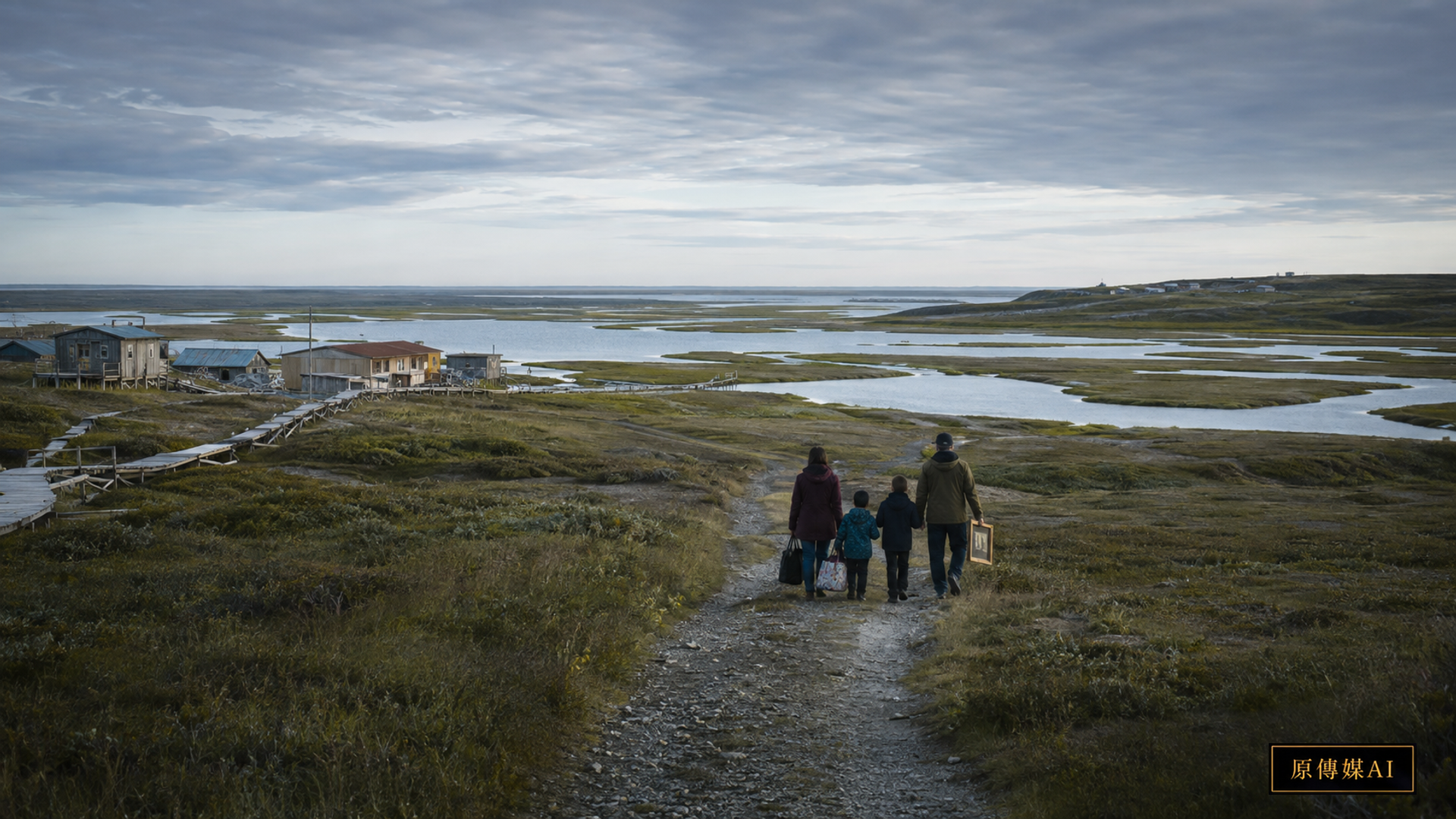
A community's decision to leave disaster-affected land does not mean it has stopped loving that place. In western Alaska's Kipnuk, relocation involves housing safety, food access, family connections and the next generation's future. Where an engineering plan shows two points, an old site and a new one, residents may see a network of relationships: relatives within walking distance, children's learning spaces, elders teaching local knowledge and the possibility of remembering home after departure.
The Alaska Institute for Justice's community page records severe floods in 2022, 2024 and 2025. Following the 2025 storm, extensive damage to homes, infrastructure and subsistence property led to evacuation; an overwhelming majority supported moving to higher ground. That account describes the organisation's record of conditions and community direction. It does not mean a new village is complete or that every resident feels the same way.
Historical assessments are not live forecasts
Alaska DCRA's historical hazard assessment identifies riverbank erosion, flooding and permafrost degradation as major risks. Its six-to-nine-feet annual erosion figure comes from earlier engineering assessments of particular stretches, not a current measurement across the entire settlement. Ground settlement and weakened foundations can interact with water and buildings. Repairing an individual home may not resolve the land's longer-term vulnerability.
Dates, locations and purposes therefore matter when interpreting evidence. Older reports can explain accumulating risk; recent engineering records can identify transport capacity being restored. Neither alone establishes that a candidate relocation site is fit for habitation. Routes, geology, drinking water, energy and maintenance require their own site-specific assessment.
A regional study offers methods, not Kipnuk's answer
An ASCE conference study published online on August 27 examines a relocating village of about 600 people in the Yukon–Kuskokwim Delta, considering how different knowledge systems inform infrastructure adaptation. The available abstract supports discussing protection, rebuilding and relocation alongside essential services. The accessible evidence does not establish that its village is Kipnuk or that its approach improved Kipnuk residents' mental health.
This distinction preserves the study's usefulness. Engineers and support professionals can ask together which hazards and time horizons a design compares, and whether residents' immediate priorities concern housing, mobility, schooling or dispersed families. Different priorities should be discussed openly. Community experience should not become an add-on after engineering decisions are complete.
Place attachment is more than a nostalgic photograph
This article's interdisciplinary interpretation is that a sense of place can emerge through continuing activities between people and their surroundings. Sharing meals, teaching children about waterways and helping relatives do not automatically resume when construction ends. Continuing those practices requires time, space, access and relationships. Local families and the community should determine which practices matter and how to sustain them.
Outside psychological professionals should not reduce Yup'ik relationships with place to a universal cultural model. Residents may anticipate safety, wish to return or feel both hope and loss. Supporting relocation does not prove emotional recovery, and valuing an old site does not mean denying danger. Judging adaptation by a single attitude can conceal practical support needs.
Map the life residents want to continue
One planning proposal is to devote part of community meetings to everyday journeys. Instead of showing only housing locations, invite people to describe their weekly destinations, companions, limits on independent movement and activities requiring elders or people familiar with the land. These journeys raise practical questions about accessible shared spaces, service hours and opportunities for mutual help.
This need not require a comprehensive cultural map. Residents should be able to describe functions without publishing sensitive sites, restricted knowledge, gathering locations or family matters. Access to resources should not depend on surrendering all knowledge to a public database. Planning teams should explain who uses records, what enters drawings and when renewed agreement is needed.
Support should go beyond asking whether someone will move
Psychologists and school social workers can begin with everyday functioning: children's routines, caregiver exhaustion, access to existing support networks and interrupted service transfers. Such questions may identify useful assistance more readily than a demand to choose between staying and leaving. Appropriate professionals should handle clinical assessments; uncertainty about relocation alone is not grounds for a diagnosis.
This is a service-design argument, not an experimentally validated relocation therapy. Residents can discuss practical difficulties without recounting every detail of a disaster. Children can express concerns in ways they choose without being filmed again for a project presentation. School transfers and referrals should identify receiving contacts so families need not retell their entire experience at every service.
Repair and relocation may both be necessary
Alaska's transportation department publishes recovery records for the 2025 storms. Each entry needs to be read for the communities, facilities and progress it concerns; regional totals should not all be attributed to Kipnuk. Essential transport and safety services remain necessary during relocation planning. Repairing facilities still in use need not reject the longer-term move.
A transparent proposal could distinguish immediate safety, transitional services and the future site, specifying each investment's useful life and potential reuse. Debate should examine who is affected if repairs are withheld, whether movable alternatives exist and whether short-term spending constrains future choices. These are proposed discussion methods, not completed local budget decisions.
Taiwan can learn from shared decision-making
Taiwan's Indigenous communities and Alaska differ in geology, land systems, housing and services. Permafrost risk cannot become a direct Taiwanese relocation criterion. The useful comparison concerns how decisions are made: can residents help compare options from the beginning, are care, schooling and cultural activities planned with roads and housing, and can sensitive local knowledge inform decisions without full disclosure?
Recovery also unfolds at different speeds. Housing delivery can have a clear date; visits, shared meals and mutual support may take longer to re-establish. Authorities can track service continuity while communities decide which changes in everyday life to record. Occupancy alone can conceal unfinished relationships, while discussion of culture alone can overlook basic water and transport responsibilities.
A safer home should accommodate existing relationships
Kipnuk suggests recovery need not reproduce pre-disaster life exactly, but should mean more than reaching another address. Safety and place relationships both deserve attention, with residents retaining decision-making power during change. New space cannot promise to erase loss, but thoughtful services and arrangements can reduce avoidable disruption.
When residents describe home, planners can ask what they hope to continue doing there and with whom. Answers may concern a safe path, space for shared meals or a distance that lets children see elders regularly. Bringing these needs to the same table as engineering requirements gives place a chance to remain somewhere people can live, remember and care for one another.
Make interim service commitments checkable
While a new site remains undecided or under construction, families may need dependable arrangements for the coming week. A short service record could identify contacts for transport, schooling, health services and family visits, separating confirmed provision from pending discussions and unavailable support. Residents should not have to infer their own prospects from an overall project completion percentage, and unanswered requests should not count as resolved.
Interim reviews can use times and formats residents can access, with room for different ages, mobility needs and household structures. When an arrangement cannot continue, an explanation, an alternative and the next response date should follow. Such commitments cannot remove every difficulty, but can reduce uncertainty repeatedly shifted onto families and assign responsibility for both long-term construction and present needs.
Sources and further reading
Role-Driven Inquiry
Yuan Media AI | Guided Questions by Role
Select a role first, then review the complete questions from that perspective; clicking a question will display Yuan Media AI’s response in real time.
Select a role
Displaced Yup'ik families and youth
Examine the article's evidence, governance boundaries, data rights, and actionable steps from the perspective of a Displaced Yup'ik families and youth.
Choose a question
AI use and content-safety disclosure
AI-assisted illustration and English translation. Proposed applications are distinguished from documented results.