Physics Meets AI: Leeds Identifies Nearly 800 Plant Proteins Worth Testing as Emulsifiers
Original Chinese title: 不用把植物蛋白一個個拿去試:Leeds 把統計物理接上 AI,一次找出近 800 個可能當乳化劑的候選
Leeds researchers combine protein sequences, statistical physics and machine learning to prioritise emulsifier experiments. Nearly 800 predicted candidates are not a list of approved, market-ready ingredients.
鄭淑禎|實踐大學專任助理教授;鍾靜蓉|台科大數位教育博士
A salad dressing contains a molecular problem
Oil and water often separate again after mixing. Emulsifiers help stabilise their interface so dispersed droplets are less likely to join together. This common function in food and household products is not easy to infer from appearance. Searching for plant alternatives raises a large practical question: which proteins deserve laboratory attention first?
Research introduced by Leeds on September 3 links protein sequences, statistical physics and machine learning to identify nearly 800 potentially useful plant proteins. That number describes a candidate space, not 800 ingredients already shown to be safe, affordable, stable and market-ready. Its value is to direct further validation.
Physics and data selection come before AI
The Communications Chemistry study builds a selection process from UniProt data, obtaining 1,950 experimentally reviewed plant protein sequences and combining self-consistent field theory with machine learning to examine interfacial adsorption. This is a computational workflow grounded in existing sequences and a defined physical problem, rather than a conversational model inventing recipes.
Experimentally reviewed describes the sequence records, not proof that each protein has undergone emulsification tests. Selection criteria determine inclusion and omission. The candidate list is not a complete ranking of every plant protein, and omission does not demonstrate a lack of function.
Different protein segments matter
Proteins consist of amino acids whose segments can interact differently with water, oil and surfaces. The study considers how segment characteristics affect the adsorbed configuration instead of assigning one average property to the entire sequence. Arrangement and combined action at the interface become part of the question.
For a general analogy, the same team members can perform differently when positioned differently. That is an explanatory comparison, not the study's calculation. Predictions involve more complex conditions and must retain their assumptions; AI does not remove the physical limitations.
Limited experiments support a direction, not every candidate
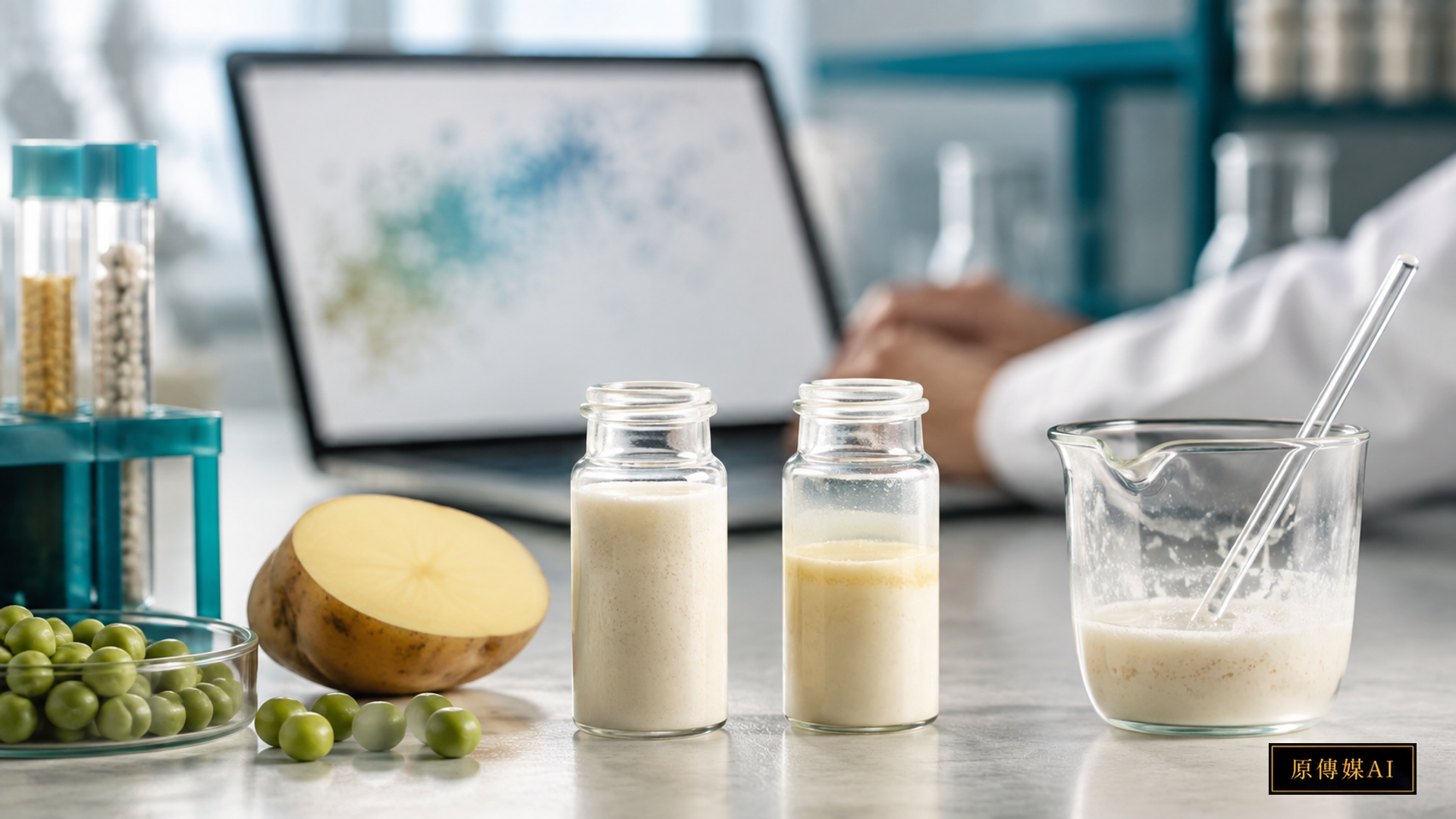
Leeds describes checks using selected commercial proteins, including pea and potato proteins whose emulsifying behaviour supported the research direction. That is a different evidence base from testing all the nearly 800 candidates. Limited experiments can assess usefulness without giving untested proteins an equivalent guarantee.
The paper also relates applicability to adsorption in which conformational flexibility matters and to its chemical denaturation conditions. Moving to a food formulation therefore requires checking compatibility with processing. Performance under the study's treatment does not establish equivalent behaviour at every acidity, temperature or manufacturing condition.
Open data supports more detailed questions
The research provides code and an associated dataset. The Leeds repository identifies data underlying main and supplementary figures, with licensing and deposit information. Other researchers can trace evidence behind plots rather than rely only on a headline total. Deposit, revision and publication are separate events, so earlier data availability is not a contradiction.
For reproducibility, this article proposes retaining data versions, selection criteria, parameters and experimental treatments. Additional sequences should be checked against the original scope. Different results may arise from inputs, models or experimental conditions. Open code lowers the starting barrier without replacing understanding or independent interpretation.
A functional candidate is not yet a food ingredient
In practical development, flavour, colour, solubility, processing tolerance, storage and supply consistency also matter. Forming an emulsion in an experiment is different from preserving product quality through transport and storage. Emulsifying performance cannot substitute for safety assessment, and plant origin does not establish suitability for every consumer.
A small business can use candidate ranking to organise trials, beginning with traceable sources, feasible processing and plausible supply. Preserve unsuccessful results and reasons to stop instead of showing only the strongest sample. Savings come from identifying unpromising directions earlier, not omitting necessary quality and safety work.
Plant origin does not automatically establish lower emissions
Plant proteins may serve sustainable-material goals, but this study does not provide a life-cycle assessment for every candidate. Cultivation, fertiliser, water, extraction, drying, transport and processing can all affect environmental burdens. High energy requirements to isolate a small quantity of functional protein could change the comparison.
A proposed environmental comparison should use an equivalent function, such as the amount and processing needed to meet the same stability requirement, rather than one kilogram of ingredient alone. By-product use also requires reliable supply, impurity control and attention to seasonal quality. These questions make sustainability claims more testable.
Farmers know more than ingredient names
Databases represent plants through species and sequences, while farming also involves seasons, growing conditions, harvesting, local uses and processing practices. Batches and treatments may differ even under the same protein label. Ignoring supply conditions while prioritising model scores can make production difficult to sustain.
Farmers, processors and researchers could jointly define quality records, responsibilities and commercially or culturally sensitive information. New demand should prompt discussion of prices, risks and returns rather than specifications alone. Field knowledge can reveal conditions a model misses; it should not be reduced to a free ingredient-data field.
A candidate list does not authorise use of Indigenous knowledge
The Leeds study did not investigate Taiwanese Indigenous plants or authorise collecting or commercialising local resources. This discussion concerns potential future research boundaries, not an existing collaboration with Taiwanese communities. Public sequence availability does not make cultural uses, collection sites or family techniques public by default.
A future partnership can distinguish public scientific information, community-provided knowledge, material sources and uses of results. Different information may require different agreements and returns. A single signature should not be presumed to cover every future purpose. Collaboration informed by Two-Eyed Seeing should let knowledge holders understand the work and retain room to decline particular uses.
A model's value is to improve the next experiment
The study connects searching, physical mechanisms and observations in a traceable workflow, reducing reliance on undirected screening. Its useful result is a clearer set of next questions: where predictions fail, which treatments work and whether performance survives a real formulation.
For consumers, nearly 800 candidates indicate research progress rather than a safety label. For businesses, they guide validation rather than replace it. For farmers and knowledge holders, they may open collaboration rather than announce unrestricted access to resources. Making these limits clear helps AI-assisted science move toward dependable everyday materials.
Set success criteria before testing
A business assessing a candidate protein could first specify the required acidity, processing temperature, shelf life and acceptable separation, then choose sampling and comparison methods. Retain the existing formulation as a reference and document ingredient batches and procedural differences. Selecting the most attractive vial cannot establish superiority. Keep model scores separate from formulation results to reveal conditions in which predictions fail.
An unsuccessful test can still guide the next question: did the source differ, did processing damage the relevant function, or was the target formulation unsuitable? Researchers and businesses can agree what results to share, what details remain confidential and when to stop adding costs. Gradually narrowing uncertainty is the practical value candidate searching can bring to development.
Sources and further reading
Role-Driven Inquiry
Yuan Media AI | Guided Questions by Role
Select a role first, then review the complete questions from that perspective; clicking a question will display Yuan Media AI’s response in real time.
Select a role
Food and colloid science researcher
Examine the article's evidence, governance boundaries, data rights, and actionable steps from the perspective of a Food and colloid science researcher.
Choose a question
AI use and content-safety disclosure
AI-assisted illustration and English translation. Proposed applications are distinguished from documented results.