The Lakebed's Microbial Backup Is Thinning: 144 Aotearoa Lakes Suggest Eutrophication Can Reduce Ecological Insurance
Original Chinese title: 湖底的「備援微生物」正在變薄:144 座 Aotearoa 湖泊顯示,優養化不只讓水變綠,也可能讓生態系少一層保險
A Nature Communications study of surface-sediment metagenomes from 144 lakes across Aotearoa New Zealand found that eutrophication can narrow the range of microbial taxa capable of performing the same ecological functions. Some pathways remain supported by abundant specialists, but overall functional backup may become thinner and less resilient to disturbance.
雙向知識實驗室
A cross-disciplinary team focused on Indigenous knowledge, data sovereignty, cultural governance and artificial intelligence applications.
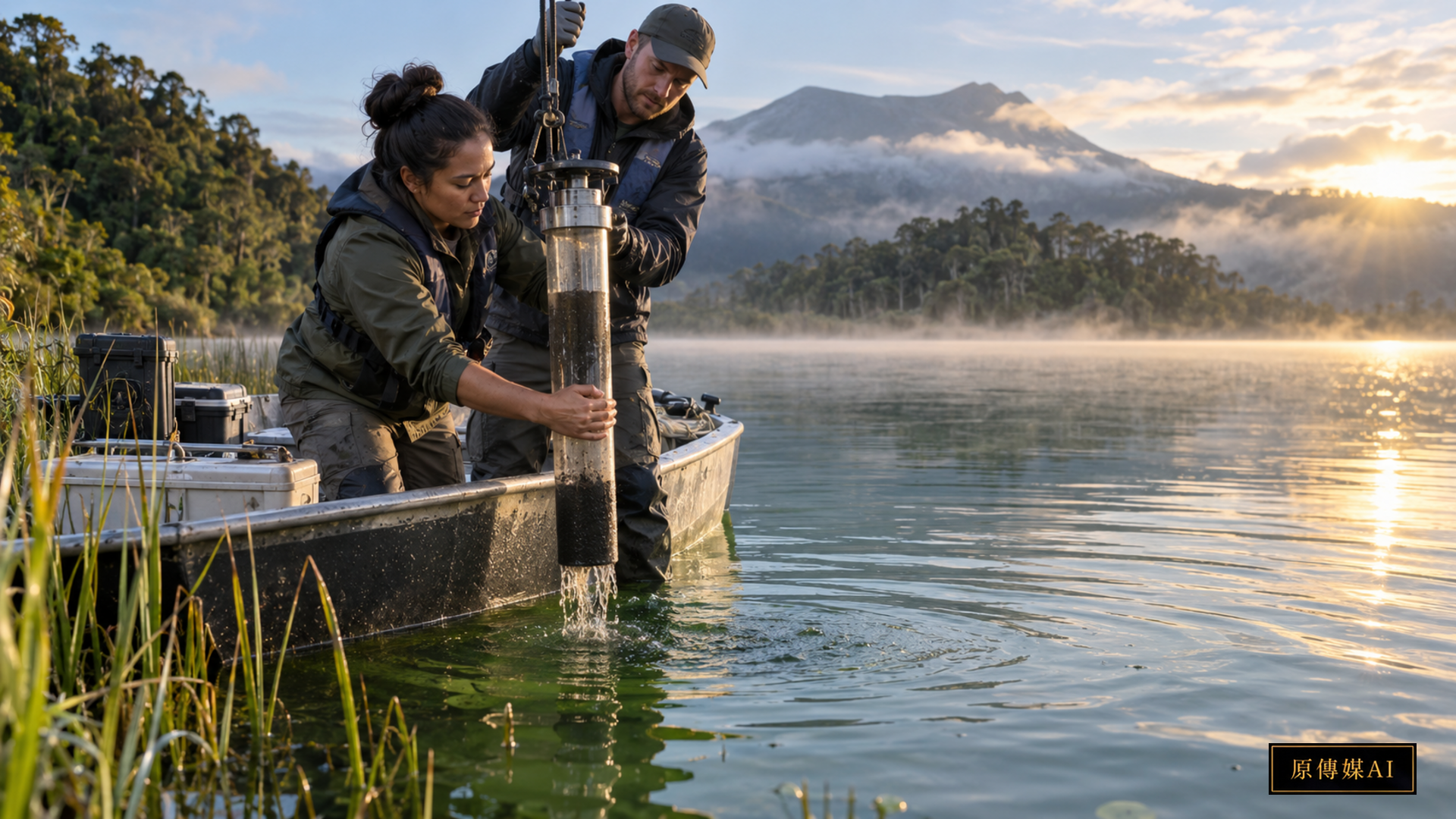
Green water is only the visible layer of eutrophication
When people hear the word eutrophication, they often think first of algal blooms, odour, oxygen depletion and fish mortality. Those are important warning signs, but nutrient cycling in a lake does not happen only in the water column. Bacteria and other microorganisms in bottom sediments continuously process nitrogen, phosphorus, sulfur and carbon. This hidden biochemical system depends not only on how many microorganisms are present, but also on how many different groups can perform the same essential task.
A study published in Nature Communications on September 7, 2026 analysed surface-sediment metagenomes from 144 lakes across Aotearoa New Zealand, spanning a broad gradient from low-nutrient to highly eutrophic conditions. The researchers found that taxon-based functional redundancy declined as eutrophication increased. In other words, fewer distinct microbial groups were available to perform the same metabolic functions. A system can still appear to work under ordinary conditions, while having fewer alternatives available if a dominant group is disrupted.
Functional redundancy is ecological insurance, not biological waste
The word “redundancy” can sound as if several organisms are doing unnecessary duplicate work. In ecology, however, redundancy can act like insurance. If ten different microbial taxa can carry out a critical nitrogen transformation, losing two or three of them during a heat event, toxic exposure or oxygen shift may still leave other groups capable of maintaining the process. If only a few taxa carry most of the function, the same disturbance can have a larger effect.
The study separated two related ideas. Taxon-based redundancy asks how many different taxa possess a given function. Abundance-based redundancy asks how abundant the organisms capable of that function are within the community. The two measures do not have to move in the same direction. Eutrophication may narrow the number of taxa while allowing a smaller number of nutrient-tolerant groups to become very abundant.
The 144-lake dataset shows that different pathways respond differently
One of the study's most useful findings is that abundance-based redundancy did not respond uniformly across metabolic pathways. Processes associated with nitrification and denitrification could show greater abundance-based redundancy under more nutrient-rich conditions, while redundancy associated with phosphorus transport could decline. That means “microbial function” cannot be compressed safely into a single universal indicator.
For lake managers, this distinction matters. A total bacterial count or a single diversity index may look reassuring while one specific ecological function is becoming more dependent on a narrow set of organisms. Nitrogen cycling may retain many abundant performers while phosphorus-related functions become concentrated in fewer taxa. A later oxygen crash, heatwave or pollution event may therefore affect the recovery of different processes in very different ways.
Why eutrophication can narrow the pool of functional performers
Eutrophication is often connected to activities across the catchment: agricultural nutrient losses, wastewater, urban runoff, changes in wetlands and broader land-use pressures. Additional nutrients alter oxygen conditions, sediment chemistry, algal deposition and the availability of organic matter. As the environment changes, some microbial groups gain a competitive advantage while others become less common.
This does not mean every nutrient-rich lake converges on exactly the same microbial community. The important point is that persistent environmental pressure can act as a filter, leaving a narrower set of organisms carrying particular functions. Metagenomics makes that invisible restructuring measurable and gives managers another way to think about lake stability beyond water colour or chlorophyll alone.
A functioning ecosystem is not automatically a resilient ecosystem
A eutrophic lake may still complete nitrogen transformations today. That does not prove that the same process will remain stable during a future heatwave, contamination event or abrupt water-level change. Declining functional redundancy is best understood as a thinning insurance pool: there may be no immediate collapse, but the system may have fewer substitutes when an additional disturbance arrives.
The Nature Communications paper therefore uses appropriately cautious language, describing changes that could potentially compromise the ability of microbial communities to sustain key metabolic processes. The research does not prove that any specific lake is destined to fail. It shows a structural change in functional potential that provides a scientifically grounded reason to investigate resilience more closely.
Metagenomics shows what organisms may be able to do, not exactly what they are doing now
Metagenomic analysis can identify functional genes within a microbial community and infer which taxa possess particular metabolic capabilities. The presence of a gene, however, does not show that the gene is active at a particular moment or that a process is occurring at a specific rate. Transcriptomic measurements, chemical fluxes, dissolved oxygen, nutrient concentrations and field experiments may still be needed to understand current activity.
The 144-lake dataset is therefore especially useful as a large-scale map of functional potential and redundancy. It can support hypotheses, identify lakes or pathways that deserve closer monitoring and help design follow-up studies. It should not replace direct water-quality and ecological observations.
Lakes are not isolated bowls of water
Many eutrophication pressures begin outside the lake. Fertiliser runoff, livestock, roads, wastewater systems, wetland loss and river transport can all change the amount and timing of nutrients entering a water body. Removing an algal bloom from the surface without reducing catchment inputs leaves the sediment microbial community exposed to the same altered chemistry.
Restoration therefore needs to connect source control, water-column conditions and sediment function. Microbial data can help identify processes that deserve attention, but the broader management goal remains to bring nutrient loading and ecological conditions back into a range the whole catchment can sustain. New Zealand's Ministry for the Environment similarly identifies excess nutrients as an important pressure on freshwater ecosystems and emphasises the need to understand long-term changes across catchments.
Why the Aotearoa setting deserves careful attention
The study covered 144 lakes and acknowledged the regional authorities, landowners and iwi who supported sampling, access and guidance. That matters because national-scale ecological datasets do not emerge from laboratory work alone. Every sample depends on access, relationships, local context and responsibilities associated with place.
At the same time, the microbial measurements should not simply be relabelled as Indigenous knowledge. Metagenomic analysis is a scientific measurement method; iwi and landholders can have substantive roles in access, place-based interpretation, research relationships and governance. Those forms of knowledge and authority can work together without being collapsed into one another.
Taiwan can use the concept without copying New Zealand's numbers
Taiwan's reservoirs, irrigation ponds, alpine lakes and coastal lagoons differ from the 144 New Zealand lakes, so the measured redundancy values should not be transferred directly. The management concept, however, is useful. When water quality changes over years, managers can ask not only whether pollution concentrations are falling, but also whether critical ecological functions are becoming increasingly dependent on a small number of microbial groups.
For watershed governance in Indigenous regions, future microbial monitoring could be linked with existing water quality, land-use, seasonal, algal and fish-community records rather than creating a costly stand-alone genetic database. Sampling questions can also be discussed in relation to drinking water, fishing, irrigation and culturally important uses so that monitoring begins with a clear public purpose.
Artificial intelligence is most useful as a cross-layer anomaly detector
A single lake may have years of water-quality measurements, satellite imagery, weather records, land-use maps, metagenomic data and human inspection notes. Artificial intelligence can help identify combinations that changed together: for example, nutrient increases followed by a rapid decline in redundancy for a particular pathway, or algal blooms that coincide with sediment oxygen depletion. Such systems can prioritise hypotheses and inspections, but they cannot replace causal verification.
A useful system should preserve traceability to each sample: which lake, which date, what depth and which laboratory batch. A black-box “lake health score” would hide the complexity that managers need to see. For public governance, a transparent chain back to the original observation is more valuable than a visually impressive number.
The same lake can look different during wet and dry seasons, stratification and turnover, or after a major storm. A single sample collected after an unusual event should not be treated as a long-term trend. Repeated sampling, event logs and catchment change records are needed to determine whether a shift in functional redundancy persists.
This is especially important if managers use artificial intelligence to rank risk. Models trained on sparse or uneven samples may interpret sampling timing as ecological change. The safest design is to keep uncertainty visible, record what is missing and use model output to decide where to measure next rather than to issue an automatic ecological verdict.
Before the water looks better, remember the lakebed is still carrying pressure
Eutrophication programmes often measure success through visible improvement: fewer blooms, clearer water and less odour. Those outcomes matter. The 144-lake Aotearoa study adds another layer to the idea of resilience: how many different organisms remain capable of sustaining the ecosystem's key functions.
“Thinning backup” is not a prediction of collapse. It is an earlier risk language. It lets managers ask, while the system is still functioning, what will happen if the next heatwave, oxygen loss or pollution event removes some of today's dominant performers. Used carefully, functional redundancy can help decide where seasonal monitoring, catchment source investigation and restoration effort should be intensified without turning a new molecular metric into a new form of overdiagnosis.
Main sources
Role-Driven Inquiry
Yuan Media AI | Guided Questions by Role
Select a role first, then review the complete questions from that perspective; clicking a question will display Yuan Media AI’s response in real time.
Select a role
Watershed and lake manager
Examine the article's evidence, governance boundaries, data rights, and actionable steps from the perspective of a Watershed and lake manager.
Choose a question
AI use and content-safety disclosure
This English version is AI-assisted and editor-reviewed in the Yuan Media AI workflow. Documented research findings are kept separate from proposed applications and governance implications.