An Earlier Harvest Is Not Always Good News: Europe's Heatwaves Are Moving Wheat and Maize Seasons Forward
Original Chinese title: 收成提早,不一定是好消息:歐洲熱浪把小麥、玉米的季節往前推,農業開始重新讀「成熟」這件事
Repeated European heatwaves and water deficits in 2026 have pushed crops toward earlier maturity and shortened grain filling in some regions. An earlier harvest can therefore arrive with yield and quality risks; the important question is how heat, rain, soil moisture and crop stage are changing the farmer's decision clock together.
原傳媒AI 編輯室
Yuan Media AI Editorial Desk focuses on technology governance, cross-disciplinary research, public services and applications relevant to Indigenous communities.
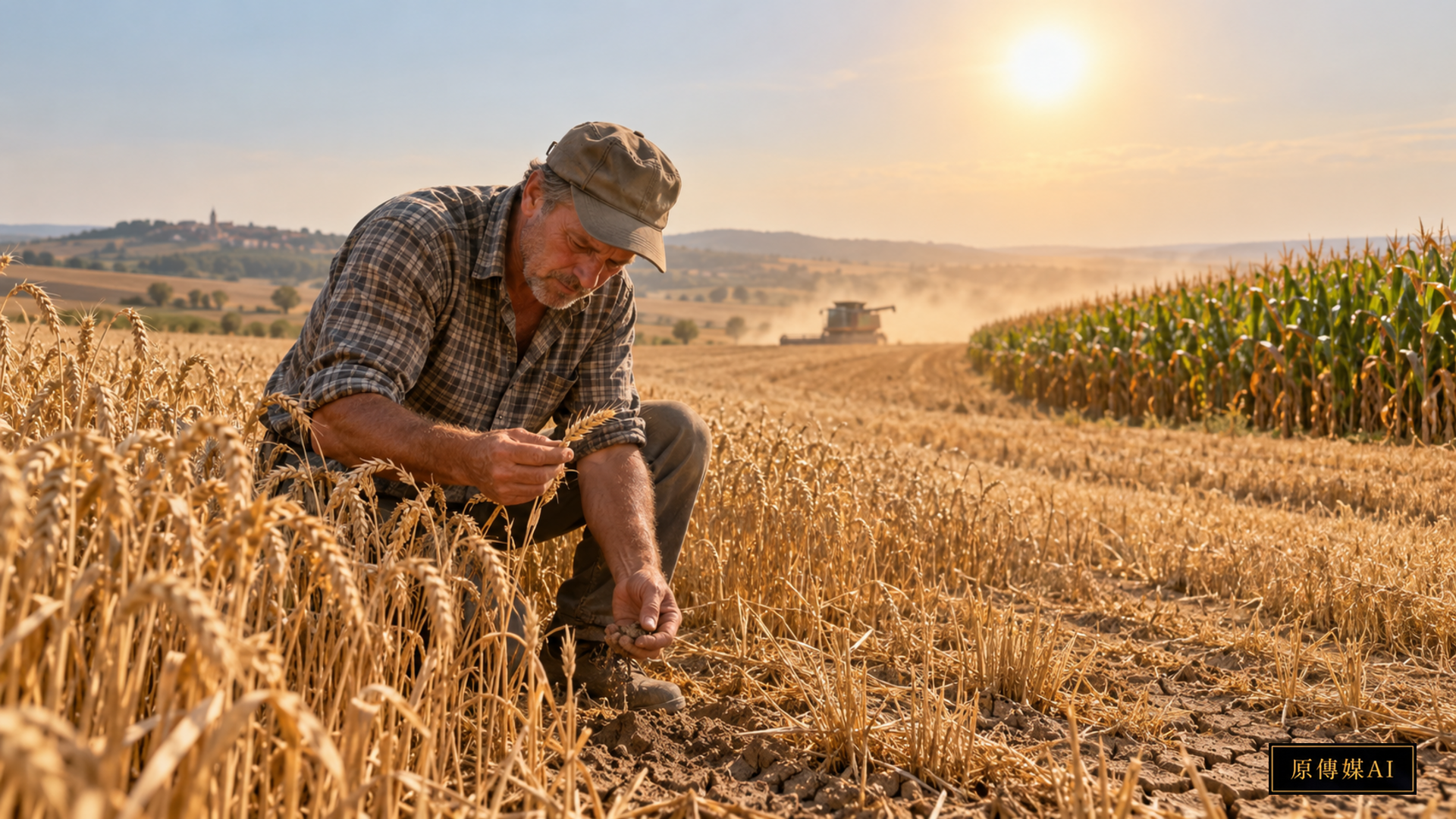
An earlier harvest can look like greater efficiency at first glance
If winter wheat in the same field reaches maturity sooner than it used to, a farmer may start the combine earlier. On a calendar, that can look like being “ahead of schedule.” Crops, however, are not factory production lines. Earlier maturity may result from moderately warmer conditions and strong growth, but it can also reflect heat compressing the growing period, shortening grain filling, or forcing plants into early senescence under water stress. Both situations can be written down as an “early harvest,” while their agricultural outcomes may be completely different.
Europe's repeated heatwaves and drought episodes in 2026 have made that distinction more visible. The European Union Joint Research Centre (JRC) reported in its July and August MARS Bulletins that heat and water deficits accelerated senescence and maturity in some winter crops while also weakening pollination, grain formation and biomass accumulation in summer crops. The lesson is that an advance in phenology cannot be judged only by the number of days. We also need to ask whether the crop completed the physiological processes required for a good harvest.
A crop's clock is more than a calendar
Farmers often organise field work around sowing, flowering and maturity dates, but inside the plant the process is closer to a clock that accumulates heat and responds to environmental signals. Many crops move through developmental stages as effective heat units accumulate. When average temperatures rise, the number of calendar days needed to reach a threshold may shrink. The problem is that warmer is not always better. Above a crop's suitable range, respiration losses, pollen viability, grain filling and leaf longevity can all be impaired.
“Heat accumulates faster” therefore does not mean “growth quality improves.” Wheat exposed to excessive temperatures during grain filling may appear to mature sooner while kernels have less time to fill. Maize exposed to heat and water stress around flowering and pollination can turn yellow quickly later without delivering a good yield. That is why agricultural meteorology needs to read crop stage and water conditions together.
What the JRC saw in 2026 was a chain of effects
The JRC's July MARS update described repeated heatwaves and limited rainfall across parts of western and central Europe, with continuing declines in soil moisture. Some winter and spring crops showed premature maturity, requiring earlier harvest and raising concern about grain size and quality. In August, the JRC again reported that persistent high temperatures and unusually large moisture deficits across broad areas of western and central Europe were worsening prospects for summer crops, with effects including reduced fertility, impaired grain filling and early senescence.
These observations should not be reduced to a claim that “all European crops moved twenty days earlier.” Countries, latitudes, varieties, sowing dates, irrigation practices and soil conditions vary widely. Longer time-series reporting for particular crops and regions can provide background evidence that maturity and harvest calendars are shifting, but farmers still need local, current field and weather data for actual decisions.
One cost of moving earlier is a shorter grain-filling period
For cereals, the period between flowering and maturity is not empty time while farmers simply wait for the crop to turn yellow. It is when kernels accumulate starch, protein and dry matter. Heat can speed development while increasing respiration losses. If grain filling is compressed, plants have less time to fill kernels, which may lead to lower grain weight, altered quality or uneven maturity.
This is also why a yellowing NDVI signal or a visible colour change in the field is not enough to judge harvest quality. Remote sensing can quickly show vegetation change, but it needs to be checked against ground samples, variety information, soil moisture and phenological records. A crop may turn yellow because of normal maturity, disease, drought or heat-driven senescence; imagery alone does not automatically tell us which explanation is correct.
Maize is more difficult because its critical window is concentrated
Heat and water stress around tasselling, silking and pollination can have a major effect on maize yield. JRC observations in 2026 repeatedly noted that some areas experienced severe water deficits while summer crops were flowering and beginning grain formation. Losses in this reproductive window cannot necessarily be repaired by a later rainfall event because the critical stage has already passed.
When a farmer hears that a crop is “running early,” the next question is therefore which stage has moved. If warmer conditions after sowing supported smooth early development, management options may differ from a situation in which high temperatures force rapid late-season senescence. In the second case, harvest quality, feed value, storage and the timing of the next crop all need to be assessed together.
Agricultural resilience is shifting from “average climate” to “critical windows”
Climate adaptation has often been described through annual average temperature or annual rainfall. Crops, however, are often most sensitive during short periods: germination, flowering, pollination and grain filling. The same annual rainfall can produce very different outcomes if it falls outside the period when water is needed. The same mean temperature can create different losses if the season includes several short, intense heatwaves.
Agricultural public services therefore need more precise answers to the question “which week?” Weather forecasts, technical guidance from agricultural research and extension stations, and local farmers' association alerts are more useful when matched to varieties and growth stages than when they merely say “this month will be warmer.” Future agricultural risk maps should overlay the crop clock with the climate clock.
Mountain agriculture and small farms in Taiwan should not copy European dates directly
Taiwan's rice, grains, fruit trees and high-mountain vegetables have different varieties, growing seasons and environments from European cereals. Earlier maturity in Europe cannot be used to infer that Taiwan will move in the same direction by the same amount. The transferable lesson is methodological: align long-term phenology records, field observations, weather-station data and remote sensing, then watch how flowering, maturity and quality change together.
Small farms do not need an expensive system before they begin. A few stable fields already create value: sowing or transplanting date, flowering or heading date, first harvest date, major quality indicators, and notable extreme-heat or water-deficit events. After five or ten years, those records can support variety and planting-date decisions far better than the memory that “this year felt earlier.”
Artificial intelligence can find shifts; it should not issue verdicts for farmers
Artificial intelligence is well suited to finding anomalies across years of photos, weather and field records: how many days earlier the same variety developed this year, which temperature period coincided with a drop in quality, or which plots lost greenness rapidly after a heatwave. But correlation produced by a model is not causation. It must be interpreted together with farmer experience, crop physiology and ground measurements.
Data are often sparse in Indigenous communities and mountain areas, which is another reason not to let a model automatically fill gaps. A useful system can say “insufficient data” and list the points that need field confirmation. A good agricultural AI tool does not deepen dependence on a black box; it focuses limited field-inspection time on places genuinely worth checking.
Turn field logs into a common language for comparison
What helps detect risk early is not always the most expensive sensor, but continuous records that can be compared over time. If farmers' associations, agricultural research and extension stations, or cooperatives build shared datasets, they should at minimum use consistent fields for date, variety, growth stage, irrigation status and quality indicators while retaining farmers' own written notes. When the next heatwave arrives, that makes it possible to compare the same variety at the same stage across different fields instead of relying on one county-wide average map.
Data sharing also needs boundaries. Field locations, yields and cultivation methods can involve commercial or personal information and should not become public simply because AI is being used. A more practical design tells farmers which data remain private, which can be aggregated anonymously and which may be used for research. When a model recommends sowing or harvest timing, it should also show which years of records informed the recommendation and what is missing. Clear provenance helps prevent a heat response from one region being imposed on a valley with a very different microclimate.
“An early harvest” should be broken back into four questions
When a report says maturity is earlier, ask four things first. Which crop, variety and region? Which developmental stage moved? What were the heat, water and soil conditions at the time? What finally happened to yield and quality? Only when those questions can be answered is it reasonable to discuss adaptation.
Europe's 2026 experience is not a climate script that can be pasted onto Taiwan. It is a warning that climate change is altering agriculture's sense of time. Farm calendars, seasonal knowledge, variety choices, irrigation schedules, labour crews and harvesting machinery may all need to be resynchronised. Resilience does not mean chasing every earlier date. It means helping farmers understand earlier why something changed and when action is actually needed.
Main sources
Role-Driven Inquiry
Yuan Media AI | Guided Questions by Role
Select a role first, then review the complete questions from that perspective; clicking a question will display Yuan Media AI’s response in real time.
Select a role
Smallholder farmer and farm manager
Examine the article's evidence, governance boundaries, data rights, and actionable steps from the perspective of a Smallholder farmer and farm manager.
Choose a question
AI use and content-safety disclosure
This English version is AI-assisted and editor-reviewed in the Yuan Media AI workflow. Documented observations are kept separate from proposed applications and management implications.