The 4.5 Kilograms of Silver May Not Be the Most Important Part: Why Two Birch-Bark Containers Could Matter More Than the Hoard
Original Chinese title: 4.5 公斤白銀不是最稀奇的:芬蘭最大維京時代銀幣窖藏,為什麼那兩只樺樹皮容器可能更重要?
The weight of the Sysmä silver hoard draws attention, but birch-bark containers and archaeological context may reveal more about packing, deposition and exchange; coin counts, chronology and depositor identity remain under study.
王振庭
A natural-science education teacher focused on science education, curriculum design, AI education, media literacy and children’s questioning and scientific literacy in technological environments; consulting committee member: 莊溪, creator of the Recognizing Plants website and recipient of an education dedication award.
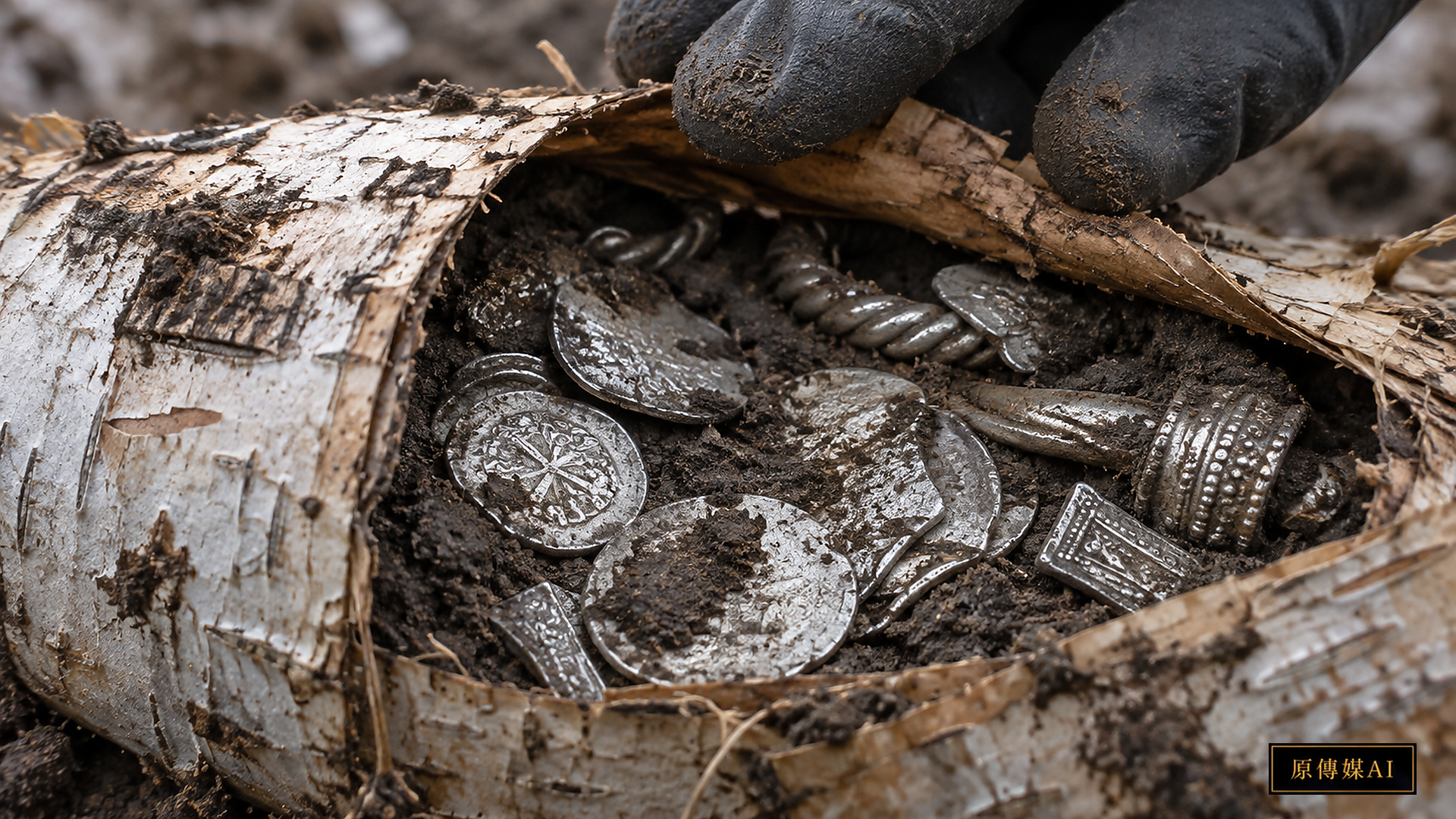
If we see only 4.5 kilograms of silver, we may miss the most important archaeological evidence
A silver hoard recently found at Sysmä, Finland, has attracted attention. Yle reports that a metal-detector enthusiast discovered many silver coins, bracelets and other silver objects weighing about 4.5 kilograms in total. The find may become Finland’s largest known Viking Age or Late Iron Age coin hoard. That makes a compelling treasure story, but archaeology reduced to counting coins, weighing metal and estimating price can excavate away the history that matters most.
The silver did not sit neatly in a metal chest. Remains of birch-bark containers were found with it, and the material came from two locations. Birch bark normally decays in soil, so recognizable remains are rare evidence. They may help researchers understand how the silver was packed, grouped, moved and deposited. The question then expands from “What is this money?” to the more human question of how someone handled the property.
Discovery is not archaeology’s greatest danger; destroying context after discovery is
Metal detectors let non-specialists locate coins, weapons and ornaments underground, creating both opportunity and risk. Archaeological information resides not only in objects but in position, depth, soil layer, distance and surrounding material. Enlarging a hole, removing every coin or brushing away soil to “finish” the find can destroy relationships preserved for centuries within minutes.
The Finnish Heritage Agency therefore tells finders to report archaeological objects, stop disturbing the site and preserve the location. This rule deserves public understanding. Heritage law is not simply designed to take treasure away; it protects context.
One coin may indicate a mint and an approximate date. Coins found with birch bark, soil and silver ornaments may show how wealth accumulated, when it was hidden, whether more than one deposit was involved, and whether exchange or crisis formed part of the story. The answers lie in relationships among objects, not in the weight of silver alone.
Why might two containers be more revealing than thousands of coins?
If two groups of silver were indeed placed in separate birch-bark containers some distance apart, researchers will compare their deposition dates, coin composition, ratio of ornaments and container construction. Different dates and sources could suggest staged accumulation or distinct uses; strong similarity could suggest deliberate dispersal.
Archaeology should preserve the possibility of answering such questions before choosing an answer. Until the coins have been fully conserved, sorted and identified, the exact count, date range and networks of origin may change. Possibility must not be reported as proof.
Media education matters here. Scientific literacy is not memorizing that Finland found 4.5 kilograms of silver. It is asking what is confirmed, what comes from a news report and what can be established only after conservation and analysis. This is where science education and media literacy meet archaeology.
The Viking world was not the single-route “pirate world” of film
Late Iron Age and Viking Age silver could move through wide exchange networks encompassing Scandinavia, the Baltic, Europe and regions farther away. A coin found in one place does not mean its maker or user came from there. It may have changed hands, been cut, weighed and recombined many times.
Numismatics therefore needs archaeological context. Inscriptions and designs can trace mints, and composition can provide another line of evidence, but the way an object was used at Sysmä still depends on site data.
This is a clear Two-Eyed Seeing problem. A detector suggests where metal lies; numismatics asks where a coin was struck; archaeology studies what accompanied it and how it was deposited; local history may add land use and earlier discoveries. No single tool can complete the story.
Citizen finders are not archaeology’s enemy, but neither are they a free excavation crew
Finland’s Ilppari reporting system reflects a changing model of heritage governance. A metal-detector user is not necessarily destructive. With clear rules, location records, reporting and cooperation, enthusiasts can become part of a broader discovery network.
Cooperation depends on distinct responsibilities. A finder stops, records and reports. Professional archaeologists control excavation and conservation. Museums and researchers clean, catalogue, date and analyze origin. If everyone treats finding objects as the endpoint, heritage becomes merchandise; if authorities treat every citizen as a likely offender, important discoveries may go unreported.
A good system does not eliminate public participation. It teaches participants when to stop.
Birch bark is also a history of technology
Birch bark is inexpensive, but northern communities have long used it for containers, wrapping and everyday tools. The hoard therefore presents a striking contrast: valuable silver was held in an ordinary and accessible organic material.
Such everyday materials preserve less readily than metal and are easily overlooked during excavation. Yet they show that ancient technology was not limited to weapons, jewelry and coinage. Containers, ropes, wood, leather and plants supported daily life.
That is where consulting committee member 莊溪’s work on plants and education is relevant without forcing plant knowledge into Viking history. Plant material in archaeology can preserve evidence of technology, environment and everyday life. Birch bark is not background decoration; it may be one reason the arrangement of the silver can still be studied.
Can AI count coins? Yes, but it cannot replace object identification
Image recognition may help sort large numbers of coins stuck together, corroded or covered by soil. It can compare motifs and group similar candidates, but heritage images are not a clean training set. Reflection, corrosion, missing fragments, dirt and viewing angle all create errors.
AI is better used for candidate classification: grouping objects that may share a type, flagging anomalies for human review and preserving the source photograph behind every suggestion. Formal conclusions about date, mint and authenticity still belong to numismatists and conservators.
A wrong coin classification is not merely a retail error. It can distort chronology and interpretations of an exchange network. Archaeological AI therefore needs traceability, not just a confidence score.
Conclusion: context is the real treasure
The weight of the silver gives news reports a vivid headline; two birch-bark containers give research a set of questions. They remind us that archaeology does not mean extracting the most valuable object. It preserves relationships so that future investigators can understand the past.
Scientific literacy does not mean assuming that the phrase “Finland’s largest” completes the story. Coin counts will be confirmed, dates refined, origins analyzed and containers studied for new evidence.
A mature account can preserve the delight of discovery while showing that “not yet known” has value. Archaeology’s greatest loss would not be one overlooked coin, but the destruction of the context needed to answer a question.
Yuan Media AI | Continue by role
- Citizen metal-detector finder: Which actions most easily destroy archaeological context after a discovery?
- Regional museum archaeologist or conservator: How should fragile organic material such as birch bark be sampled, stabilized and analyzed?
- Numismatist or Viking exchange-network researcher: How far can we infer from a coin’s origin to the history of its deposition site?
- Cultural-heritage law or public-collection manager: How can citizen discovery, reporting and professional archaeology cooperate rather than exclude one another?
Sources
Role-Driven Inquiry
Yuan Media AI | Guided Questions by Role
Select a role first, then review the complete questions from that perspective; clicking a question will display Yuan Media AI’s response in real time.
Select a role
Metal-detecting citizen finder
Examine the article's evidence, governance boundaries, data rights, and actionable steps from the perspective of a Metal-detecting citizen finder.
Choose a question
AI use and content-safety disclosure
This English edition is an AI-assisted translation of the supplied Chinese feature, checked for source parity and evidence boundaries.