Biology’s Next Bottleneck May Not Be a Lack of Data, but Data That Cannot Talk to One Another
Original Chinese title: 生物學下一個瓶頸不是「沒有資料」,而是資料彼此不會說話:NSF 用 2,000 萬美元押注「生命韌性資料合成」
NSF’s investment in organismal-resilience synthesis shifts attention from collecting more data to integrating provenance, scales and rights; AI can help connect evidence but cannot replace domain judgment or governance.
雙向知識實驗室
The Two-Eyed Seeing Lab centers Indigenous knowledge, data sovereignty, cultural governance and AI applications.
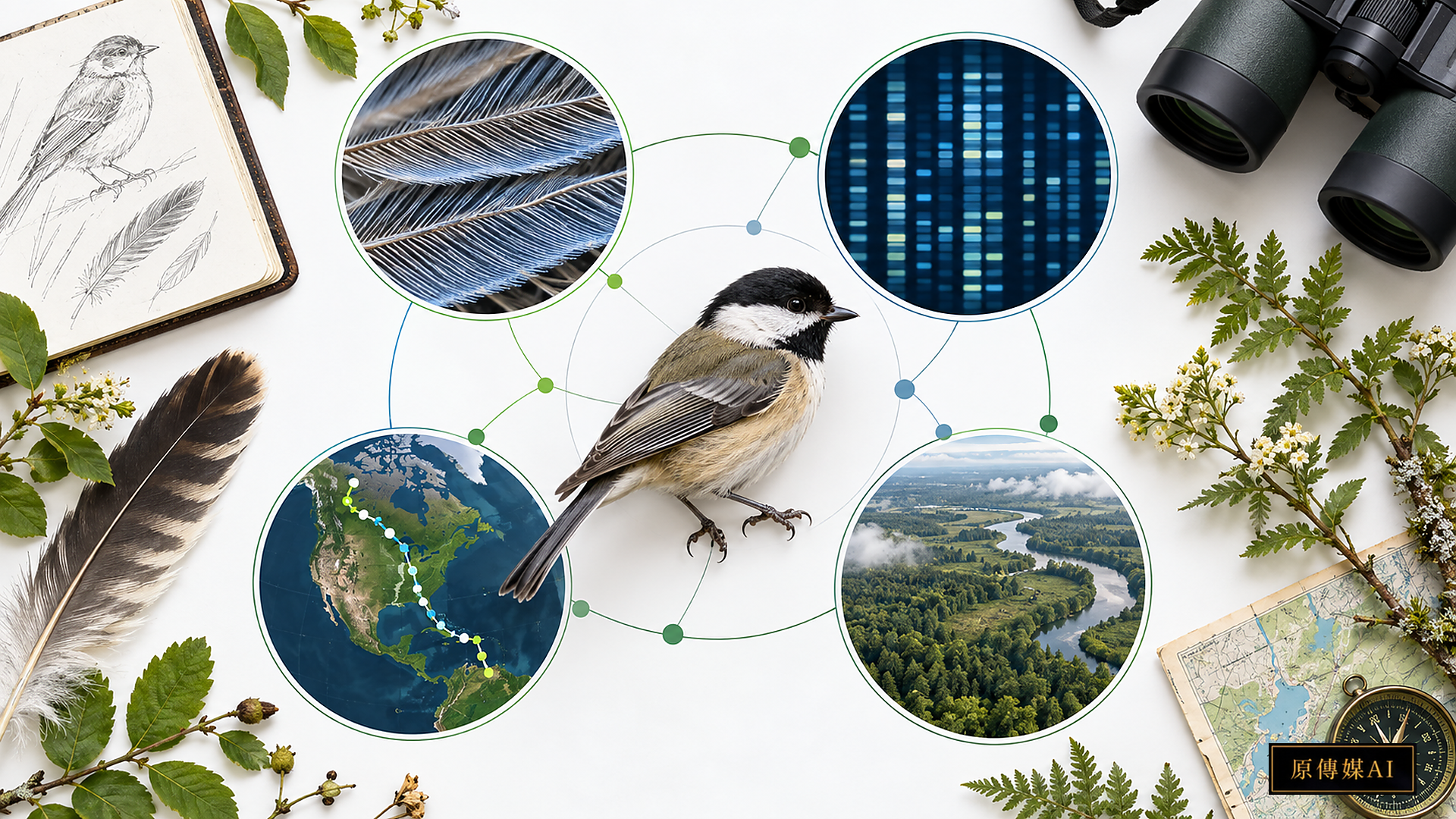
Life science has a strange problem: more data does not necessarily mean more understanding
Biology has generated data at remarkable speed over the past two decades. Genome sequencing, remote sensing, animal tracking, digitized museum collections, environmental sensors, image recognition and physiological measurements now connect molecules to ecosystems. The new bottleneck is not the absence of data, but the lack of a shared language among different datasets.
Gene-expression records center on samples and sequences; tracking records center on time and coordinates; natural-history specimens record collection date, location, taxonomy and collection identity; ecological datasets may center on plots, species and environmental variables. Without explicit metadata, units, time scales, geographic resolution and provenance, putting them on one drive does not create integration.
The U.S. National Science Foundation’s support for the National Synthesis Center for Organismal Resilience (NSCORE) targets this problem. The center is not merely designed to collect more samples. It recombines existing evidence to ask how organisms persist, adjust and recover under environmental stress.
Why invest in synthesis instead of simply collecting more observations?
New data often symbolizes innovation, yet many important questions already have abundant fragments scattered across disciplines and repositories. Studying heat effects on birds, for example, can involve genes, hormones, physiology, feathers, behavior, migration, reproduction, climate and landscape. If each discipline publishes only its own layer, researchers cannot tell whether observations across scales describe the same phenomenon.
A synthesis center provides time, data engineering and interdisciplinary collaboration for responsible reuse. That work may attract less attention than discovering a species, but it can fundamentally improve research efficiency.
It also advances the promise of open science: data should not disappear on a drive after a paper is published, but should be organized so that it can answer new questions. Openness, however, does not mean that every record must be public, especially when it concerns sensitive species locations, human communities, Indigenous knowledge or restricted biological resources.
The hardest part of data synthesis is not AI but provenance
Cross-dataset work is often framed immediately as an AI problem. Large models may assist with literature, align fields, find associations and build forecasts, but they cannot replace a more basic question: where did every observation come from?
Provenance includes sampling method, instrument, time, place, researcher, processing history and rights status. A model may combine two tables without knowing that one represents a controlled laboratory experiment and another an uncontrolled field observation. The resulting correlation can then lack biological meaning.
Rights are part of provenance. If a dataset was licensed for a limited purpose, technical access does not authorize an AI system to ignore that restriction. For Indigenous and community ecological data, sovereignty should be a metadata field rather than an appendix: who provided the information, who may use it, whether derivatives are allowed, whether locations may be published and whether model training is permitted.
Molecular and forest scales cannot simply be added together
Organismal resilience spans scales. A bird’s survival during a heatwave may involve cellular heat-shock proteins, metabolism, feathers, drinking behavior, shade, habitat fragmentation and population genetic diversity. Every layer uses its own timing and measurements.
Putting those records together is easy; establishing a defensible causal chain is hard. Researchers must ask which variables share a time point, which associations are only correlations, which differences come from measurement and whether a North American forest dataset can be compared directly with evidence from a tropical island.
That is why a synthesis center needs organismal biologists, ecologists, museum curators, statisticians and domain experts as well as data scientists. Data science connects wires; disciplinary knowledge decides which connections make biological sense.
Natural-history museums may again become essential infrastructure in the AI era
Museum specimens are sometimes described as old data, but they provide irreplaceable depth for climate and biodiversity research. A bird feather, insect or plant collected a century ago may preserve traces of pollution, isotopes, morphology and DNA from its time.
Digitization can connect those specimens with modern climate, genomic and remote-sensing records. Data quality does not improve automatically. Historical place names need modern coordinates, taxonomic names change, dates may be incomplete and old labels may reflect collector bias.
AI can help read handwriting, recognize images and align names, but a curator is still needed to interpret the history and context of a collection. Data integration remains more than an engineering operation.
Why should Taiwan pay attention?
An international center of this kind has direct relevance to biodiversity research in Taiwan. The island’s varied topography, high diversity and long natural-history record sit alongside data from national research institutions, universities, museums and citizen observation. Trusted metadata, standard formats and rights-aware interoperability could improve research on phenology, extreme weather, species movement and habitat pressure.
Taiwan also holds extensive ecological knowledge within Indigenous and local communities. Such information cannot be reduced to one more biodiversity dataset. The appearance of a plant may carry gathering, ritual, hunting or family significance; publishing a location may increase extraction pressure; names may carry cultural rights.
An advanced synthesis system should therefore support information that is linkable without being fully public. It can state that a record exists and identify its governor and access route without exposing the content to every researcher or model.
AI is most useful when it finds inconsistencies
Across large, multiscale collections, AI is well suited to finding anomalies: names that differ among databases, shifted coordinates, conflicting environmental records for one period, or strongly associated variables produced by different methods.
That task is more reliable than automatically announcing a conclusion about resilience. AI can show researchers where to inspect; people remain responsible for biological explanation.
If centers such as NSCORE succeed, their greatest contribution may not be one supermodel. It may be an institutional framework that permits data to be reused correctly and lets questions cross disciplinary boundaries.
“Open” and “governable” must be designed together
Open science often follows the FAIR principles: Findable, Accessible, Interoperable and Reusable. Those principles are valuable, but sensitive cultural, ecological and community data also requires attention to rights, responsibilities and relationships.
Fully open coordinates for an endangered nest can increase poaching. A public Indigenous gathering site can invite outside extraction. Traditional knowledge included in AI training can be regenerated after its source and conditions are stripped away.
The next generation of data centers must therefore know what should remain restricted. Good synthesis does not pull everything into one central store. It lets distinct datasets be analyzed together while retaining their governance boundaries.
Conclusion: the next breakthrough may come from rereading data we already have
Science often equates progress with more: more samples, sensors, sequences and satellites. Once the volume outgrows communication among disciplines, integration becomes the real constraint.
Centers such as NSCORE represent an important shift. Research resources are being directed toward giving existing data a second life. Done well, synthesis improves efficiency and connects molecular, organismal, population and ecosystem research.
Mature data synthesis is nevertheless not only technical. It must preserve provenance, authorization, uncertainty and community governance. Only after we know where data came from, whether it can be used and how it can be compared should AI help answer larger questions about life.
Yuan Media AI | Continue by role
- Organismal biologist: How can cross-scale datasets be combined without mistaking correlation for mechanism?
- Bioinformatics or data-science researcher: How do metadata, provenance and standards determine whether an AI analysis can be trusted?
- Natural-history museum and specimen-data manager: How can historical collections connect to current genomic, climate and remote-sensing evidence?
- Taiwan biodiversity researcher or data steward: How can Indigenous and community ecological data support research without losing its governance boundaries?
Sources
Role-Driven Inquiry
Yuan Media AI | Guided Questions by Role
Select a role first, then review the complete questions from that perspective; clicking a question will display Yuan Media AI’s response in real time.
Select a role
Organismal biologist
Examine the article's evidence, governance boundaries, data rights, and actionable steps from the perspective of a Organismal biologist.
Choose a question
AI use and content-safety disclosure
This English edition is an AI-assisted translation of the supplied Chinese feature, checked for source parity and evidence boundaries.