Did We Miss a Whole Population of Ultra-Soft X-ray Emitters? Chandra’s 84 Hypersoft Sources Reopen an Observational Blind Spot
Original Chinese title: 我們是不是漏看了一整群「太軟的 X 光」?Chandra 找到 84 個 hypersoft sources,把天文學的極紫外盲區打開
A Chandra archive study identifies 84 hypersoft X-ray sources and exposes a selection effect between low-energy X-rays and the extreme ultraviolet; the shared spectrum defines a class without yet proving one physical origin.
Lawrence Lee
Lawrence Lee is a technology journalist, science-fiction critic and space-science educator.
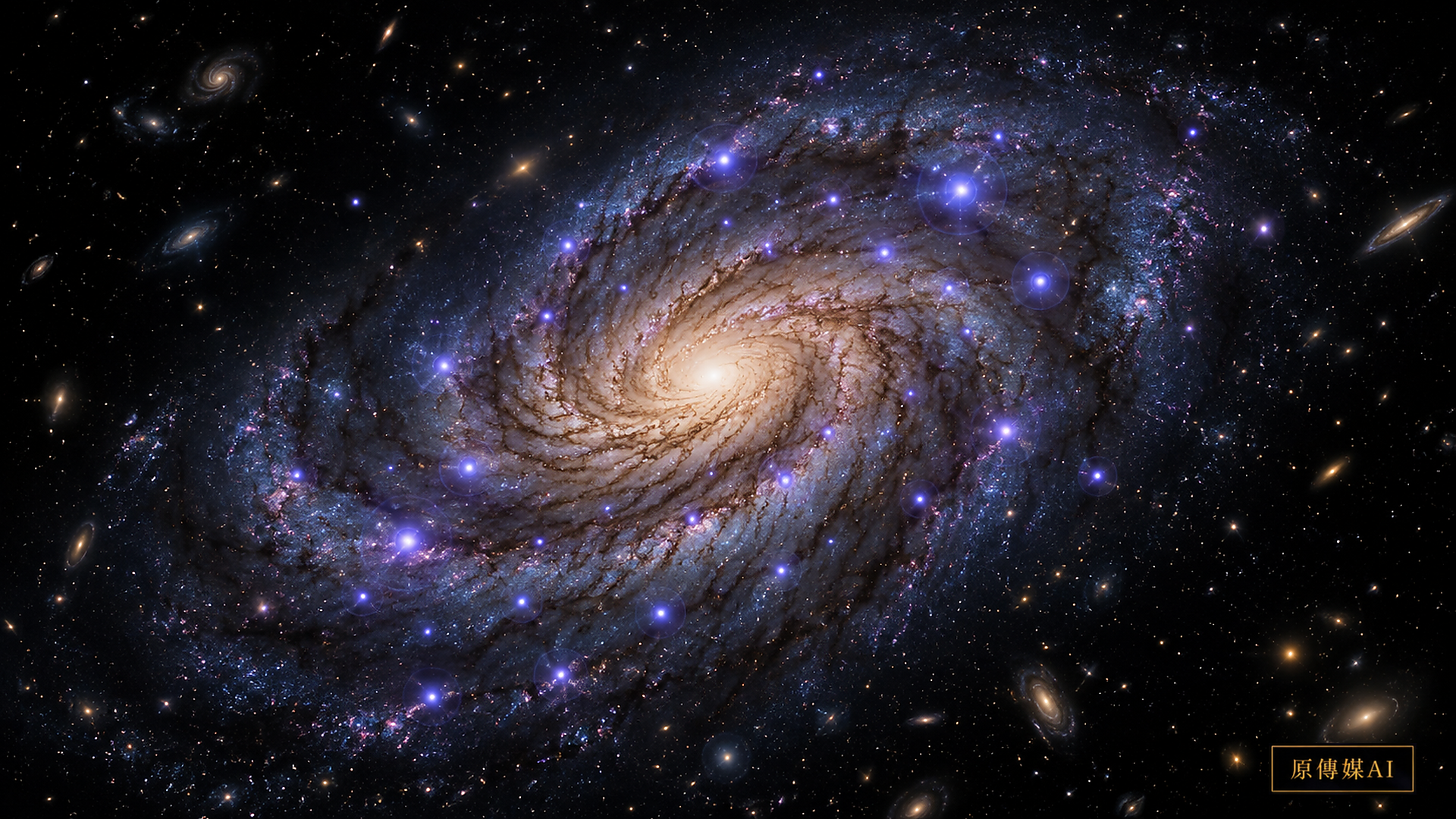
A discovery can begin by recognising what our methods were trained to miss
Powerful observatories do not deliver a complete universe automatically. Every detector has an energy range, every catalogue has thresholds, and every analysis pipeline makes choices about what deserves attention. The report of eighty-four hypersoft X-ray sources in nearby galaxies is important because it exposes those choices rather than pretending that absence from a catalogue means absence from nature.
These emitters are prominent at very low X-ray energies and fade quickly toward harder energies. A survey tuned to harder photons can therefore reject them as weak, uncertain or uninteresting. The blind spot lies near the difficult boundary between the extreme ultraviolet and soft X-rays, where interstellar absorption and instrumental response make inference especially demanding.
Why eighty-four matters, and why the number is not the conclusion
One unusual object can be treated as an exception. A systematically selected sample creates a population-level question. Naming a hypersoft class gives astronomers a way to compare spectra, luminosities, variability and environments, and to ask whether earlier catalogues grouped unlike things together or discarded them altogether.
The count should still be read with its selection rules attached. It depends on the galaxies searched, exposures available, detection threshold, background treatment and definition of softness. Reanalysis may add or remove candidates. That would refine the result rather than erase the value of discovering a reproducible pattern.
A spectral class is not yet a single physical species
The shared observational signature does not prove that all eighty-four objects have the same engine. Possible explanations can involve accreting white dwarfs, neutron stars, black-hole binaries or other luminous systems whose higher-energy radiation is weak, reprocessed or absorbed. Distinguishing among them requires evidence beyond one colour of X-ray light.
Useful tests include time variability, optical and ultraviolet counterparts, host-galaxy environment, surrounding ionised gas and observations with other instruments. Distance and absorption estimates are crucial because both alter inferred luminosity and spectral shape. The responsible statement is that a low-energy population has been identified; its internal taxonomy remains open.
What this could change in stellar evolution
If hypersoft emitters are common, some evolutionary channels may have been undercounted. That could affect estimates of how compact binaries grow, how white dwarfs accrete, which systems may contribute to Type Ia supernova pathways, and how luminous sources ionise gas around them.
Those consequences are hypotheses, not automatic deductions from the catalogue. Population modelling must incorporate the probability that an object would be detected under each observing condition. Otherwise the same bias that hid the sources can be reproduced inside the model used to explain them.
Archive science is a method, not simply the reuse of old files
The result also demonstrates why observatory archives are scientific infrastructure. A new question, classification rule or statistical method can turn existing observations into a new experiment. The sky did not change because researchers re-read the archive; the analytical frame changed.
Reproducibility therefore requires more than publishing the final list. Calibration versions, query conditions, energy cuts, exclusions, code and uncertainty estimates should be preserved. Another team must be able to recover the sample and understand why borderline objects were included or rejected.
Teaching the observational blind spot
For students, the case offers a concrete correction to the idea that a telescope merely “sees farther.” Different bands are more like different senses. Radio, optical, ultraviolet and X-ray observations reveal different processes, and even one named band contains regions where instruments vary greatly in sensitivity.
A classroom can compare how the same object appears across bands, then ask what a non-detection means. Sometimes it gives a strong upper limit; sometimes it says only that the instrument was looking in the wrong way. That distinction turns a slogan about hidden objects into a testable lesson about selection effects.
Science communication should preserve uncertainty
“Mysterious X-ray objects” is an inviting headline, but it should not become “a new kind of black hole” without evidence. The excitement lies in a map being redrawn, not in forcing every blank area into a familiar dramatic story.
Good reporting can state three things separately: what was measured, which interpretations are plausible, and what observations would discriminate among them. This makes uncertainty informative. It also lets readers see that classification is an evolving tool rather than a final label attached to nature.
Conclusion: the visible universe includes the habits of the observer
Chandra’s archive has not suddenly created eighty-four objects. Researchers have developed a way to notice a low-energy signature that conventional habits could neglect. That is why the finding reaches beyond one catalogue.
Whether the sources ultimately divide into several physical families or establish a major new evolutionary channel, the methodological lesson will remain. Instruments, thresholds and categories shape what becomes visible, and mature science periodically turns those tools back on themselves.
Yuan Media AI | Continue by role
- X-ray astronomer: Which energy cuts and background rules most strongly control the sample?
- Stellar-evolution or compact-object researcher: Which follow-up observation best separates competing physical models?
- Science archive or data scientist: What must be preserved so another team can reproduce all eighty-four candidates?
- Science educator or public communicator: How can non-detection and selection effects be explained without turning uncertainty into spectacle?
Sources
Role-Driven Inquiry
Yuan Media AI | Guided Questions by Role
Select a role first, then review the complete questions from that perspective; clicking a question will display Yuan Media AI’s response in real time.
Select a role
X-ray astronomer
Examine the article's evidence, governance boundaries, data rights, and actionable steps from the perspective of a X-ray astronomer.
Choose a question
AI use and content-safety disclosure
This English edition is an AI-assisted translation of the supplied Chinese feature, checked for source parity and evidence boundaries.