Not Every Safe Fire Is Measured Only by Fuel Load: What Mimal Women’s Cultural Burning Tells Us About Judgment, Responsibility and Carbon Governance
Original Chinese title: 不是「燒得越多越安全」:Mimal 女性用 17 個文化地點告訴我們,有些火要點、有些地方不能燒——當 Ranger 工作遇上防災與碳市場,誰來承擔判斷?
Seventeen culturally important places identified with Mimal women show why cultural fire cannot be reduced to hectares burned: disaster planning and carbon audits must remain accountable to place-based authority and responsibility.
王莉如
A counseling psychology supervisor focused on trauma recovery, couple and family relationships, helping-profession ethics, and social and emotional support.
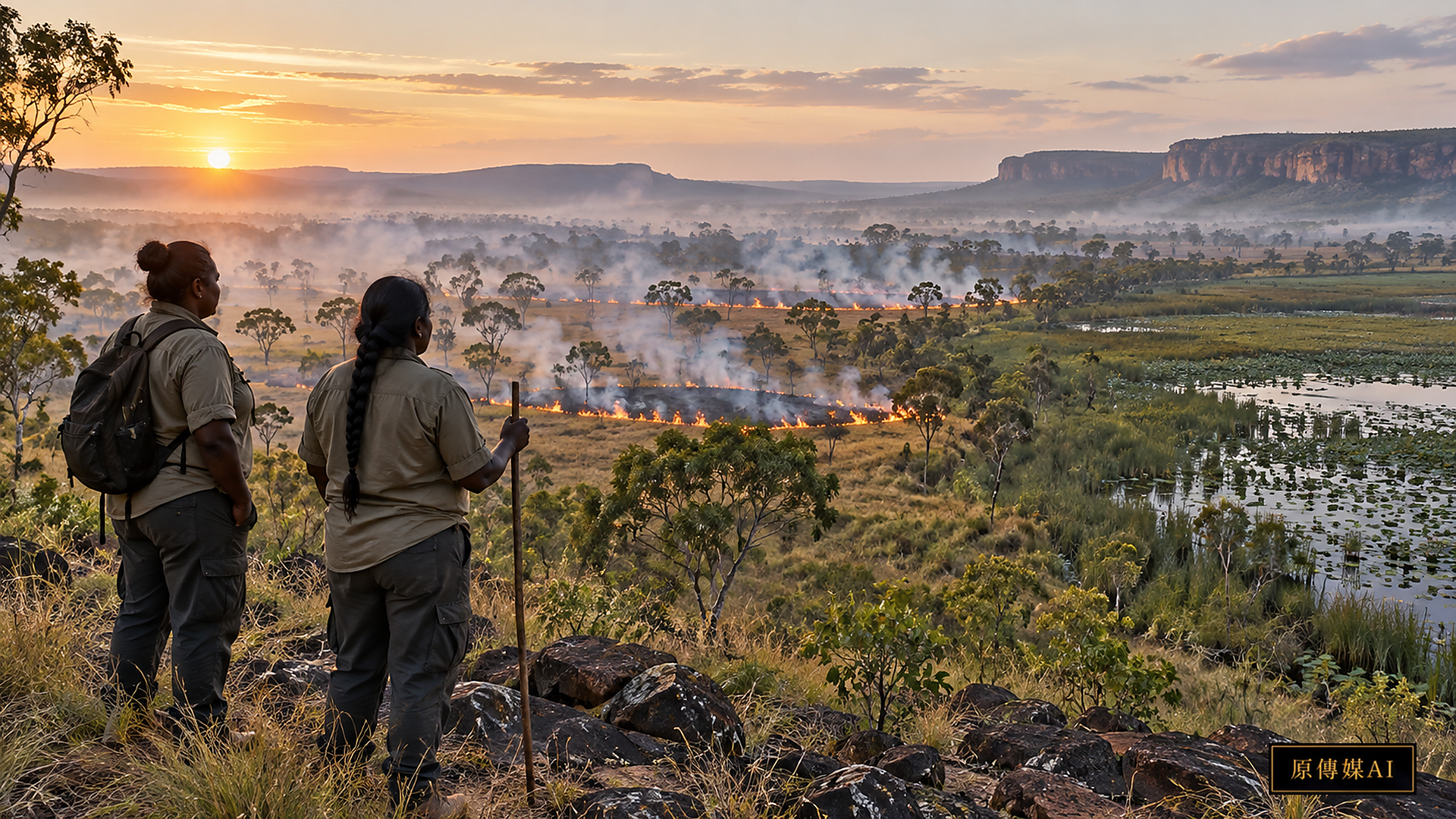
Cultural fire is not a slogan about returning to tradition
Discussion of northern Australian savanna management is often compressed into convenient claims: early-season fire is safer, cultural burning is beneficial, and carbon methods can reduce emissions. The 2026 study from the Mimal Indigenous Protected Area asks a more exacting question. Fire is never abstract and Country is not a blank map. Decisions concern particular food plants, medicines, sacred places, hunting access, seasons, kinship obligations and the people authorised to speak for a place.
Working with Dalabon, Mayili and Rembarrnga women, the researchers identified seventeen culturally important places. The number is not a universal checklist. Its importance is that it moves assessment from broad landscape statistics to site-specific responsibilities: whether a place should burn, how it should burn, when it should be protected and who can make that judgment.
Why women rangers change the picture
The phrase “Indigenous knowledge” can wrongly suggest that knowledge is distributed identically across a community. In practice, gender, kinship, age, ceremonial standing and responsibility shape who may know, decide or disclose particular matters. By centring women rangers, Traditional Owners and Djungkayi, the study makes visible work that can disappear behind a generic account of community consultation.
Ranger work therefore involves far more than carrying out a burn plan. Women may coordinate vehicles, crews, maps and reporting while also caring for places through obligations that an outside project cannot define. Their judgment is skilled labour. Treating it as a decorative cultural contribution undervalues both the work and the risk they carry when decisions affect Country.
Carbon accounting creates benefits and pressure
Savanna-burning carbon projects can support jobs, biodiversity work and lower emissions by reducing extensive late dry-season wildfire. Those benefits matter. Yet carbon markets also require measurable baselines, spatial records, annual reports and auditable results. What can be counted is not automatically everything that should govern the work.
Sensitive sites may not be suitable for public coordinates. A cultural authority may be able to approve an action without disclosing the knowledge behind it. A project may verify that a process occurred without owning the underlying cultural information. Good governance separates the evidence needed for an audit from knowledge that remains under community authority.
Two accountability systems must meet without one swallowing the other
Satellite products, fuel models and fire-behaviour forecasts can estimate where a fire may move and when conditions may become dangerous. They cannot independently decide what deserves priority, who may enter a place, or which obligations continue after a crew leaves. Those are governance questions, not missing variables waiting to be harvested.
Two-Eyed Seeing is useful here only if it changes authority as well as vocabulary. Scientific tools and lived cultural responsibility can inform the same plan, but an external timetable must not silently outrank a Traditional Owner’s decision. Consultation has substance only when local people can alter, postpone or refuse the proposed work.
Recording a decision not to burn
A mature management record should include more than ignition dates and hectares. It can document why a burn was delayed, why a boundary was narrowed, which authorised decision-makers were involved and what conditions would trigger review. Sensitive details need not be published for the decision to be accountable.
This matters because reporting systems can create incentives. If funding recognises only visible burning, teams may be pushed to translate careful restraint into apparent inactivity. Recognising patrols, seasonal assessment, consultation and protected areas as real outputs gives the project a truer picture of the labour involved.
Lessons for disaster planning beyond Australia
The Mimal case should not be copied mechanically into Taiwan or another jurisdiction. Its transferable lesson is a question for public programmes: when they invoke local knowledge, do knowledge holders also have the power to stop or change a plan? If they can supply stories but cannot affect schedules, budgets or risk thresholds, participation remains shallow.
A robust sequence starts with cultural authority over whether a place may be discussed or treated, continues with operational assessment of weather, fuel and staffing, and ends with the production of the limited information needed by disaster or carbon institutions. Information can move between those layers without allowing one layer to replace the others.
Conclusion: some fires may be lit, but judgment cannot be outsourced
The study does not prove that every customary preference is automatically correct or that contemporary science is unnecessary. It shows substantial alignment as well as discrepancies, and it provides a method for examining them. That is more useful than romanticising cultural fire as conflict-free wisdom.
The central lesson is institutional. Safety, ecological effectiveness and legitimate authority are distinct tests that must be considered together. A project that reduces emissions while excluding the people responsible for Country has solved only part of the problem.
Yuan Media AI | Continue by role
- Mimal woman ranger: Which operational judgments must remain with the people working on Country?
- Traditional Owner / Djungkayi cultural authority: How can approval be documented without exposing restricted knowledge?
- Fire ecologist / local disaster planner: How should cultural authority and fire models share one decision process?
- Savanna carbon project / data auditor: What evidence is necessary for assurance, and what must remain protected?
Sources
- Ecological Management & Restoration | Does Contemporary Fire Management Reflect Indigenous Women’s Cultural Values and Preferences?
- Mimal Land Management | Mimal Indigenous Protected Area
- Australian Government DCCEEW | Carbon Farming Outreach Program
- Indigenous Carbon Industry Network | Mimal Land Management
Role-Driven Inquiry
Yuan Media AI | Guided Questions by Role
Select a role first, then review the complete questions from that perspective; clicking a question will display Yuan Media AI’s response in real time.
Select a role
Mimal female ranger
Examine the article's evidence, governance boundaries, data rights, and actionable steps from the perspective of a Mimal female ranger.
Choose a question
AI use and content-safety disclosure
This English edition is an AI-assisted translation of the supplied Chinese feature, checked for source parity and evidence boundaries.