Identifying Five Denisovan Remains from Sixty Thousand Bone Fragments: How a Yunnan Cave Re-Anchors the Penghu Submarine Mandible onto Asia's Migration Map
Original Chinese title: 六萬塊碎骨裡找出五件丹尼索瓦人遺骸:雲南洞穴如何讓澎湖海底顎骨重新落在亞洲遷徙地圖上?
Five Denisovan specimens from Bianfu Cave in Yunnan fill a critical geographic void in known Asian distributions, while the Penghu mandible provides paleoproteomic evidence from the Taiwan Strait; fossil localities can be juxtaposed comparatively but cannot be connected into proven migration routes or modern ethnic identities.
山海資料庫;共同作者:李文驤|天主教達人高中地理老師|山海資料庫關注城市地景、空間資料與公共治理
Co-authors: 李文驤, 空間資料與公共治理
Mountain and Ocean Database focuses on urban landscapes, spatial data, and public governance; co-author 李文驤 is a geography teacher at Catholic Daren High School, assisting readers in understanding trans-regional research evidence through geographic education, spatial relationships, and environmental contexts.
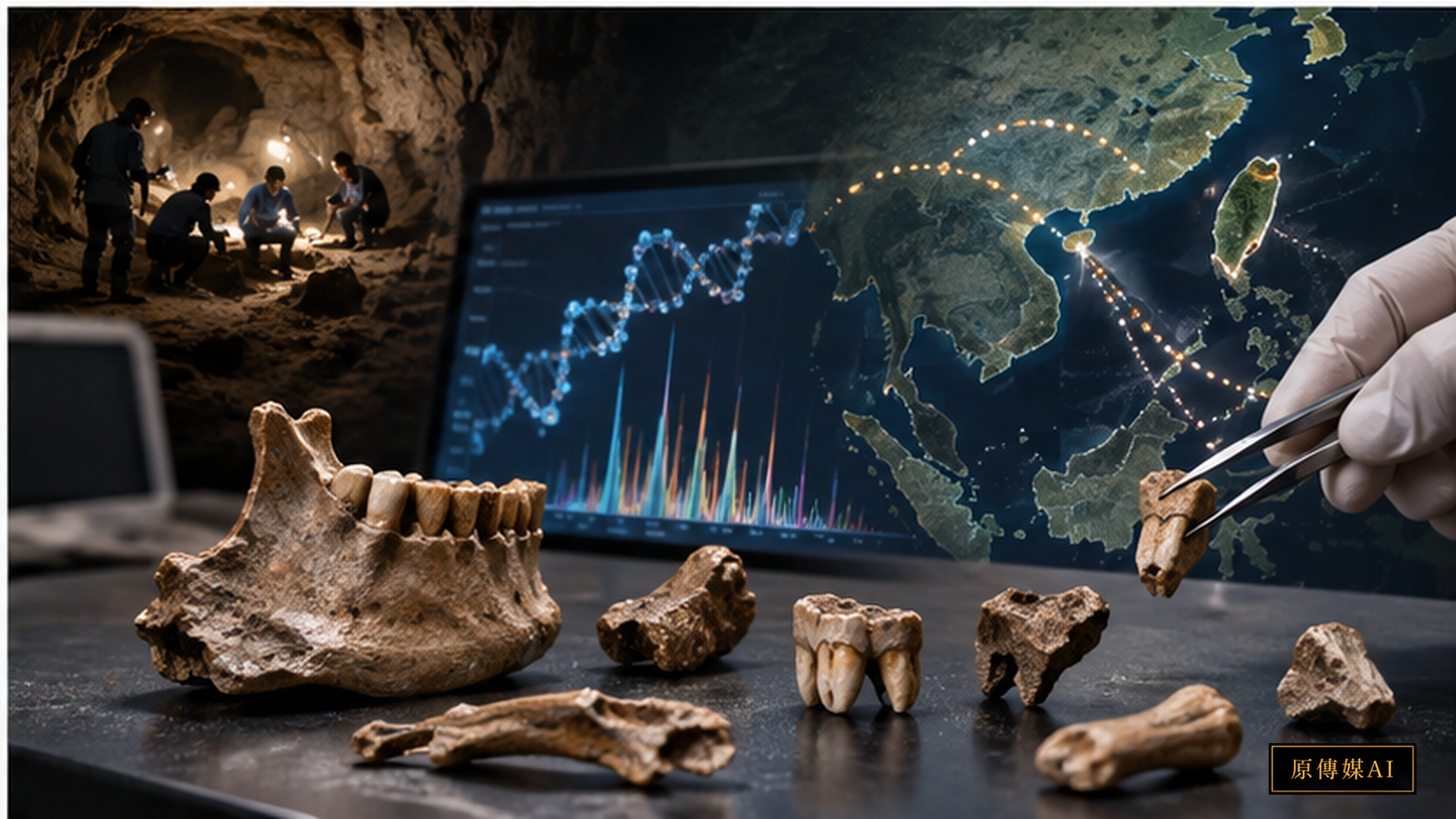
Paleoanthropology is frequently romanticized by the public as unearthing an intact skull that scientists seamlessly assemble into historical narrative. Yet the research from Bianfu Cave in Yunnan, published in Nature on September 9, 2026, presents an entirely different methodological scale: investigators confronted tens of thousands of fragmented bones, many so splintered that visual identification of animal species was virtually impossible. The research team first conducted morphological sorting across more than 60,000 bone fragments, deployed ZooMS (Zooarchaeology by Mass Spectrometry) and paleoproteomics to narrow candidate specimens, and ultimately verified that three hominin bone fragments and two teeth belonged to Denisovans. This breakthrough not only expands the known fossil catalog, but pushes the confirmed geographic distribution of Denisovans deep into the pivotal junction of Southwest China.
One of the companion Nature papers details how the team sampled candidates from over 60,000 bone fragments in Bianfu Cave, using protein mass spectrometry to identify two parietal fragments and a proximal radius fragment, alongside two excavated teeth, yielding molecular evidence for Denisovans across five distinct specimens. The stratigraphic layer containing these hominin fossils dates to approximately 167,000 to 134,000 years ago. A second paper published simultaneously placed the fossils within broader archaeological context, demonstrating that the cave's cultural deposits span roughly 190,000 to 70,000 years ago, yielding extensive mammalian fauna and lithic assemblages that illuminate how these archaic hominins utilized landscapes and procured subsistence.
The pivotal technological capability here is not "extracting pristine ancient DNA." In humid, warm, or deep-time subtropical environments, ancient DNA degradation is extraordinarily rapid, whereas certain bone and tooth enamel proteins persist across vastly longer timescales. Paleoproteomic methodologies sequence residual protein chains, identifying diagnostic amino acid substitutions that distinguish divergent hominin clades, and benchmark them against established databases. Concurrently, ZooMS utilizes collagen fingerprinting via mass spectrometry to rapidly screen vast assemblages of unidentified bone slivers. Together, these tools enable researchers to discover diagnostic needles within mountainous haystacks of highly fragmented bone.
Consequently, the archaic human mandible dredged from the Penghu Submarine Channel re-emerges prominently upon this pan-Asian distribution map. In 2025, a landmark Science paper utilized paleoproteomic evidence to establish the taxonomic affinity between the Penghu 1 mandible and Denisovans, positioning the Taiwan Strait as a vital southeastern anchor in the known Denisovan range. The 2026 Yunnan discovery supplies an explicit geographical anchor in Southwest China. Scientific publications now position Siberia, the Tibetan Plateau, Northeast China, the Taiwan Strait, and the Yunnan-Guizhou Plateau within a unified distribution framework, demonstrating that the geographic dispersal of Denisovans was vastly broader than early models based solely on Denisova Cave envisioned.
However, "having multiple points on a map" is fundamentally different from claiming we understand their migration routes. Disparate fossil sites represent distinct chronological windows, paleoenvironments, and preservation conditions, separated by vast gulfs of time and space. Researchers can legitimately assert that molecular evidence of Denisovans spans vast swaths of Asia; they cannot draw definitive directional arrows connecting these isolated coordinates into proven migration pathways, nor can any archaic hominin fossil be simplistically equated with the ancestry of contemporary ethnic populations. The true strength of scientific inquiry resides in this exact discipline: knowing what the evidence supports, and rigorously clarifying what remains unproven.
Yunnan's geographic significance lies in its spatial position. Situated on the southeastern flank of the Tibetan Plateau, it connects East Asia, South Asia, and Southeast Asia, serving as an indispensable corridor for understanding archaic hominin dispersal, ecological adaptation, and inter-clade interaction. Through the lens of geographic education, the Denisovan story should not be framed as a static distribution map, but must incorporate Pleistocene sea-level fluctuations, mountain corridors, river drainages, paleoclimates, and faunal migrations. The Taiwan Strait in particular was exposed repeatedly as a dry terrestrial plain during Pleistocene glacial lowstands; contemporary maritime boundaries do not reflect ancient landscapes. The Penghu mandible, recovered from seafloor fishing nets, reminds us that ancestral topographies now lie submerged beneath modern ocean waters.
This is precisely where spatial databases and the Mountain and Ocean Database contribute. Spatial visualization is not merely pinning fossil coordinates onto a digital map; it requires simultaneously encoding chronological ranges, dating uncertainties, paleoenvironmental layers, and evidentiary typologies. Future interactive maps should explicitly annotate whether each data point derives from ancient DNA, paleoproteomics, skeletal morphology, or archaeological association, displaying temporal confidence intervals rather than presenting all discoveries with uniform visual certainty. This transparent methodology teaches audiences that science is not a completed static picture, but an evolving evidentiary network.
Two-Eyed Seeing holds meaningful relevance within paleoanthropology, provided it is deployed with precision. Molecular genetics and proteomics answer where a specimen situates within taxonomic evolutionary trees; archaeology and stratigraphy reconstruct the temporal and ecological context of its deposition; while local fisheries history, marine lore, and museum archives chronicle how specimens were discovered, stewarded, and brought into scientific study. These distinct bodies of knowledge complement one another without subsuming their respective boundaries. Especially when handling hominin ancestral remains, museum stewardship, public display, and scientific sampling must uphold ethical governance rather than merely pursuing analytical data points.
Significantly, the Bianfu Cave research confirms that "legacy materials in museum collections hold profound potential for new discoveries." In vast collections of bone fragments, the proportion of identifiable hominin material is extraordinarily low; without cutting-edge biomolecular screening, they would remain categorized forever as undifferentiated scrap. Technological progress therefore does not only mean excavating new field sites; it means re-examining materials already preserved in museum and archaeological repositories. This approach is paramount for Asian paleoanthropology, where tropical and subtropical taphonomy limits ancient DNA preservation, elevating ancient proteins as an indispensable window into deep human history.
From Penghu to Yunnan, what is being redrawn is not a settled, linear "Denisovan migration highway," but our scientific awareness of archaic human diversity across Asia. Every new specimen reshapes the map, but it equally reveals vast uncharted voids. For public science literacy, this is the most vital insight to communicate: rigorous science does not rush to force fragmented clues into a tidy narrative, but allows each fragment to retain its authentic evidentiary weight, progressively updating our understanding of humanity's past as new pieces of the puzzle emerge.
A Map Is Not an Answer, but the Beginning of the Next Cycle of Inquiries
When Yunnan and Penghu are discussed together within the Denisovan distribution, the most common visual fallacy is drawing a thick directional arrow between discovery points, leading audiences to assume a verified migration route has been established. In reality, each locality occupies a distinct chronological epoch, anatomical element, and evidentiary tier. A rigorous cartographic visualization must decouple discovery coordinates, chronometric age, biomolecular methodology, and margin of error, making clear that points plotted across the same map are not evidentiary equivalents.
The Penghu mandible requires this nuanced treatment. Its monumental significance lies in ancient protein sequences that allowed researchers to evaluate it within a comparative Denisovan framework. Yet because it was recovered by seafloor commercial fishing trawlers, it lacks the pristine stratigraphic context preserved within cave chambers like Bianfu. Thus, while its biogeographical value is immense, it carries distinct interpretive boundaries compared to excavated cave sediments. Juxtaposing these two discoveries provides a brilliant pedagogical lesson in understanding evidentiary asymmetry in archaeological science.
In geographic education, Pleistocene sea-level fluctuations constitute an essential conceptual layer for understanding the Taiwan Strait. Landscapes currently separated by ocean straits presented radically different terrestrial topographies during glacial maxima. This does not permit assuming archaic hominins followed a specific shoreline path, but reminds us that modern coastlines cannot be projected backward as fixed ancient baselines. Any dispersal hypothesis must be tested against chronological dates, paleoclimates, geomorphology, and associated fossil records.
Museum and archival repositories will consequently assume an even greater role. Breakthroughs in paleoproteomics and mass spectrometry mean that bone fragments long filed away as "unidentified fragments" may yield revolutionary insights. Legacy collections across Asia can be re-evaluated using non-destructive or micro-sampling proteomic techniques. This simultaneously brings sampling ethics to the forefront: every destructive test must balance specimen consumption, scientific yield, replication standards, and open data sharing, rather than permitting indiscriminate sampling simply because technology exists.
For public science communication, the most vital lesson is celebrating the self-correcting nature of the scientific process. In 2025, protein analysis of the Penghu mandible re-anchored the Taiwan Strait within global Denisovan research; in 2026, the Bianfu Cave specimens in Yunnan filled a pivotal continental void in Southwest China. Future fossil, proteomic, or genetic evidence will undoubtedly alter our current maps again. Rather than proclaiming today's findings as a final destination, public science should illuminate the beauty of human evolution research: how every new piece of evidence compels us to revise and enrich a story we once thought was complete.
Sources and Further Reading
Role-Driven Inquiry
Yuan Media AI | Guided Questions by Role
Select a role first, then review the complete questions from that perspective; clicking a question will display Yuan Media AI’s response in real time.
Select a role
Paleoproteomics researcher
Examine the article's evidence, governance boundaries, data rights, and actionable steps from the perspective of a Paleoproteomics researcher.
Choose a question
AI use and content-safety disclosure
This article was compiled from official and research sources; established facts, observational associations, institutional boundaries, and extended analyses are presented separately. The cover is an AI-assisted concept illustration.