Trauma Did Not Cease 25 Years Ago: When 9/11 Responders Inhabit Hotter, More Polluted, Canopy-Deficient Neighborhoods, Why Can PTSD and Frailty Be Compounded?
Original Chinese title: 創傷沒有只停在 25 年前:9/11 救援者住進更熱、更髒、缺少綠地的街區後,為何 PTSD 與衰弱仍可能被放大?
An observational study tracking 18,861 World Trade Center rescue and recovery responders found that subsequent residential heat, air pollution, and lack of green view were associated with frailty, PTSD, and depression scores; findings support cross-system longitudinal care rather than proving any single factor causes PTSD.
王莉如|諮商心理師督導
Long focusing on trauma recovery, couples and family relationships, helping professional ethics, mental health, and socio-emotional support; this feature takes psychological care and cross-cultural knowledge dialogue as its primary analytical perspective.
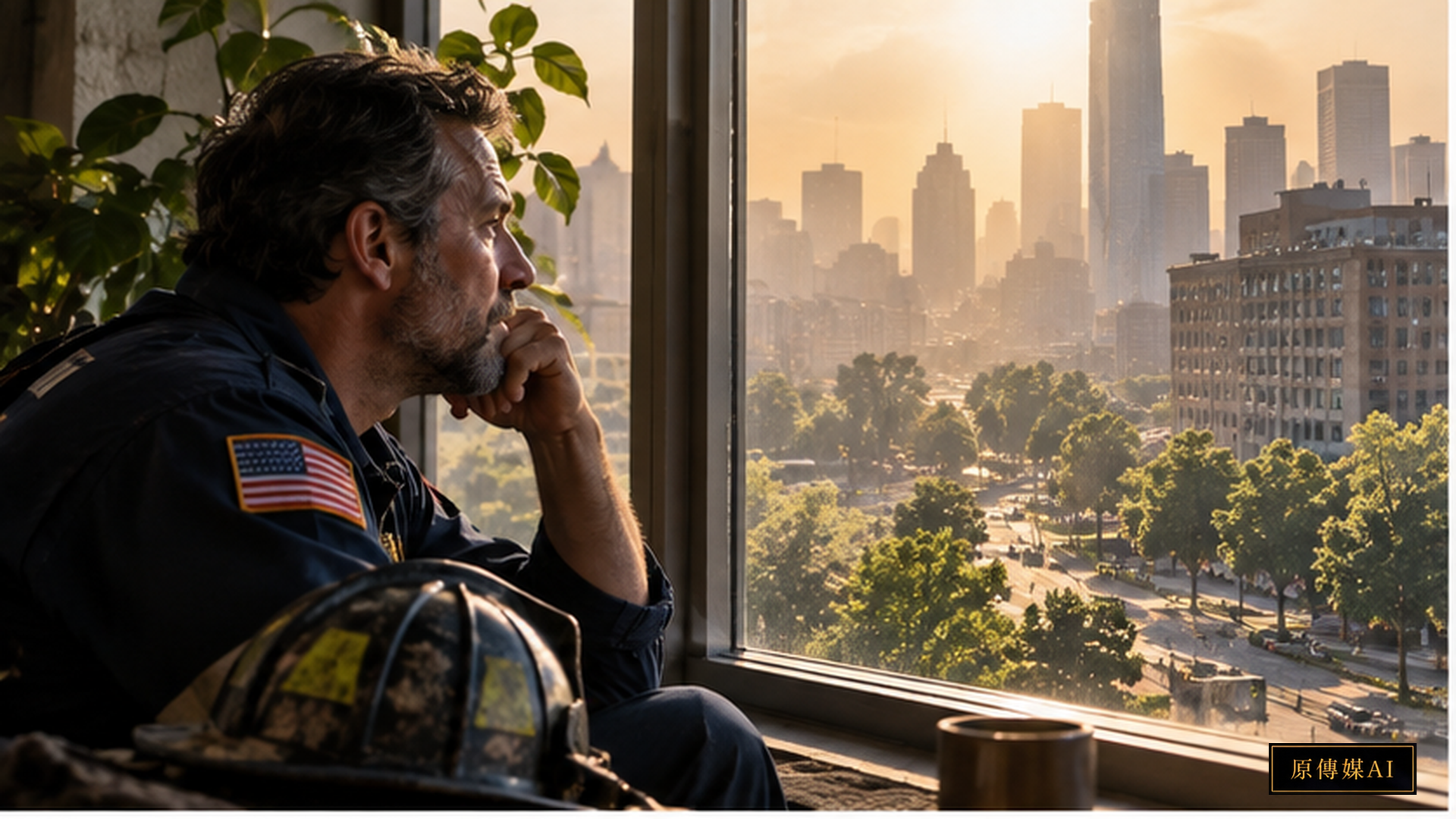
Following September 11, 2001, many individuals who engaged in rescue, recovery, and cleanup operations at the World Trade Center bore far more than acute dust inhalation, chemical toxicities, and profound psychological stress. A quarter-century later, researchers are examining an overlooked epidemiological inquiry: can the physical and psychological toll sustained during a major disaster be compounded years later by the everyday urban environments in which survivors reside? A study published in Nature Communications on September 11, 2026, linked longitudinal health registries from 18,861 general responders in the World Trade Center Health Program with residential fine particulate matter (PM2.5), mean ambient temperatures, and street-level Green View Index metrics, offering an integrated analytical framework for public health and psychological care.
The epidemiological cohort spans 2003 through 2023. The research team evaluated over 80,000 frailty measurements, 110,000 PTSD assessments, and 100,000 depression scores. The analysis demonstrated that within this unique responder cohort, elevated PM2.5 exposure and higher ambient temperatures correlated with heightened frailty, PTSD, and depression scores; conversely, higher street-level green view correlated with lower clinical symptom burdens. When investigators modeled the three environmental factors as a joint environmental mixture, each decile increase in cumulative exposure corresponded to modest but statistically significant increases in frailty and PTSD indices, with ambient heat contributing substantial weight across the aggregate model.
These measurements stem from repeated longitudinal assessments collected from the same cohort over scheduled monitoring visits; individual score records must not be conflated with newly incident cases. While longitudinal registries enable investigators to track physiological and psychiatric trajectories, residential geocoding was updated systematically only from 2012 onward, and environmental exposures were modeled to residential locations, leaving potential susceptibility to measurement error and unmeasured residual confounding.
These findings cannot be crudely reduced to slogans such as "ambient heat causes PTSD" or "planting trees cures trauma." The investigation is fundamentally observational; it delineates longitudinal associations within cohort data rather than demonstrating that a single environmental variable deterministically triggers psychological pathology in an individual. The critical breakthrough lies in situating catastrophic trauma history and post-disaster living environments within a unified analytical matrix: individuals who survived acute toxic and psychological shocks may exhibit prolonged multi-system vulnerability, while urban heat islands, chronic air pollution, and degraded green canopy act as persistent environmental stressors.
From a psychological care standpoint, this prompts a re-evaluation of what constitutes authentic "recovery." Following catastrophic events, psychiatric services predominantly focus on individualized symptomatology, DSM diagnoses, pharmacotherapy, psychotherapy, or community support circles. Yet the physical realities to which a survivor returns—the thermal stress of daily transit, chronic ambient emissions, and the presence or absence of accessible public green spaces—exert continuous physiological and allostatic loads. In short, mental health is not confined to clinical consulting rooms; it is deeply embedded in the built and natural environments where individuals live and labor.
Another compelling epidemiological signal is that responders with higher initial World Trade Center acute exposure often demonstrated larger effect estimates under subsequent environmental mixtures. While not all interaction terms reached formal statistical significance, this points to a meaningful public health reality: acute early-life or mid-career trauma and toxic exposure may render physiological systems more fragile against subsequent ambient environmental stressors. If validated across broader populations and disparate metropolitan regions, long-term trauma survivorship should not merely ask "are you currently symptomatic," but also inquire "where do you reside, what is your thermal and air exposure, and do you have daily access to restorative public spaces?"
This analytical paradigm offers valuable implications for Taiwan, though New York metropolitan cohort data cannot be exported unexamined into Taiwanese communities. Subtropical island climates, urban microclimates, national health insurance structures, residential vernaculars, and kinship safety nets differ markedly, and Indigenous township ecologies cannot be substituted with metropolitan density models. The enduring value lies in the interdisciplinary methodology: psychological trauma registries, physical frailty, particulate pollution, ambient thermal stress, vegetation canopy, and residential geocodes can be scrutinized together rather than divided across insulated professional silos.
In Indigenous township public services, this framework is especially salient. For tribal members who have navigated typhoon landslides, catastrophic road severances, permanent relocations, or hazardous frontline emergency work, long-term health is not determined solely by episodic crisis counseling. Residential ground stability, transport connectivity, heat mitigation during sweltering summers, shaded walkable corridors for elders, and accessible healthcare and social support collectively dictate recovery quality. This does not attribute every health disparity to geography; rather, it reminds policymakers that if trauma is an extended biographical experience, care must be sustained as an enduring, cross-system public service.
This is precisely where Two-Eyed Seeing emerges within public health. Epidemiological and spatial models excel at synthesizing big data to identify population-level risk correlations; responders, families, and frontline caseworkers understand intimately how insomnia, functional employment capacity, family stability, housing displacement, isolation, and daily economic stresses intersect. Statistical modeling cannot displace lived narrative, nor can localized narrative alone quantify population-level attributable risk. A mature care infrastructure ensures statistical evidence and lived experience continuously calibrate one another.
Ultimately, the core contribution of this research is not crowning which environmental variable is most perilous, but demonstrating that disaster health governance must not expire when memorial ceremonies conclude. As survivors transition through middle age into senescence, past occupational exposures, contemporary living environments, and chronic health states converge. Confronting these interconnected realities requires clinical psychology, occupational medicine, environmental protection, and urban planning to articulate a unified public service language. This does not environmentalize PTSD, nor does it medicalize urban forestry; it simply acknowledges that human healing unfolds within the tangible, physical contours of a living world.
From Research to Long-Term Care: Moving Beyond the Single Answer of "Individual Resilience"
When public policy delegates the entire burden of recovery onto individual fortitude, an institutional blind spot emerges: individuals who diligently adhere to psychotherapy and strive to maintain daily functioning, yet reside in neighborhoods with severe heat-island effects, heavy particulate pollution, and degraded tree canopy, navigate significantly heavier allostatic burdens. Thus, the transformative potential of such research is not cataloging citizens into rigid risk tiers, but empowering municipal and health governance to identify remediable environmental hazards. For occupational health regimes, longitudinal surveillance can evolve from static symptom surveys into comprehensive tracking of residential thermal exposure, mobility, occupational hazards, and social support architectures.
This perspective equally dismantles a common misconception: treating urban green space purely as aesthetic landscaping. The Green View Index utilized in this research captures the horizontal proportion of vegetation visible from the pedestrian perspective at eye level, differing fundamentally from overhead satellite NDVI metrics. This reminds urban planners that street-level shade, tree canopy, pedestrian comfort, and accessible community rest areas reflect lived human experience far more accurately than gross acreage designated as municipal parks on zoning maps. Adapting this methodology for Taiwan necessitates incorporating high humidity, dense building envelopes, alleyway ventilation, and localized traffic corridors rather than uncritically duplicating New York metrics.
For post-disaster communities and Indigenous townships, the most crucial methodological takeaway is temporal scale. Disaster reportage typically dissipates weeks following an acute event, but epidemiological consequences endure across decades. Road repairs, relocations, economic disruption, chronic stress, and population aging compound over time. If institutions provide short-term emergency counseling while neglecting post-disaster living conditions and infrastructure, they miss the systemic determinants of long-term recovery. Long-term care must operate as an unbroken service chain rather than an episodic emergency intervention.
Finally, this research exemplifies an essential tenet of ethical science communication: empirical registries can illuminate meaningful correlations without diminishing participants into passive victims. Responders are not defined by epidemiological risk odds; they are autonomous agents possessing professional histories, families, competencies, and personal dignity. The duty of public service is to eliminate avoidable environmental hazards, deliver equitable healthcare access, and preserve agency for individuals to define their own recovery. When trauma care and environmental governance achieve mutual alignment, societies can finally transition "recovery" from a solitary private struggle into a shared public commitment.
Sources and Further Reading
Role-Driven Inquiry
Yuan Media AI | Guided Questions by Role
Select a role first, then review the complete questions from that perspective; clicking a question will display Yuan Media AI’s response in real time.
Select a role
Rescuers and families
Examine the article's evidence, governance boundaries, data rights, and actionable steps from the perspective of a Rescuers and families.
Choose a question
AI use and content-safety disclosure
This article was compiled from official and research sources; established facts, observational associations, institutional boundaries, and extended analyses are presented separately. The cover is an AI-assisted concept illustration.