Does Sowing Rice Seeds Directly into Soil Truly Conserve Water? Direct-Seeded Rice Meets Mountain Terraces: Water Savings, Weed Competition, and G×E Interactions Are Decisive
Original Chinese title: 把稻種直接播進土裡,真的更省水嗎?旱田直播遇上山區稻作:節水、除草與品種環境互作才是關鍵
Dry direct-seeded rice reduces nursery labor, transplanting, and initial water demand, but it is far more complex than simply turning a paddy dry. From Hawaiian trials of Japanese japonica cultivars to IRRI direct-seeding research, true success demands co-validating cultivars, weed dynamics, water regimes, and local environments.
原傳媒AI 編輯室
The Yuan Media AI Editorial Desk synthesizes artificial intelligence, agricultural science, environmental governance, and Indigenous public issues grounded in verifiable sources, localized context, and Two-Eyed Seeing.
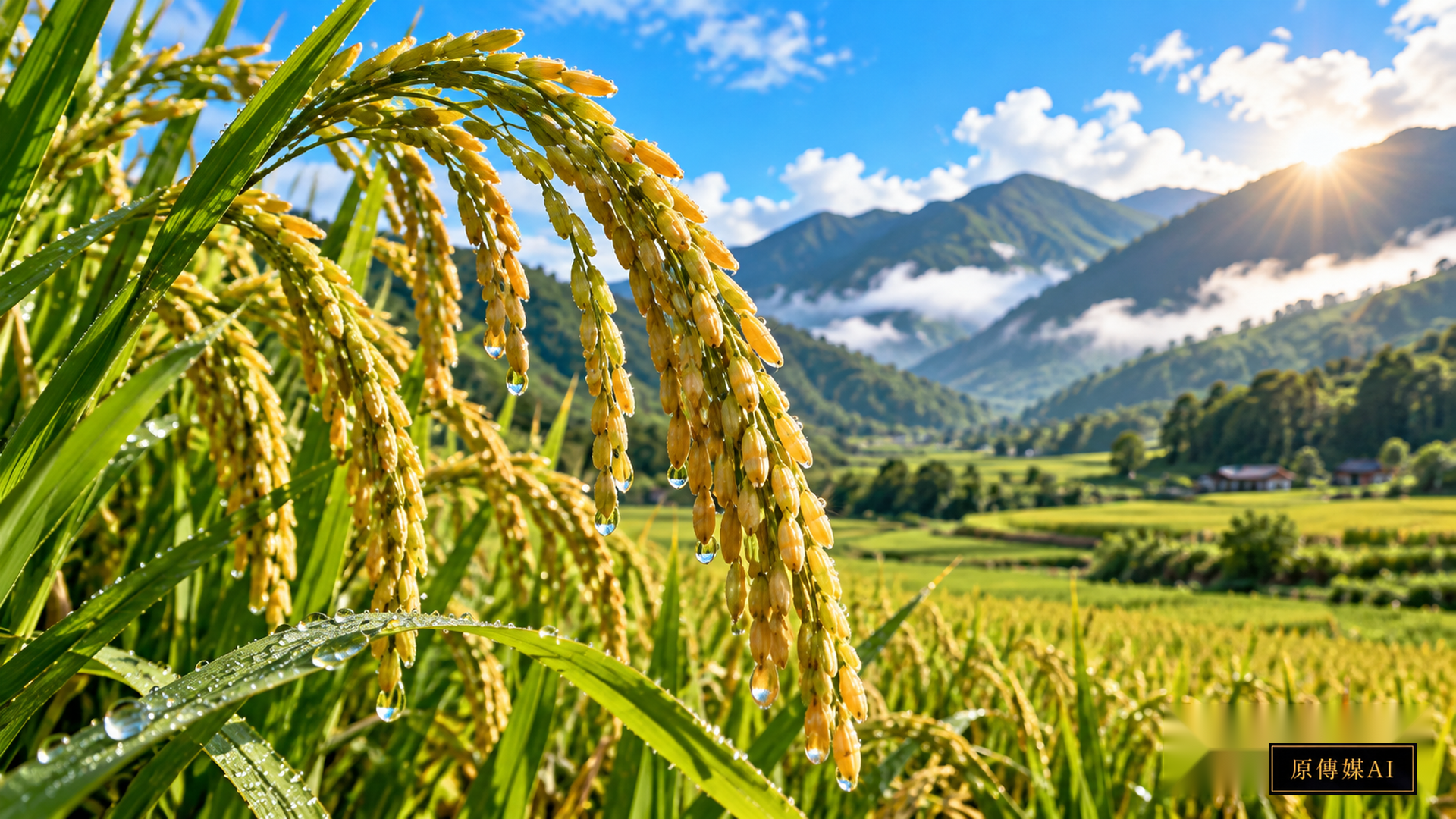
# Does Sowing Rice Seeds Directly into Soil Truly Conserve Water? Direct-Seeded Rice Meets Mountain Terraces: Water Savings, Weed Competition, and G×E Interactions Are Decisive
Viewing a single photograph of an alpine valley terrace or post-disaster field easily leads observers to interpret it as an isolated incident: someone sowing seeds, rice panicles ripening, emergency road repairs, or a table of produce ready for distribution. Yet the authentic challenges of Indigenous townships rarely reside in a single frame, but in the concurrent interplay of local ecology, labor structures, traditional knowledge, physical infrastructure, and statutory institutions. This analysis contextualizes research and official data within this broader landscape, not to impose a monolithic formula upon all communities, but to cleanly separate verifiable empirical evidence, conditions requiring localized validation, and tasks where artificial intelligence can constructively assist without overstepping human authority.
Direct Seeding Alters Crop Establishment, Not Merely Whether a Field Holds Standing Water
Conventional rice production nurses seedlings in specialized seedbeds before transplanting them into thoroughly puddled, flooded paddies; direct seeding sows seeds straight into production fields. Dry direct seeding establishes seedlings in unflooded soil conditions, circumventing nursery preparation, seedling pulling, and manual transplanting—positioning it as an attractive candidate for water conservation, labor reduction, and input cost containment. However, direct seeding is not an isolated mechanical trick; it is an integrated management architecture encompassing tillage, seed priming, planting depth, irrigation scheduling, and weed management. Modifying the seeding method without recalibrating adjacent agronomic practices often produces outcomes opposite to expectations.
From an implementation perspective, such initiatives stumble most frequently by mistaking technological access for institutional capability. Genuine capability encompasses who operates hardware, who maintains components, how data is interpreted, who bears accountability when anomalies arise, and whether communities retain sovereignty to reject ill-fitting methodologies. Every technology introduction must establish an auditable record: when implementation commenced, operating parameters applied, participating stakeholders, empirical observations recorded, and anticipated outcomes that failed to materialize. These detailed records determine whether a technology warrants expansion far more reliably than an idealized demonstration showcase.
The True Lesson from Hawaiian Field Trials: Beyond 'Japanese Rice Can Grow Here'
Research compiled by the Agricultural Knowledge Entrance in 2026 evaluated Japanese temperate japonica cultivars Koshihikari and Hitomebore cultivated under dry direct-seeded conditions in Hawaiʻi. The crop cycle compressed while grain yields approached comparative baselines of Japanese upland cultivation, demonstrating promising milling and visual grain quality. The paramount takeaway is the profound impact of genotype-by-environment-by-management (G×E×M) interactions. The study confirms that cross-environmental trials can uncover viable agroecological niches, but it cannot be assumed that all cultivars will replicate those metrics across disparate geographies. Diurnal temperature swings, solar radiation, mountain soil profiles, and water reliability in alpine terraces demand localized validation.
From an implementation perspective, such initiatives stumble most frequently by mistaking technological access for institutional capability. Genuine capability encompasses who operates hardware, who maintains components, how data is interpreted, who bears accountability when anomalies arise, and whether communities retain sovereignty to reject ill-fitting methodologies. Every technology introduction must establish an auditable record: when implementation commenced, operating parameters applied, participating stakeholders, empirical observations recorded, and anticipated outcomes that failed to materialize. These detailed records determine whether a technology warrants expansion far more reliably than an idealized demonstration showcase.
Water Conservation Is Not an Automatic Feature of Direct Seeding
The International Rice Research Institute (IRRI) explicitly emphasizes that direct seeding is a crop establishment methodology; whether water is genuinely conserved depends strictly upon irrigation management and soil water dynamics. Between seeding and seedling emergence, excessively waterlogged soils suffocate seeds and cause fungal rotting, whereas desiccated soils precipitate poor emergence rates. Throughout vegetative and reproductive growth, water demand shifts dynamically. Panicle initiation, booting, and flowering stages are extraordinarily vulnerable to moisture deficits; pursuing dry conditions during critical reproductive windows converts water savings into catastrophic yield collapses. Local trials must measure volumetric water consumption alongside final grain yield, rather than assessing whether surface water is absent.
From an implementation perspective, such initiatives stumble most frequently by mistaking technological access for institutional capability. Genuine capability encompasses who operates hardware, who maintains components, how data is interpreted, who bears accountability when anomalies arise, and whether communities retain sovereignty to reject ill-fitting methodologies. Every technology introduction must establish an auditable record: when implementation commenced, operating parameters applied, participating stakeholders, empirical observations recorded, and anticipated outcomes that failed to materialize. These detailed records determine whether a technology warrants expansion far more reliably than an idealized demonstration showcase.
The Formidable Hurdle: Weed Pressure and Uniform Crop Emergence
Flooding puddled paddy fields serves a primary ecological purpose: suppressing aerobic weed germination. Transitioning to dry direct seeding exposes rice seedlings to fierce, unbuffered weed competition. If planting depth varies across uneven seedbeds or rainfall is erratic, seedling emergence becomes ragged and irregular. While broad-acre commercial plains mitigate these risks through laser-guided land leveling and precision mechanical seed drills, small mountain plots, steep stepped terraces, or irregularly shaped parcels cannot adopt mechanized packages unadapted. Prior to adopting direct seeding, farmers must systematically evaluate parcel acreage, farm machinery accessibility, weeding regimes, and household labor capacity.
From an implementation perspective, such initiatives stumble most frequently by mistaking technological access for institutional capability. Genuine capability encompasses who operates hardware, who maintains components, how data is interpreted, who bears accountability when anomalies arise, and whether communities retain sovereignty to reject ill-fitting methodologies. Every technology introduction must establish an auditable record: when implementation commenced, operating parameters applied, participating stakeholders, empirical observations recorded, and anticipated outcomes that failed to materialize. These detailed records determine whether a technology warrants expansion far more reliably than an idealized demonstration showcase.
For Indigenous Mountain Townships: Saving Labor May Resonate More Than Saving Water
Many mountain agricultural valleys confront acute population aging, peak-season labor shortages, and off-farm employment migration. If direct seeding successfully eliminates the labor bottlenecks of seedling nursery management and manual transplanting, it delivers substantial economic value. However, if post-emergence weed control demands ballooning hand-weeding hours, labor has merely been shifted from early spring to early summer. Evaluation cannot isolate a single stage; the entire seasonal balance sheet must be audited—recording cumulative labor hours, irrigation water volume, seed application rates, weeding frequencies, fertilizer regimes, harvest yield, and grain quality—and rigorously benchmarked against traditional transplanting baselines.
From an implementation perspective, such initiatives stumble most frequently by mistaking technological access for institutional capability. Genuine capability encompasses who operates hardware, who maintains components, how data is interpreted, who bears accountability when anomalies arise, and whether communities retain sovereignty to reject ill-fitting methodologies. Every technology introduction must establish an auditable record: when implementation commenced, operating parameters applied, participating stakeholders, empirical observations recorded, and anticipated outcomes that failed to materialize. These detailed records determine whether a technology warrants expansion far more reliably than an idealized demonstration showcase.
Conducting Small-Scale Side-by-Side Trials to Find Authentic Community Answers
A single production field can maintain conventional transplanted paddies alongside an experimental direct-seeded plot, utilizing identical or comparable cultivars while systematically logging emergence rates, weed pressures, water applications, pest occurrences, heading dates, and final yields. Integrating on-site weather microstations or soil moisture sensors adds valuable telemetry, yet the heart of inquiry remains detailed agronomic field logs. This side-by-side methodology prevents growers from misjudging a technology based on an anomalous single-year weather event, clearly revealing which agronomic stages require adjustment.
From an implementation perspective, such initiatives stumble most frequently by mistaking technological access for institutional capability. Genuine capability encompasses who operates hardware, who maintains components, how data is interpreted, who bears accountability when anomalies arise, and whether communities retain sovereignty to reject ill-fitting methodologies. Every technology introduction must establish an auditable record: when implementation commenced, operating parameters applied, participating stakeholders, empirical observations recorded, and anticipated outcomes that failed to materialize. These detailed records determine whether a technology warrants expansion far more reliably than an idealized demonstration showcase.
Climate Adaptation Transcends Chasing a Single 'Water-Saving' Technique
As rainfall patterns grow increasingly erratic under climate change, agricultural resilience demands farming systems capable of adjusting dynamically across divergent hydrological states. Direct seeding, stress-resilient heritage cultivars, alternate wetting and drying (AWD) irrigation, soil organic matter conservation, and precision weather forecasting all constitute useful tools. Genuine adaptive capacity resides in the synergistic combination of practices, not in the brand name of a single technique. For Indigenous rice cultivation, the most vital foundation to safeguard is landrace varieties, watershed hydrology, and local farmer experience, deploying new practices deliberately to reduce systemic risk.
From an implementation perspective, such initiatives stumble most frequently by mistaking technological access for institutional capability. Genuine capability encompasses who operates hardware, who maintains components, how data is interpreted, who bears accountability when anomalies arise, and whether communities retain sovereignty to reject ill-fitting methodologies. Every technology introduction must establish an auditable record: when implementation commenced, operating parameters applied, participating stakeholders, empirical observations recorded, and anticipated outcomes that failed to materialize. These detailed records determine whether a technology warrants expansion far more reliably than an idealized demonstration showcase.
Moving from Reading to Action: Beginning with an Auditable Small Step
General readers can organize core analytical concepts into three operational columns: empirically verified facts, conditions requiring localized confirmation, and immediate low-cost actions. Technical practitioners must systematically log research methodologies, sample sizes, environmental microclimates, and documented failure thresholds. For Indigenous and community practitioners, the primary priority is verifying that local knowledge actively shapes operational decisions rather than merely serving as decorative citations in academic papers. Policymakers must budget long-term maintenance overhead, human capacity building, and community feedback loops. When these four stakeholder tiers achieve alignment, technology transitions from transient pilot subsidies into resilient, sustainable public capabilities.
Role-Guided Inquiries for Continued Deliberation
- If you are a general reader, you may ask: Within this report, which assertions are directly verifiable against public sources, and which conditions remain contingent on localized field validation?
- If you are a rice agronomy and crop cultivation specialist, you may ask: If we were to initiate implementation within our community or research field, what is the most cost-effective first step?
- If you are an Indigenous rice grower or local agricultural producer, you may ask: What specific analytical tasks is artificial intelligence best suited to handle here, and what operational decisions must remain under human control?
- If you are an agricultural water resources and climate policy planner, you may ask: How can governance frameworks determine whether an agricultural technology is genuinely effective, rather than merely appearing successful during subsidized pilot demonstrations?
Sources and Further Reading
Role-Driven Inquiry
Yuan Media AI | Guided Questions by Role
Select a role first, then review the complete questions from that perspective; clicking a question will display Yuan Media AI’s response in real time.
Select a role
General reader
Examine the article's evidence, governance boundaries, data rights, and actionable steps from the perspective of a General reader.
Choose a question
AI use and content-safety disclosure
This article was compiled from official and research sources; established facts, research limitations, localized contexts, and extended analyses are presented separately. The cover is an AI-assisted concept illustration.