After a Landslide, the First Task Is More Than Just Clearing the Road: From Community Observations to AI Disaster Synthesis, How Indigenous Recovery Embeds Local Knowledge into Engineering Decisions
Original Chinese title: 山崩之後,第一件事不只是把路挖通:從部落觀察到人工智慧災情整理,原鄉復原如何把在地知識放進工程決策
Emergency road opening is critical, but authentic post-disaster recovery requires understanding where runoff flows, which slopes remain unstable, and which families are isolated by transit disruptions. Marrying community observations with official monitoring, civil engineering data, and AI synthesis prevents 'roads being cleared while risks remain.'
原傳媒AI 編輯室
The Yuan Media AI Editorial Desk synthesizes artificial intelligence, agricultural science, environmental governance, and Indigenous public issues grounded in verifiable sources, localized context, and Two-Eyed Seeing.
# After a Landslide, the First Task Is More Than Just Clearing the Road: From Community Observations to AI Disaster Synthesis, How Indigenous Recovery Embeds Local Knowledge into Engineering Decisions
Viewing a single photograph of an alpine valley terrace or post-disaster field easily leads observers to interpret it as an isolated incident: someone sowing seeds, rice panicles ripening, emergency road repairs, or a table of produce ready for distribution. Yet the authentic challenges of Indigenous townships rarely reside in a single frame, but in the concurrent interplay of local ecology, labor structures, traditional knowledge, physical infrastructure, and statutory institutions. This analysis contextualizes research and official data within this broader landscape, not to impose a monolithic formula upon all communities, but to cleanly separate verifiable empirical evidence, conditions requiring localized validation, and tasks where artificial intelligence can constructively assist without overstepping human authority.
Rapid Road Clearance Is Urgent, but It Is Not the Whole of Recovery
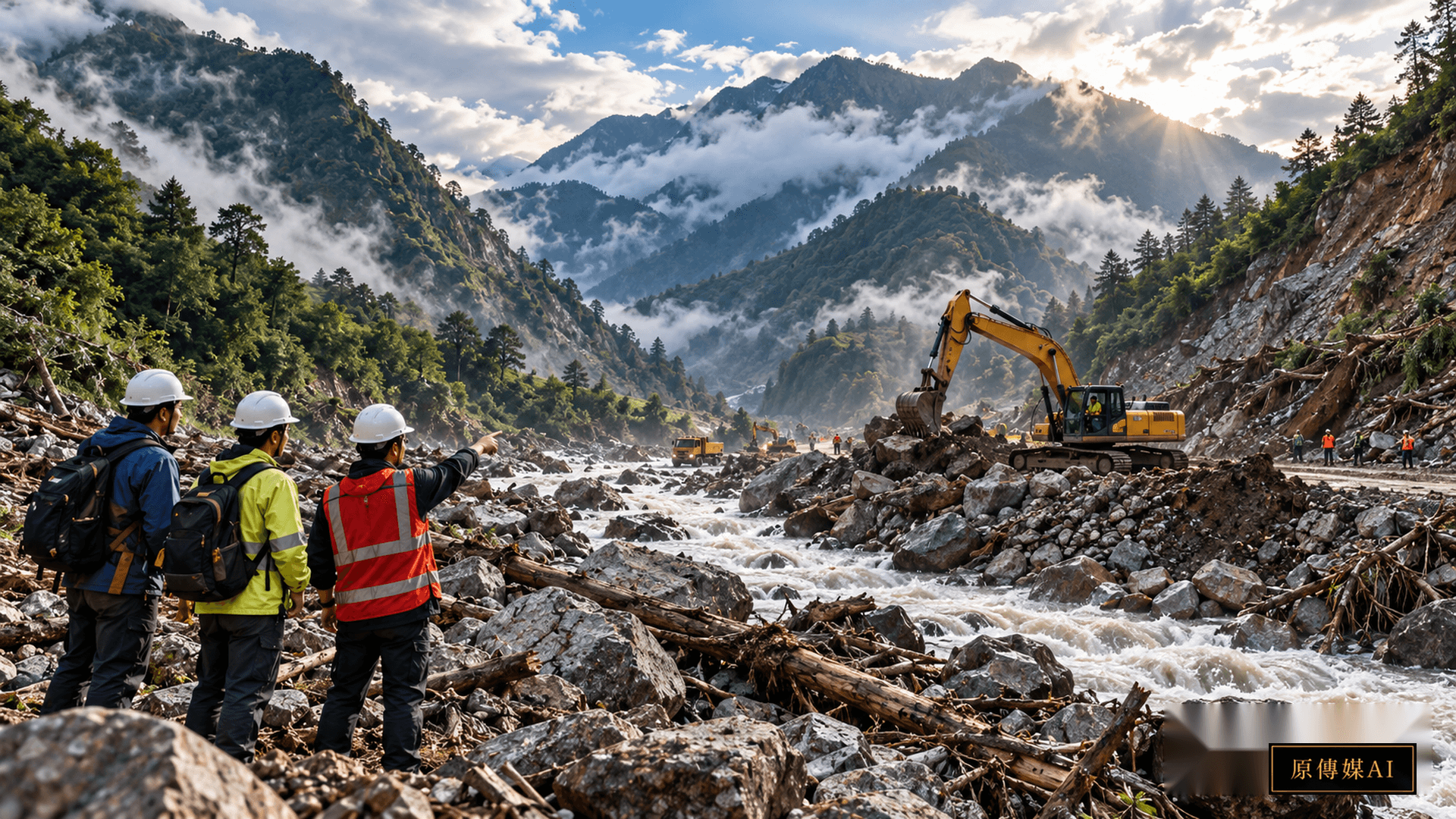
When mountain roads are severed by debris flows, mobilizing excavators to punch through emergency bypasses so relief supplies can enter is the most immediate public imperative. Yet re-establishing road connectivity merely restores basic transport function. Destabilized hillsides, sediment-choked riverbeds, disrupted drainage culverts, and upstream colluvial deposits continue to shift dynamically. If civil engineering decisions rely solely on aerial photography taken on day one or a single site survey, subsequent monsoon rains can trigger devastating secondary disasters. Genuine recovery demands decoupling "passable today" from "safe over the coming weeks."
From an implementation perspective, such initiatives stumble most frequently by mistaking technological access for institutional capability. Genuine capability encompasses who operates hardware, who maintains components, how data is interpreted, who bears accountability when anomalies arise, and whether communities retain sovereignty to reject ill-fitting methodologies. Every technology introduction must establish an auditable record: when implementation commenced, operating parameters applied, participating stakeholders, empirical observations recorded, and anticipated outcomes that failed to materialize. These detailed records determine whether a technology warrants expansion far more reliably than an idealized demonstration showcase.
Community Residents Possess a Far Longer Temporal Baseline than Episodic Site Surveys
Families living within the same river drainage or mountain slope for generations remember which swales discharge water first during prolonged downpours, which road curves drop stones after seismic tremors, and which stretches of river water turning turbid indicate upstream damming. These observations do not displace geological engineering surveys, but they provide the long-term historical baseline that civil engineering datasets routinely lack. Recent UNDRR guidelines affirm that traditional and local knowledge must be positioned alongside empirical science, rather than relegated to ornamental cultural anecdotes.
From an implementation perspective, such initiatives stumble most frequently by mistaking technological access for institutional capability. Genuine capability encompasses who operates hardware, who maintains components, how data is interpreted, who bears accountability when anomalies arise, and whether communities retain sovereignty to reject ill-fitting methodologies. Every technology introduction must establish an auditable record: when implementation commenced, operating parameters applied, participating stakeholders, empirical observations recorded, and anticipated outcomes that failed to materialize. These detailed records determine whether a technology warrants expansion far more reliably than an idealized demonstration showcase.
Early Warnings Must Be Understandable, Reachable, and Action-Triggering
A technologically precise hazard warning achieves zero utility if remote communities cannot receive it, cannot comprehend its jargon, or do not know what operational steps to take upon receipt. In 2026, UNDRR reiterated that early warning architectures in remote Indigenous areas must be co-designed around local languages, diverse communication channels, and traditional governance structures. This principle applies directly to Taiwan's mountainous townships: SMS broadcasts, messaging groups, village loudspeakers, ward systems, tribal leaders, and household networks can complement one another, provided protocols clearly designate who communicates warnings, who assists elders and individuals with mobility impairments, and what thresholds trigger evacuation.
From an implementation perspective, such initiatives stumble most frequently by mistaking technological access for institutional capability. Genuine capability encompasses who operates hardware, who maintains components, how data is interpreted, who bears accountability when anomalies arise, and whether communities retain sovereignty to reject ill-fitting methodologies. Every technology introduction must establish an auditable record: when implementation commenced, operating parameters applied, participating stakeholders, empirical observations recorded, and anticipated outcomes that failed to materialize. These detailed records determine whether a technology warrants expansion far more reliably than an idealized demonstration showcase.
Artificial Intelligence Can Convert Fragmented Incident Reports into Auditable Timelines
During acute disaster events, administrative databases, news dispatches, social media posts, field sensors, and smartphone photographs flood response centers concurrently. Artificial intelligence is extraordinarily effective at de-duplicating reports, categorizing data by geographic location and timestamp, annotating sources, and assembling events at a given locus into a coherent chain of causality. For instance, when a rockfall is reported along a road segment, followed two hours later by river turbidity and subsequently by photos of slope tension cracks, AI can flag that these separate data points represent a single evolving risk chain. However, AI must never unilaterally order road closures or mandatory evacuations; statutory authority and human judgment must remain with designated public officers and engineering specialists.
From an implementation perspective, such initiatives stumble most frequently by mistaking technological access for institutional capability. Genuine capability encompasses who operates hardware, who maintains components, how data is interpreted, who bears accountability when anomalies arise, and whether communities retain sovereignty to reject ill-fitting methodologies. Every technology introduction must establish an auditable record: when implementation commenced, operating parameters applied, participating stakeholders, empirical observations recorded, and anticipated outcomes that failed to materialize. These detailed records determine whether a technology warrants expansion far more reliably than an idealized demonstration showcase.
Reporting Schema Must Include 'Local Observations' Beyond Engineering Terminology
If emergency management software only permits data entry for highway mile markers, GPS coordinates, cubic meters of earthwork, and pavement structural condition, invaluable qualitative clues provided by local residents are excluded. Robust platforms incorporate descriptive fields for "river water discoloration," "unusual subterranean rumbles," "expansion of historical cracks," "displacement of customary spring outlets," and "anomalous livestock or wildlife movement," preserving raw voice memos and photographs. While these qualitative indicators may not instantly confirm impending failure, they provide vital intelligence for prioritizing dispatch and field investigations.
From an implementation perspective, such initiatives stumble most frequently by mistaking technological access for institutional capability. Genuine capability encompasses who operates hardware, who maintains components, how data is interpreted, who bears accountability when anomalies arise, and whether communities retain sovereignty to reject ill-fitting methodologies. Every technology introduction must establish an auditable record: when implementation commenced, operating parameters applied, participating stakeholders, empirical observations recorded, and anticipated outcomes that failed to materialize. These detailed records determine whether a technology warrants expansion far more reliably than an idealized demonstration showcase.
Recovery Engineering Requires a Continuously Updating Risk Map
Post-disaster terrain is never static. Clearing emergency bypasses, dredging river channels, temporarily stockpiling colluvium, or installing interim culverts permanently alters hydraulic flow paths and sediment routing. Hazard maps cannot remain frozen pre-disaster susceptibility overlays marked with a static "cleared" stamp; they must continuously incorporate ongoing field surveys, rainfall telemetry, satellite and drone imagery, resident reports, and civil works progress. Artificial intelligence can assist in managing version deltas, but each update must record timestamps and provenance so engineers know the exact conditions under which determinations were made.
From an implementation perspective, such initiatives stumble most frequently by mistaking technological access for institutional capability. Genuine capability encompasses who operates hardware, who maintains components, how data is interpreted, who bears accountability when anomalies arise, and whether communities retain sovereignty to reject ill-fitting methodologies. Every technology introduction must establish an auditable record: when implementation commenced, operating parameters applied, participating stakeholders, empirical observations recorded, and anticipated outcomes that failed to materialize. These detailed records determine whether a technology warrants expansion far more reliably than an idealized demonstration showcase.
Embedding Local Communities into Decision-Making Is the Core of True Resilience
Resilience does not mean demanding that vulnerable communities endure hardship more stoically; it means public institutions continuously absorb localized community intelligence across preparedness, response, and recovery. Community disaster response groups, tribal councils, local hazard monitors, public works engineers, and technological teams can establish fixed communication nodes: baseline reviews during calm periods, dense monitoring during typhoons, and daily updates post-disaster. When local knowledge, scientific monitoring, and civil authority maintain auditable feedback loops, recovery does not simply restore past vulnerabilities—it systematically diminishes the probability of recurrent catastrophe.
From an implementation perspective, such initiatives stumble most frequently by mistaking technological access for institutional capability. Genuine capability encompasses who operates hardware, who maintains components, how data is interpreted, who bears accountability when anomalies arise, and whether communities retain sovereignty to reject ill-fitting methodologies. Every technology introduction must establish an auditable record: when implementation commenced, operating parameters applied, participating stakeholders, empirical observations recorded, and anticipated outcomes that failed to materialize. These detailed records determine whether a technology warrants expansion far more reliably than an idealized demonstration showcase.
Moving from Reading to Action: Beginning with an Auditable Small Step
General readers can organize core analytical concepts into three operational columns: empirically verified facts, conditions requiring localized confirmation, and immediate low-cost actions. Technical practitioners must systematically log research methodologies, sample sizes, environmental microclimates, and documented failure thresholds. For Indigenous and community practitioners, the primary priority is verifying that local knowledge actively shapes operational decisions rather than merely serving as decorative citations in academic papers. Policymakers must budget long-term maintenance overhead, human capacity building, and community feedback loops. When these four stakeholder tiers achieve alignment, technology transitions from transient pilot subsidies into resilient, sustainable public capabilities.
Role-Guided Inquiries for Continued Deliberation
- If you are a general reader, you may ask: Within this report, which assertions are directly verifiable against public sources, and which conditions remain contingent on localized field validation?
- If you are a disaster management and civil engineering specialist, you may ask: If we were to initiate implementation within our community or research field, what is the most cost-effective first step?
- If you are an Indigenous community member or local disaster preparedness practitioner, you may ask: What specific analytical tasks is artificial intelligence best suited to handle here, and what operational decisions must remain under human control?
- If you are a regional and national disaster risk reduction policy planner, you may ask: How can governance frameworks determine whether a disaster technology is genuinely effective, rather than merely appearing successful during subsidized pilot demonstrations?
Sources and Further Reading
- UNDRR: Voices for resilience—integrating Indigenous knowledge into early warning systems
- UNDRR: Words into Action—Using Traditional and Indigenous Knowledges for Disaster Risk Reduction
- Agency of Rural Development and Soil and Water Conservation: Public Disaster Preparedness Guide—Debris Flows and Large-Scale Landslides
Role-Driven Inquiry
Yuan Media AI | Guided Questions by Role
Select a role first, then review the complete questions from that perspective; clicking a question will display Yuan Media AI’s response in real time.
Select a role
General reader
Examine the article's evidence, governance boundaries, data rights, and actionable steps from the perspective of a General reader.
Choose a question
AI use and content-safety disclosure
This article was compiled from official and research sources; established facts, research limitations, localized contexts, and extended analyses are presented separately. The cover is an AI-assisted concept illustration.