A Harvest Table Is More Than 'Specialty Produce': From Taro, Sweet Potatoes, and Beans to Rice, How Indigenous Food Systems Anchor Resilience, Nutrition, and Local Economies
Original Chinese title: 一張豐收桌不是「特色農產」而已:從芋頭、甘藷、豆類到稻米,原住民族食物系統如何撐起韌性、營養與地方經濟
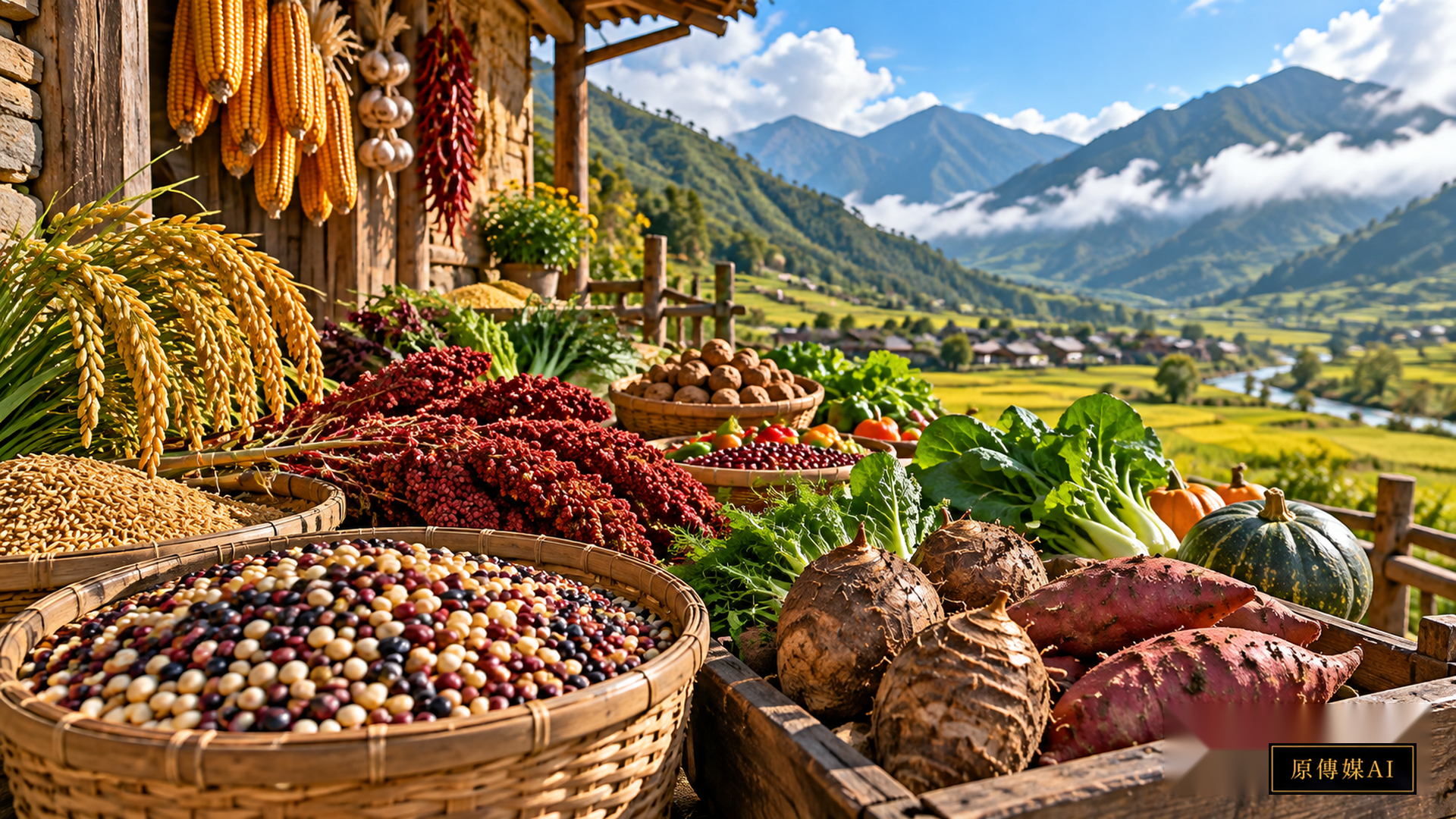
Placing taro, sweet potatoes, beans, maize, upland rice, and wild greens upon a single table embodies far more than diverse commercial goods; it represents an integrated food system linking soil, seasons, preservation, ceremonial customs, nutrition, and reciprocal exchange. Reducing seed saving and heritage crop revitalisation to souvenir gifts risks forfeiting their profound resilience value.
原傳媒AI 編輯室
The Yuan Media AI Editorial Desk synthesizes artificial intelligence, agricultural science, environmental governance, and Indigenous public issues grounded in verifiable sources, localized context, and Two-Eyed Seeing.
# A Harvest Table Is More Than 'Specialty Produce': From Taro, Sweet Potatoes, and Beans to Rice, How Indigenous Food Systems Anchor Resilience, Nutrition, and Local Economies
Viewing a single photograph of an alpine valley terrace or post-disaster field easily leads observers to interpret it as an isolated incident: someone sowing seeds, rice panicles ripening, emergency road repairs, or a table of produce ready for distribution. Yet the authentic challenges of Indigenous townships rarely reside in a single frame, but in the concurrent interplay of local ecology, labor structures, traditional knowledge, physical infrastructure, and statutory institutions. This analysis contextualizes research and official data within this broader landscape, not to impose a monolithic formula upon all communities, but to cleanly separate verifiable empirical evidence, conditions requiring localized validation, and tasks where artificial intelligence can constructively assist without overstepping human authority.
Diverse Crops upon a Single Table: The Microcosm of a Living Ecological System
Seeing taro, sweet potatoes, native legumes, maize, mountain rice, and gathered edible greens displayed before a homestead in a mountain village readily prompts external markets to label them collectively as "specialty produce." Yet for local communities, each crop corresponds to specific micro-seasons, slope aspects, post-harvest storage techniques, kinship gift exchanges, and culinary knowledge. Some varieties tolerate severe drought, others thrive during torrential monsoon rains, some cure for extended winter storage, and others occupy sacred positions within ceremonies or clan gatherings. Biodiversity is not an aesthetic exhibit; it distributes environmental risk across distinct crops and bodies of knowledge.
From an implementation perspective, such initiatives stumble most frequently by mistaking technological access for institutional capability. Genuine capability encompasses who operates hardware, who maintains components, how data is interpreted, who bears accountability when anomalies arise, and whether communities retain sovereignty to reject ill-fitting methodologies. Every technology introduction must establish an auditable record: when implementation commenced, operating parameters applied, participating stakeholders, empirical observations recorded, and anticipated outcomes that failed to materialize. These detailed records determine whether a technology warrants expansion far more reliably than an idealized demonstration showcase.
Seed Saving Is Not Locking Seeds in Cold Storage, but Keeping Them Planted, Eaten, and Exchanged
Research on Indigenous crop conservation compiled by the Agricultural Knowledge Entrance emphasizes that many landrace varieties are the product of centuries of farmer-led seed selection under localized environmental pressures, endowing them with remarkable climate adaptation. If seed germplasm is merely frozen in gene banks while farmers cease cultivation, families stop cooking traditional recipes, and younger generations never learn selection criteria, seeds forfeit their living cultural and ecological functions. Authentic seed saving requires continuous field propagation, selection standards, phenological timing, culinary processing, and community sharing networks—a living, unbroken biocultural cycle.
From an implementation perspective, such initiatives stumble most frequently by mistaking technological access for institutional capability. Genuine capability encompasses who operates hardware, who maintains components, how data is interpreted, who bears accountability when anomalies arise, and whether communities retain sovereignty to reject ill-fitting methodologies. Every technology introduction must establish an auditable record: when implementation commenced, operating parameters applied, participating stakeholders, empirical observations recorded, and anticipated outcomes that failed to materialize. These detailed records determine whether a technology warrants expansion far more reliably than an idealized demonstration showcase.
Food System Resilience: Never Placing Total Reliance upon a Single Crop
Commercial commodity markets universally reward standardized specifications, concentrated monoculture, and uniform branding; however, when mountainous regions confront typhoons, droughts, pests, and highway severance, agricultural biodiversity provides an indispensable buffer. Root crops store securely underground, legumes fix atmospheric nitrogen and facilitate crop rotations, grains provide dry storable calories, and wild vegetables supplement micronutrients during seasonal gaps. This does not reject commercial cash crops, but warns that when rural economies depend entirely upon a single high-value export crop, their vulnerability to market price crashes or extreme climate events escalates drastically.
From an implementation perspective, such initiatives stumble most frequently by mistaking technological access for institutional capability. Genuine capability encompasses who operates hardware, who maintains components, how data is interpreted, who bears accountability when anomalies arise, and whether communities retain sovereignty to reject ill-fitting methodologies. Every technology introduction must establish an auditable record: when implementation commenced, operating parameters applied, participating stakeholders, empirical observations recorded, and anticipated outcomes that failed to materialize. These detailed records determine whether a technology warrants expansion far more reliably than an idealized demonstration showcase.
When FAO Discusses Indigenous Food Systems, the Emphasis Is Never on Nostalgia
The Food and Agriculture Organization (FAO) recognizes Indigenous food and knowledge systems as vital assets in confronting climate change, biodiversity loss, and global malnutrition because they embody centuries of environmental phenology, circular nutrient recycling, seasonal adaptability, and multi-species stewardship. These traditional systems can partner powerfully with modern agronomy, nutritional science, and supply chain logistics, provided local knowledge is not commodified and extracted while traditional producers are stripped of decision-making authority and economic returns.
From an implementation perspective, such initiatives stumble most frequently by mistaking technological access for institutional capability. Genuine capability encompasses who operates hardware, who maintains components, how data is interpreted, who bears accountability when anomalies arise, and whether communities retain sovereignty to reject ill-fitting methodologies. Every technology introduction must establish an auditable record: when implementation commenced, operating parameters applied, participating stakeholders, empirical observations recorded, and anticipated outcomes that failed to materialize. These detailed records determine whether a technology warrants expansion far more reliably than an idealized demonstration showcase.
Upgrading Rural Economies: From 'Selling a Single Product' to 'Sustaining a Living System'
If public policy merely subsidizes product packaging, commercial branding, and e-commerce portals, assistance inevitably funnels into single commodities most readily commodified by urban markets. Conversely, if seed saving, heirloom cultivation, artisanal processing, school nutrition programs, farm-to-table culinary experiences, cultural ecotourism, and community seed fairs are integrated into a single regional development map, diverse community roles find meaningful engagement. Elder seed-saving and culinary arts, youth digital media and logistics, farmer agronomic skills, and community school diet education all become collaborative nodes in a single regenerative system.
From an implementation perspective, such initiatives stumble most frequently by mistaking technological access for institutional capability. Genuine capability encompasses who operates hardware, who maintains components, how data is interpreted, who bears accountability when anomalies arise, and whether communities retain sovereignty to reject ill-fitting methodologies. Every technology introduction must establish an auditable record: when implementation commenced, operating parameters applied, participating stakeholders, empirical observations recorded, and anticipated outcomes that failed to materialize. These detailed records determine whether a technology warrants expansion far more reliably than an idealized demonstration showcase.
AI Can Assist Documentation and Logistics, but Must Never Flatten Biodiversity into Sales Rankings
Artificial intelligence can organize botanical names, phenological planting and harvest calendars, cooking preparations, inventory counts, and customer orders, while transcribing elder audio field interviews into searchable databases and signaling when specific seed lots require rejuvenation. However, if algorithms exclusively optimize for "bestselling items" or "highest monetary yield," they inadvertently reinforce destructive monoculture. Resilient evaluation metrics must concurrently track conserved landrace varieties, participating cultivating households, dietary consumption frequencies, youth engagement, post-disaster availability, and localized household income.
From an implementation perspective, such initiatives stumble most frequently by mistaking technological access for institutional capability. Genuine capability encompasses who operates hardware, who maintains components, how data is interpreted, who bears accountability when anomalies arise, and whether communities retain sovereignty to reject ill-fitting methodologies. Every technology introduction must establish an auditable record: when implementation commenced, operating parameters applied, participating stakeholders, empirical observations recorded, and anticipated outcomes that failed to materialize. These detailed records determine whether a technology warrants expansion far more reliably than an idealized demonstration showcase.
Authentic Food Sovereignty: The Community's Sovereign Power to Decide What Endures
A robust Indigenous food system does not reject modern markets or emerging technologies; it preserves sovereign agency: deciding which seeds are stewarded, what cultural knowledge is shared publicly, which goods are commercialized, and which crops are prioritized for community sustenance. When these choices are deliberated by community growers, families, and local organizations, external technology becomes a powerful ally. The profound worth of a harvest table lies not in visual abundance, but in the living land relationships and knowledge networks that sustain every single dish upon it.
From an implementation perspective, such initiatives stumble most frequently by mistaking technological access for institutional capability. Genuine capability encompasses who operates hardware, who maintains components, how data is interpreted, who bears accountability when anomalies arise, and whether communities retain sovereignty to reject ill-fitting methodologies. Every technology introduction must establish an auditable record: when implementation commenced, operating parameters applied, participating stakeholders, empirical observations recorded, and anticipated outcomes that failed to materialize. These detailed records determine whether a technology warrants expansion far more reliably than an idealized demonstration showcase.
Moving from Reading to Action: Beginning with an Auditable Small Step
General readers can organize core analytical concepts into three operational columns: empirically verified facts, conditions requiring localized confirmation, and immediate low-cost actions. Technical practitioners must systematically log research methodologies, sample sizes, environmental microclimates, and documented failure thresholds. For Indigenous and community practitioners, the primary priority is verifying that local knowledge actively shapes operational decisions rather than merely serving as decorative citations in academic papers. Policymakers must budget long-term maintenance overhead, human capacity building, and community feedback loops. When these four stakeholder tiers achieve alignment, technology transitions from transient pilot subsidies into resilient, sustainable public capabilities.
Role-Guided Inquiries for Continued Deliberation
- If you are a general reader, you may ask: Within this report, which assertions are directly verifiable against public sources, and which conditions remain contingent on localized field validation?
- If you are an agricultural biodiversity and food systems specialist, you may ask: If we were to initiate implementation within our community or research field, what is the most cost-effective first step?
- If you are an Indigenous farmer, traditional cook, or cultural knowledge keeper, you may ask: What specific analytical tasks is artificial intelligence best suited to handle here, and what operational decisions must remain under human control?
- If you are an agricultural, public health, and rural economic policy planner, you may ask: How can governance frameworks determine whether a food initiative is genuinely effective, rather than merely appearing successful during subsidized pilot demonstrations?
Sources and Further Reading
Role-Driven Inquiry
Yuan Media AI | Guided Questions by Role
Select a role first, then review the complete questions from that perspective; clicking a question will display Yuan Media AI’s response in real time.
Select a role
General reader
Examine the article's evidence, governance boundaries, data rights, and actionable steps from the perspective of a General reader.
Choose a question
AI use and content-safety disclosure
This article was compiled from official and research sources; established facts, research limitations, localized contexts, and extended analyses are presented separately. The cover is an AI-assisted concept illustration.