From Learning How to Be a Dad to Building a Support Network: How First Nations Men in Australia Connect Fatherhood, Culture, Community, and Mental Health
Original Chinese title: 從「怎麼當爸爸」走進支持網:澳洲原住民男性如何以父職、文化與社群連起心理健康?
A fatherhood program in remote Australian communities places men's mental health within family, culture, and community relationships. Its early trends merit follow-up, but a small sample and nonsignificant between-group differences do not establish clinical efficacy.
王莉如|諮商心理師督導
A counseling psychology supervisor whose long-term work focuses on trauma recovery, couple and family relationships, professional ethics in helping professions, and social and emotional support.
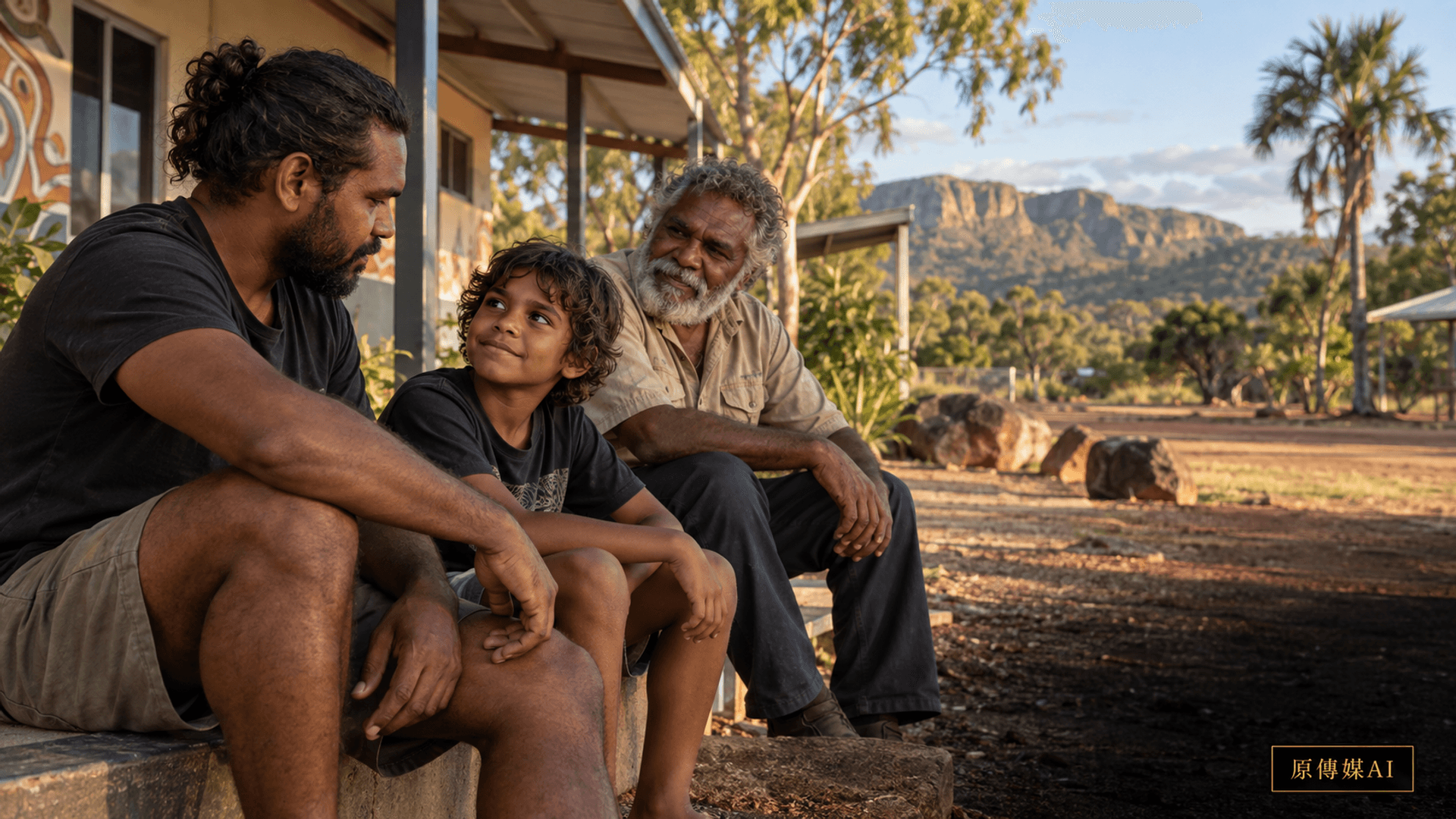
# From Learning How to Be a Dad to Building a Support Network: How First Nations Men in Australia Connect Fatherhood, Culture, Community, and Mental Health
Why a Fatherhood Session Can Become an Entry Point to Mental Health
In remote communities of Far North Queensland, Australia, “how to be a dad” is not a question a manual can settle. Men may simultaneously carry parenting responsibilities, work and transport constraints, distrust of institutions rooted in colonial history, and disrupted connections with Country, kin, and culture. The research team therefore did not begin with diagnostic labels or a consulting room. It placed fatherhood, communication with partners, recognition of emotions, and community support inside locally facilitated gatherings. That approach can lower the pressure created by the idea that asking for help means admitting failure. It also moves mental health beyond an individual pathology and makes it a shared subject that can be discussed through family relationships and cultural safety.
Clarifying the Participant Counts: 68, 66, 38, and 36 Are Not the Same
The easiest detail to misreport is the set of different participant counts at different stages. The abstract says the intervention involved 68 adult men. The flow diagram shows that 68 were screened and 66 were eligible and randomized: 38 were allocated to the intervention group and 28 to control, with 36 and 27 followed up respectively. The methods narrative also says that 40 joined at baseline and 38 completed the full program, which does not fully align with the flow diagram. The most responsible reading is to label the screening pool, randomized population, allocated group, and follow-up sample separately. We should neither combine them into one number nor assume without evidence that one passage is merely a typographical error.
The Quantitative Results Suggest a Direction but Do Not Prove Superiority
The trial used the Gender-Equitable Men scale and the Kessler 6 psychological distress scale. Average changes in the intervention group moved in a more favorable direction, and several items concerning confidence, happiness, and feeling centered improved within that group. However, the main between-group comparisons were not statistically significant; the paper reports p values of .36 and .26. The evidence therefore supports a trend worth studying, not a claim that efficacy has been established or that the program can replace existing clinical services. The small sample, short follow-up, and limited number of communities all make estimates unstable. A headline that keeps only an improvement figure while omitting nonsignificant comparisons would exaggerate what the study has answered.
What Fifteen Interviews Reveal Beyond the Numbers
The study also invited participants into qualitative interviews, with 15 men interviewed in Doomadgee and Hope Vale. Their accounts describe how storytelling, collective discussion, and peer support helped fathers reconsider relationships with children, partners, and their own emotions. The value of these accounts is to show how the program was experienced, not to provide a guarantee of quantitative efficacy. Positive accounts may be shaped by voluntary participation, relationships with facilitators, or social expectations; the experiences of those who did not take part cannot be represented on their behalf. Qualitative and quantitative evidence can illuminate one another, but neither should be made to substitute for the other.
Social and Emotional Well-being Is Broader Than the Presence or Absence of Illness
The Australian Institute of Health and Welfare describes Indigenous social and emotional well-being as holistic and multidimensional. It includes physical and mental dimensions as well as connections to family and kin, community, culture, land and sea, spirituality, and ancestors. This framework reminds services that whether a father feels capable may be linked at once to parent-child relationships, cultural roles, housing stability, transport access, and respectful treatment by institutions. Reducing every difficulty to an individual symptom overlooks the support network. Conversely, speaking only about culture while withholding necessary clinical referral can delay care. Both dimensions must operate together.
Two-Eyed Seeing: Measurement Enables Comparison, While Community Determines Meaning
Two-Eyed Seeing does not mean placing a Western scale beside a cultural activity and calling the balance complete. It means that knowledge systems jointly shape the question, the measurement, and the interpretation. Researchers can contribute randomization, scales, follow-up, and estimates of uncertainty. Communities can determine which words are understandable, which settings are safe, how fatherhood responsibilities connect to kinship networks, and what change is genuinely useful. Data feedback should not stop at an academic publication; it should return to Elders, local councils, and participants. A larger future trial must preserve local co-governance rather than allowing scale to flatten differences among communities.
A Support Pathway Needs Named Responsibilities
For a community program to endure, it should specify at least four things: who first receives a man when he is ready to talk, when referral to psychological or medical professionals is required, how transport and costs will be addressed, and who coordinates an immediate response during a crisis. A fatherhood group can be a low-threshold entry point, but it cannot carry every crisis response. The Australian Department of Health lists mental health and crisis supports available to Aboriginal and Torres Strait Islander peoples. Local implementation still needs locally usable contacts, opening hours, and commitments to cultural safety. The quality of a network depends on whether someone follows through after help is requested, not on the number of sessions delivered.
The Next Study Must Examine More Than Average Scores
Future trials need larger samples, longer follow-up, and transparent records of withdrawal reasons, different community contexts, and adverse events. Beyond average scale scores, researchers could track service use, parent-child interaction, family safety, and outcomes that participants themselves define as important. Primary outcomes and analytical methods should be specified in advance so that reporting does not shift toward a few favorable items after results are seen. If an effect appears in some communities but not others, inquiry should examine implementation quality, facilitator support, and local conditions instead of hastily attributing differences to participants.
Read the Study with Hope and with Proportion
The public value of this case is not a declaration that a six-week course cured anyone. It demonstrates that fatherhood and cultural safety can open a conversation about men's mental health. At this stage, we can say that the program began from community context, participants described meaningful experiences, and quantitative signals provide direction for the next study. We cannot yet determine the size or duration of a clinical effect or whether results transfer to other communities. Naming what is known and unknown at the same time does not diminish the program; it makes investment, consent, and future validation more honest.
When Bringing the Case to Taiwan, Translate the System Before Copying the Course
Australia's Indigenous social and emotional well-being framework cannot be transferred to Taiwan simply by changing service names and copying a curriculum. Indigenous peoples, communities, languages, kinship organization, and access to care differ across Taiwan, and fathers or men do not share one way of asking for help. A community wishing to learn from this case should first bring community organizations, men and family representatives, mental-health workers, and social-service staff together to map the existing support pathway: whom people approach first, who responds at night, how transport works, and who can use the local language or understands relationships. That map matters more than copying six sessions because it establishes whether a person will be supported after the activity ends.
Evaluation does not need to begin at scale. A pilot can record recruitment, attendance, reasons for leaving, participants' assessments of safety and usefulness, and whether referrals were completed. Any scale requires review of wording, cultural fit, and how results will be returned. Data responsibility must be agreed before collection: who sees raw records, how findings return to the community, and when identifiable information is deleted. Family violence, self-harm risk, or acute mental-health needs require professional and statutory responses rather than remaining in a general fatherhood discussion. The transferable lesson is community leadership and verifiable practice, not a ready-made efficacy claim.
Attendance alone should not represent effectiveness. A participant may complete sessions without receiving a needed referral, while someone who leaves early may build support elsewhere; both outcomes deserve follow-up. A trusted person should conduct follow-up, participants must be free not to answer, and crisis contact should remain separate from research interviews. Evaluation becomes an improvement tool only when participants understand data use and communities can review the conclusion.
Continue by Asking from Your Role
- If you are among General readers and family caregivers, continue by asking about evidence boundaries, governance responsibility, and the next verifiable action.
- If you are among First Nations men, fathers, and community members, continue by asking about evidence boundaries, governance responsibility, and the next verifiable action.
- If you are among Counseling psychology and social and emotional well-being practitioners, continue by asking about evidence boundaries, governance responsibility, and the next verifiable action.
- If you are among Community health, policy, and research professionals, continue by asking about evidence boundaries, governance responsibility, and the next verifiable action.
Sources and Further Reading
- American Journal of Men's Health: a fatherhood and social and emotional well-being trial with First Nations men in remote Australia
- PubMed: the Enabling Dads / Strong Fathers randomized trial protocol
- Australian Institute of Health and Welfare: Indigenous social and emotional well-being
- Australian Department of Health: mental health support for Aboriginal and Torres Strait Islander peoples
Role-Driven Inquiry
Yuan Media AI | Guided Questions by Role
Select a role first, then review the complete questions from that perspective; clicking a question will display Yuan Media AI’s response in real time.
Select a role
General readers and family caregivers
Examine the article's evidence, governance boundaries, data rights, and actionable steps from the perspective of a General readers and family caregivers.
Choose a question
AI use and content-safety disclosure
This article was compiled from official and research sources. Established facts, limitations, local context, and analysis are presented separately. The cover is an AI-assisted concept illustration.