Making Pollution Monitoring Follow Old Products into Their Second Life: What 181 Studies Reveal About Flame Retardants Across Europe's Environment and Recycling Flows
Original Chinese title: 讓污染監測跟上舊產品的第二生命:181篇研究如何追出阻燃劑在歐洲環境與回收物流中的路徑?
A synthesis of 181 European studies finds PBDEs across air, water, soil, sediment, sludge, snow, and firn. Monitoring must follow products into waste and recycled materials, while environmental detection must not be treated as proof of individual exposure or disease.
鍾靜蓉|台科大數位教育博士
A researcher in digital teaching strategies and meta-data reasoning who studies the integration of artificial intelligence into teaching, assessment, teacher professionalism, and higher-education governance.
# Making Pollution Monitoring Follow Old Products into Their Second Life: What 181 Studies Reveal About Flame Retardants Across Europe's Environment and Recycling Flows
When an Old Product Leaves Home, Its Pollution Path Merely Changes Names
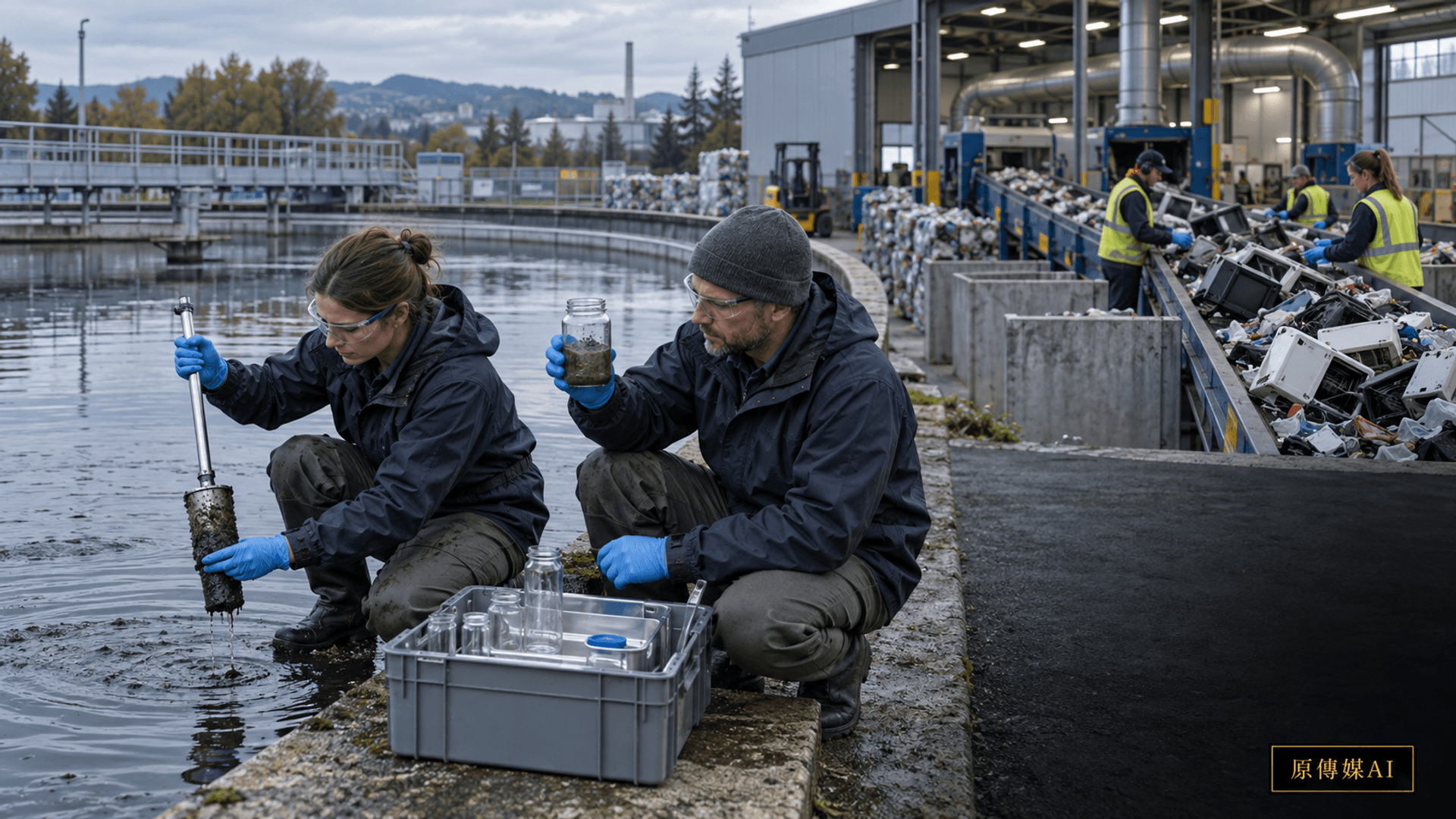
After an old sofa, electronics casing, vehicle interior, or plastic-containing household item is discarded, it may enter dismantling, shredding, sorting, incineration, landfill, or remanufacturing. Polybrominated diphenyl ethers (PBDEs), once added to reduce fire risk, do not disappear when a product is relabeled waste or recycled feedstock. They can bind to dust and particles, accumulate in sludge and sediment, or move with brominated materials into new consumer products. Understanding an old product's second life requires monitoring that follows material flows instead of standing only at an industrial discharge pipe.
The 181 Studies Form a Distribution Map, Not One Concentration
A 2026 systematic review used a PRISMA process to synthesize 181 peer-reviewed studies available through November 2025. It covered European air, water, sediment, soil, snow and firn, sludge, and other environmental compartments. Sampling years, congeners analyzed, units, detection limits, and geographic density differ among studies. The review is therefore powerful for comparing broad patterns and gaps, not for calculating a single concentration that represents all of Europe. Combining every result into a ranking without harmonization would hide methodological differences.
Water May Look Lower While Sediment and Sludge Retain a Long Signal
The review reports that concentrations in water are often lower and more transient, but that does not mean the system is clean. PBDEs are hydrophobic and tend to bind to particles and organic matter, making sediment, sludge, and some soils longer-term reservoirs. Storms, dredging, use of sludge, or surface disturbance can remobilize stored pollutants. A design based only on water samples may underestimate historical loading, while sediment alone cannot describe short pulses of transport. Cross-compartment sampling conducted in comparable periods is better able to portray movement.
Different Congeners Point to Different Material and Transformation Questions
BDE-209 commonly dominates particle-rich and wastewater-related matrices in the review, while lower-brominated congeners such as BDE-47 and BDE-99 are more prominent in air and some soils. These profiles can generate hypotheses about source and transformation, but one ratio cannot identify a single factory or product. Sampling contamination, photolysis, debromination, long-range transport, and mixed sources can all alter a pattern. Source apportionment needs time series, material information, quality control, and supporting chemical indicators.
At Least Two Bridges Separate Environmental Concentration from Health Outcome
Detecting PBDEs in an environmental sample answers how much of a chemical was present at a particular place and time. It does not measure the dose absorbed by an individual. Human exposure also depends on indoor dust, diet, occupation, contact frequency, age, and metabolism. Even when a biomarker is measured, a health outcome requires analysis of dose-response, temporal order, co-exposures, and other determinants. Monitoring can identify priority areas and guide reduction, but a single detection in river sediment or sludge cannot prove that a resident developed a particular disease.
The Recycling Dilemma: Circularity Must Not Circulate Hazards
The European Environment Agency identifies hazardous flame retardants in waste streams as a barrier to plastics circularity. Without identification and separation, regulated chemicals can enter recycled-plastic consumer goods. If all suspect material is incinerated or discarded, material value is lost and other environmental burdens may rise. The answer is not to reject recycling, but to build bromine screening, product and material information, diversion thresholds, traceable batches, and safe treatment capacity. Circular-economy performance should measure whether hazardous substances leave the loop, not only how many tonnes are recycled.
Two-Eyed Seeing: Laboratory Profiles Must Meet Material Knowledge from the Sorting Floor
Analytical chemistry provides congener concentrations, detection limits, and quality control. Dismantling workers, recyclers, and local monitoring staff know which ages and product types enter a stream, where dust increases, and when equipment behaves abnormally. Two-Eyed Seeing here connects both observations in the sampling strategy; experience does not replace the instrument. If sampling point, shift, product batch, and unusual events are recorded together, laboratory results can return as actionable segregation, ventilation, cleaning, and occupational-protection measures.
A Regulatory Phase-out Does Not Erase Historical Stock Overnight
The Stockholm Convention has listed multiple PBDE congeners associated with commercial penta- and octabromodiphenyl ether mixtures for elimination, while the European Chemicals Agency continues to assess group management of brominated flame retardants. Furniture, construction materials, vehicles, electronics, and recycled feedstock can remain in use for years, and sediment and sludge can retain older releases. Declining trends and local hot spots can therefore coexist. Policy evaluation must distinguish new use, release from stocks, cross-border material flows, and historical environmental reservoirs instead of assuming pollution ended on the date of a restriction.
Next-generation Monitoring Should Move with Products, Compartments, and Decisions
A more useful network would maintain comparable long-term sites across urban, industrial, wastewater, waste-treatment, and remote-background settings while linking samples to product age, material batch, and treatment process. Method details and nondetects must be retained for comparison. Artificial intelligence can help identify spatial-temporal gaps and unusual combinations, but it cannot turn measurements with incompatible units or quality into precise predictions. Indicators should lead back to decisions: which materials need early segregation, which sites need denser sampling, and which exposure scenarios require separate biomonitoring or occupational studies.
Turn Monitoring Results into Sorting Rules, Not a List of Fears
For households, learning that an old product may contain flame retardants does not mean it should be dismantled, sanded, or burned at home. A safer response is to use local waste channels for electronics, furniture, and plastics, keep children away from dismantling dust, and use damp cleaning to reduce indoor dust. Color and odor generally cannot identify a particular PBDE formulation, and one environmental study does not make every flame-retarded material an equal risk. Consumers need recognizable collection instructions, accepted drop-off points, and material information; they should not be expected to act as a chemistry laboratory.
For recycling facilities and regulators, a measurement must connect back to a batch and process. High-risk product ages and categories can be screened for bromine and then confirmed with laboratory methods for regulated substances. Records should include dust control, negative pressure and ventilation, protective equipment, cleaning, residue destination, and end use of recycled material. A published concentration without sampling location, unit, and quality control cannot readily guide improvement. Cross-border materials also need shared documentation and inspection so that stocks removed from stricter markets are not shifted to places with weaker information and treatment capacity only to re-enter supply chains in recycled goods.
A public dashboard should show sampling compartment, date, unit, detection limit, congener, and quality flag, and should let users compare water, sediment, and sludge separately. Map colors must not be labeled health-risk levels without a separate exposure and toxicological assessment. Values below detection should retain their original qualifier rather than being converted automatically to zero. Transparent method metadata is what makes annual trends and policy effects interpretable. Authorities should also publish data gaps and the next sampling plan so that unmeasured areas are not mistaken for clean ones. Method changes that break a time series must be marked; better detection should not be misreported as a sudden environmental deterioration.
Continue by Asking from Your Role
- If you are among Consumers and households, continue by asking about evidence boundaries, governance responsibility, and the next verifiable action.
- If you are among Environmental monitoring and analytical chemistry professionals, continue by asking about evidence boundaries, governance responsibility, and the next verifiable action.
- If you are among Recycling, waste, and materials-sector professionals, continue by asking about evidence boundaries, governance responsibility, and the next verifiable action.
- If you are among Chemicals and environmental-health policymakers, continue by asking about evidence boundaries, governance responsibility, and the next verifiable action.
Sources and Further Reading
- University of Oulu repository: systematic review of PBDEs across European environmental compartments
- European Environment Agency: hazardous flame retardants in recycled-plastic consumer goods
- European Chemicals Agency: restriction assessment for selected brominated flame retardants
- Stockholm Convention: overview of listed polybrominated diphenyl ethers
Role-Driven Inquiry
Yuan Media AI | Guided Questions by Role
Select a role first, then review the complete questions from that perspective; clicking a question will display Yuan Media AI’s response in real time.
Select a role
Consumers and households
Examine the article's evidence, governance boundaries, data rights, and actionable steps from the perspective of a Consumers and households.
Choose a question
AI use and content-safety disclosure
This article was compiled from official and research sources. Established facts, limitations, local context, and analysis are presented separately. The cover is an AI-assisted concept illustration.