Why Does One Seaweed Sugar Take a Bacterial Team to Break Down? Fucoidan and Division of Labor in the Marine Carbon Cycle
Original Chinese title: 一種海藻糖,為什麼需要整個細菌團隊才能拆解?fucoidan 讓海洋碳循環看見分工的力量
Some marine bacteria target the fucose-rich backbone of fucoidan while others use side chains. A reconstructed consortium reveals complementarity, but global carbon storage requires separate field evidence.
全明正|布農族雙龍部落|文化與影像記錄者|長期關注能源轉型、材料科技、低碳供應鏈、產業政策與地方環境治理
A Bunun cultural and visual documentarian from Shuanglong community whose work covers energy transition, materials, low-carbon supply chains, industrial policy, and local environmental governance.
# Why Does One Seaweed Sugar Take a Bacterial Team to Break Down? Fucoidan and Division of Labor in the Marine Carbon Cycle
Seaweed carbon does not automatically reach the seabed
Brown algae contain complex polysaccharides in cell walls and mucus, including fucoidans. Their resistance to microbial breakdown raises questions about particle formation, transport, and possible long-term storage. Resistance is not permanence: microbes, currents, and seabed conditions can change the fate of carbon before it reaches a durable reservoir.
Backbone and side chains are different jobs
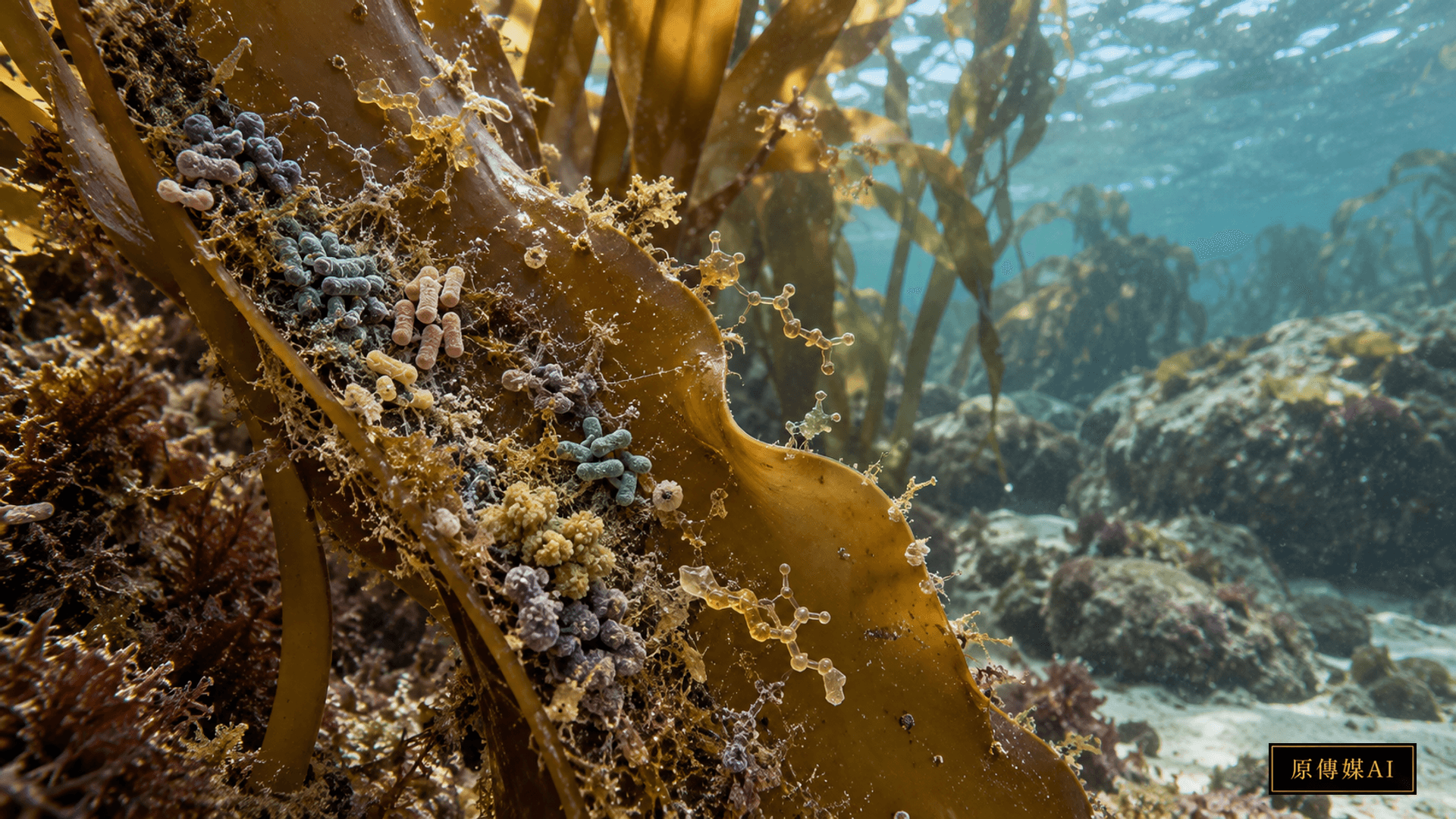
The Nature study distinguishes a sulfated fucose-rich backbone from side chains containing less common sugars. Bacterial strains differ in the enzymes and products they use. “Division of labor” describes complementary metabolic abilities, not conscious task assignment. A single strain can miss what a community can accomplish.
What fucoidan means
The Chinese headline uses a general phrase for seaweed sugar, but fucoidan is more precisely a brown-algal fucose-rich, often sulfated polysaccharide. It is not the disaccharide trehalose, sometimes literally called “seaweed sugar” in Chinese. Fucoidans vary by algae in backbone linkages, sulfate positions, and side chains. Performance on one substrate cannot represent every seaweed.
How cooperation was tested
Researchers enriched a coastal seawater community on fucoidan from Fucus vesiculosus, then separated and reconstructed strains and measured metabolites and substrate loss. The paper reports 90% degradation after twelve enrichment cycles and synergistic interactions increasing efficiency by up to 97.1% under specified experimental conditions. These are laboratory measures, not an average rate for the ocean or a direct measure of global carbon storage.
Complementarity need not mean mutualism
Synergy can arise because enzyme repertoires complement one another. It need not mean bacteria exchange nutrients in a stable mutualistic relationship. Laboratory reconstruction helps identify mechanism but excludes many field variables such as currents, predation, season, and changing nutrients. Co-occurrence of complementary strains in natural samples suggests relevance; field rates and carbon fate still need direct measurement.
The denominator behind a percentage
A reported increase in degradation needs its comparison: which fucoidan, how long, which single and mixed strains, and whether the measure is polymer disappearance or a product. Large percentages cannot necessarily be added if denominators, culture periods, or measurements differ. A headline using the highest value should identify it as a particular reconstructed community result, not an ocean carbon budget.
What the model predicts
A simplified community model linked bacterial abilities and combinations to fucoidan degradation and was tested with different substrates. It can ask which step slows when a guild is scarce. It does not yet predict global seaweed carbon, ocean uptake, or climate. Neither “all seaweed carbon is stored forever” nor “microbes prevent any storage” follows from this experiment.
Two-Eyed Seeing: two-way knowledge on the coast
Fishers, coastal residents, and aquaculture workers observe seasonal algae, drift, facilities, and water quality. Their observations can guide when and where to sample and reveal field conditions absent from laboratory work. Molecular methods identify polysaccharide structure, enzymes, and products. Neither local observation nor molecular evidence replaces the other; results and limits should return to the communities that help frame field questions.
Implications for aquaculture and governance
A climate claim for seaweed cultivation needs an accounting of growth, harvest, processing, transport, leakage, sinking, and decomposition. Microbial composition may shape one part of that chain. Long-term records of algae, season, water quality, and organic matter fate can guide whether molecular sampling is useful. Engineered microbial applications would require separate evaluation of safety, cost, and release.
Following carbon along the whole route
Carbon in seaweed may stay in biomass, be harvested or eaten, dissolve, sink as particles, or return to circulation after microbial breakdown. The timescales and climate implications differ. Fucoidan enzymology helps explain one decomposition route but cannot replace a carbon budget. A field claim about durable storage requires observations of algae, particles, dissolved organic matter, transport, depth, and season.
Testing the model in the field
Laboratories fix a carbon source and know the strains; seawater contains multiple algae, particles, viruses, predators, and shifting water masses. Sampling across seasons can compare environmental conditions, guild composition, and actual fucoidan changes. A model that fails in a place may reveal a missing ecological factor. Its value is being testable and revisable, and failures should be reported.
Local partners are more than sampling assistants
Fishers and farmers contribute boats, time, place knowledge, and long-term observation. Before sampling, partners should agree on purpose, data use, sensitive locations, and how results return. Publishing precise coordinates may be inappropriate in culturally or economically sensitive areas. Molecular tools and usable local findings should inform a jointly defined question rather than treating local accounts as decorative context.
Keep the unknowns visible
Fucoidan structures, bacteria, and conditions differ. In the ocean, transport speed, particle formation, and depth also matter. The study offers a testable mechanism for community-level breakdown of complex polymers, not a claim that one consortium determines global sequestration. Field time series, tracers, microbial data, and carbon budgets are needed next.
Continue asking from your role
- Coastal residents and fishers: Ask about evidence, limits, and practical action.
- Seaweed farmers: Ask about evidence, limits, and practical action.
- Marine microbiologists: Ask about evidence, limits, and practical action.
- Marine governance and science educators: Ask about evidence, limits, and practical action.
Sources and further reading
Role-Driven Inquiry
Yuan Media AI | Guided Questions by Role
Select a role first, then review the complete questions from that perspective; clicking a question will display Yuan Media AI’s response in real time.
Select a role
Coastal residents and fishers
Examine the article's evidence, governance boundaries, data rights, and actionable steps from the perspective of a Coastal residents and fishers.
Choose a question
AI use and content-safety disclosure
This article draws on official and research sources. Evidence, limitations, and analysis are distinguished. The cover is an AI-assisted concept image.