After the Rains, a Snail Shell Keeps the Marks: Clues to Extreme Rainfall and Past Cyclones
Original Chinese title: 雨季離開後,蝸牛殼仍留下刻度:一枚殼如何保存極端降雨與昔日氣旋的線索?
About 200 stable-isotope samples and eight radiocarbon measurements from one Queensland banded snail shell outline roughly 4.5 years of growth and rainfall clues, without establishing prehistoric cyclone tracks.
山海資料庫;共同作者:李文驤|天主教達人高中地理老師
Co-authors: ["李文驤
The 山海資料庫 team focuses on urban landscapes, spatial data, and public governance. Co-author 李文驤 teaches geography at Catholic Ta-jen Senior High School.
# After the Rains, a Snail Shell Keeps the Marks: Clues to Extreme Rainfall and Past Cyclones
Fine lines after the rain
Rain marks on a forest floor soon fade, but a banded snail shell retains material laid down during growth. It is neither a rain gauge that records dates and millimeters nor a map of a cyclone. A shell becomes a local environmental archive only when samples along its growth path are dated and checked against known weather, with attention to the animal’s activity, diet, and shell formation.
A study of one modern specimen
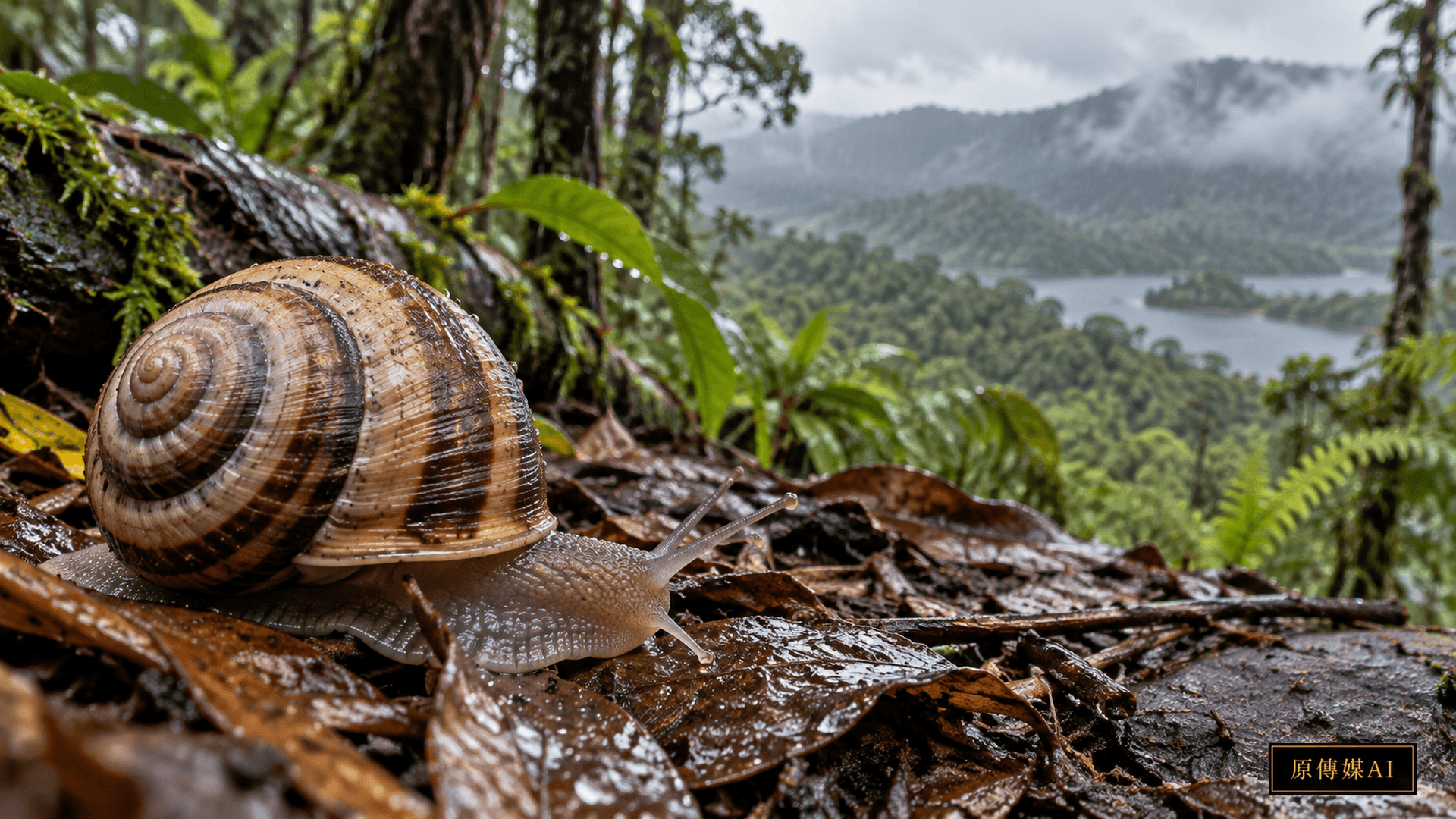
The Holocene study used one recently dead Biggenden Banded Snail from Coalstoun Lakes National Park in Queensland. Researchers took about 200 samples along its growth axis for oxygen and carbon stable isotopes, plus eight radiocarbon measurements to establish chronology. They inferred a life of roughly 4.5 years with uneven growth. These numbers describe sampling and dating, not 200 snails or eight cyclone events. The biological sample remains one shell.
Chronology before weather
Isotope values arranged along a shell show chemical change, but without dates they cannot be compared reliably with rain events. The team used multiple radiocarbon points and accounted for older carbon in the snail’s food, which affects apparent age. ANSTO describes one age model based on radiocarbon and another incorporating known major rain events. The latter helps form a continuous chronology, but events used for calibration cannot also count as wholly independent prediction successes.
Oxygen and carbon tell different stories
Shell oxygen isotopes respond to rainwater sources, temperature, and evaporation. The study observed a rapid decline in oxygen values after heavy rain, followed by a slower rise as conditions dried. Carbon isotopes more strongly reflect food plants and life stage, perhaps including reproduction. These are not duplicate rain gauges. Calling every fluctuation a storm or translating carbon values directly into forest area would skip ecological and physical processes.
Marcia and Debbie as comparisons
Researchers compared the shell’s growth period with local heavy rain associated with Cyclone Marcia in 2015 and Cyclone Debbie in 2017. UQ describes faster growth after such events; the paper links some oxygen-isotope declines with known extreme rain. Modern documented events help test whether an archive is promising. They do not mean every ancient shell can identify a named storm or trace its route.
A landscape filters signals
Microtopography, shade, leaf litter, and food mean the same rain may leave different effects at different places. ANSTO suggests local conditions may buffer ordinary seasonal variability, leaving extreme events more prominent in the oxygen record. A natural archive is not a direct copy of the sky; weather passes through landscape, ecology, and physiology. Comparing shells requires attention to species, habitat, and period.
The limit of one specimen
This is a proof of concept on one modern specimen. It shows that sampling, dating, and comparison can produce a plausible account for that shell. It does not measure differences among individuals in the same forest or show whether old shells retain the same signals after burial, dissolution, or contamination. Older climate work needs multiple well-preserved, datable specimens and local calibration alongside other proxies.
Two-Eyed Seeing: two-way knowledge: field observation and laboratory calibration
Rangers and residents may know where ground stays wet, when lakes reach a path, or when snails are active. Laboratories provide isotopes, radiocarbon dates, and uncertainty estimates. Dated field records, documented methods, and park sampling permits make comparison possible. Local experience is not a stamp of approval for a paper. Researchers should return what matches and what remains unexplained, while protecting sensitive habitat locations.
Teaching the chain of evidence
In class, students can draw a chain from rainfall through surface water and food to snail growth, shell chemistry, and laboratory dating, marking uncertainty at each step. Known cyclones are comparisons; the shell does not announce a storm’s name. Radiocarbon constrains time, not rainfall in millimeters. Distinguishing observation, inference, and unanswered questions makes one shell interesting without treating it as an all-purpose disaster-history machine.
Growth marks are not calendar ticks
Snail growth can slow with dryness, cold, reproduction, or limited food, so adjacent sample points need not represent equal time. Dividing a 4.5-year life evenly could assign rainfall to the wrong month. Multiple radiocarbon constraints and event references improve the chronology but do not eliminate uncertainty. Age ranges and measurement error should accompany event claims.
Calibration between modern and ancient shells
A modern shell can be compared with documented weather; an ancient shell lacks a complete life record. Ancient inference needs species and habitat identification, preservation checks, local rainfall isotope patterns, and knowledge of carbon sources in food. Vegetation and lakes may have changed. A downward curve in a modern shell cannot simply be mapped onto a prehistoric cyclone without independent evidence constraining time and event type.
Sampling has ecological costs
The value of a shell does not justify collecting many live animals or damaging habitat. Teams need park permissions, should consider recently dead specimens, document provenance and storage, and protect precise locations of vulnerable populations. Images, specimens, and data should remain available for method checks, reducing repeated collection. An archive has lasting public value when its habitat is also cared for.
How local rain records help
A weather station may be distant from the snail’s habitat. Terrain, canopy, and brief downpours can make station readings differ from forest conditions. Ranger notes, lake levels, path photographs, and residents’ accounts can add spatial detail if dated and located. Place them beside official rainfall and shell chronology to test whether a signal is local. Disagreement is a reason to revisit sampling and dating.
Do not draw a storm track too soon
Even multiple shells indicating heavy rain around the same period suggest a broad event, not a storm track. Sediments, other geological records, models, and dating errors must be compared. Heavy rain need not be cyclone-driven, and one cyclone rains unevenly. Shells can identify candidate events for testing. A map should show uncertainty, not a falsely precise line.
From shell to conservation and education
The study brings a small terrestrial invertebrate into climate discussion and shows why ecological and weather records are worth keeping. Schools can use one shell to explain layered evidence; conservation teams can document habitat change alongside extreme rain. With more specimens, researchers should report repeatable patterns and individual differences. Respect for an animal’s life history prevents it from becoming merely a passive instrument.
Returning a small archive to place
A shell draws attention back to water, plants, and animal life in a forest, and reminds us that climate records are not held only by instruments. It broadens the questions: which rainfall events leave biological traces, and which traces disappear as habitats change? Answers require habitat protection, specimen provenance, and modern weather records. Only after checks across species, places, and times could shells become one reliable tool among others for reconstructing past extreme rain.
Continue asking by role
- Snail or terrestrial ecology researcher: Ask about evidence, limits, and feasible action.
- Isotope or paleoclimate researcher: Ask about evidence, limits, and feasible action.
- Ranger or local environmental observer: Ask about evidence, limits, and feasible action.
- Meteorology, disaster-history, or environmental educator: Ask about evidence, limits, and feasible action.
Sources and further reading
Role-Driven Inquiry
Yuan Media AI | Guided Questions by Role
Select a role first, then review the complete questions from that perspective; clicking a question will display Yuan Media AI’s response in real time.
Select a role
Snail or terrestrial ecology researcher
Examine the article's evidence, governance boundaries, data rights, and actionable steps from the perspective of a Snail or terrestrial ecology researcher.
Choose a question
AI use and content-safety disclosure
This article draws on official and research sources. Evidence, limitations, and analysis are distinguished. The cover is an AI-assisted concept image.