Wait Until Manoomin Ripens, Then Harvest by Canoe: How Rice Chiefs, Harvest Windows and Restoration Quotas Protect the Next Season
Original Chinese title: 先等 Manoomin 成熟,再划船收穫:米長、採收時窗與復育配額如何一起守住下一季?
Manoomin harvesting is not a simple yield exercise: rice chiefs, harvest families, water conditions and restoration rules connect ecological observation with treaty rights and food sovereignty.
Two-Eyed Seeing Lab
The Two-Eyed Seeing Lab focuses on Indigenous knowledge, environmental observation, data sovereignty, cultural governance and AI applications, placing remote sensing alongside long-term local observation rather than treating either as a substitute.
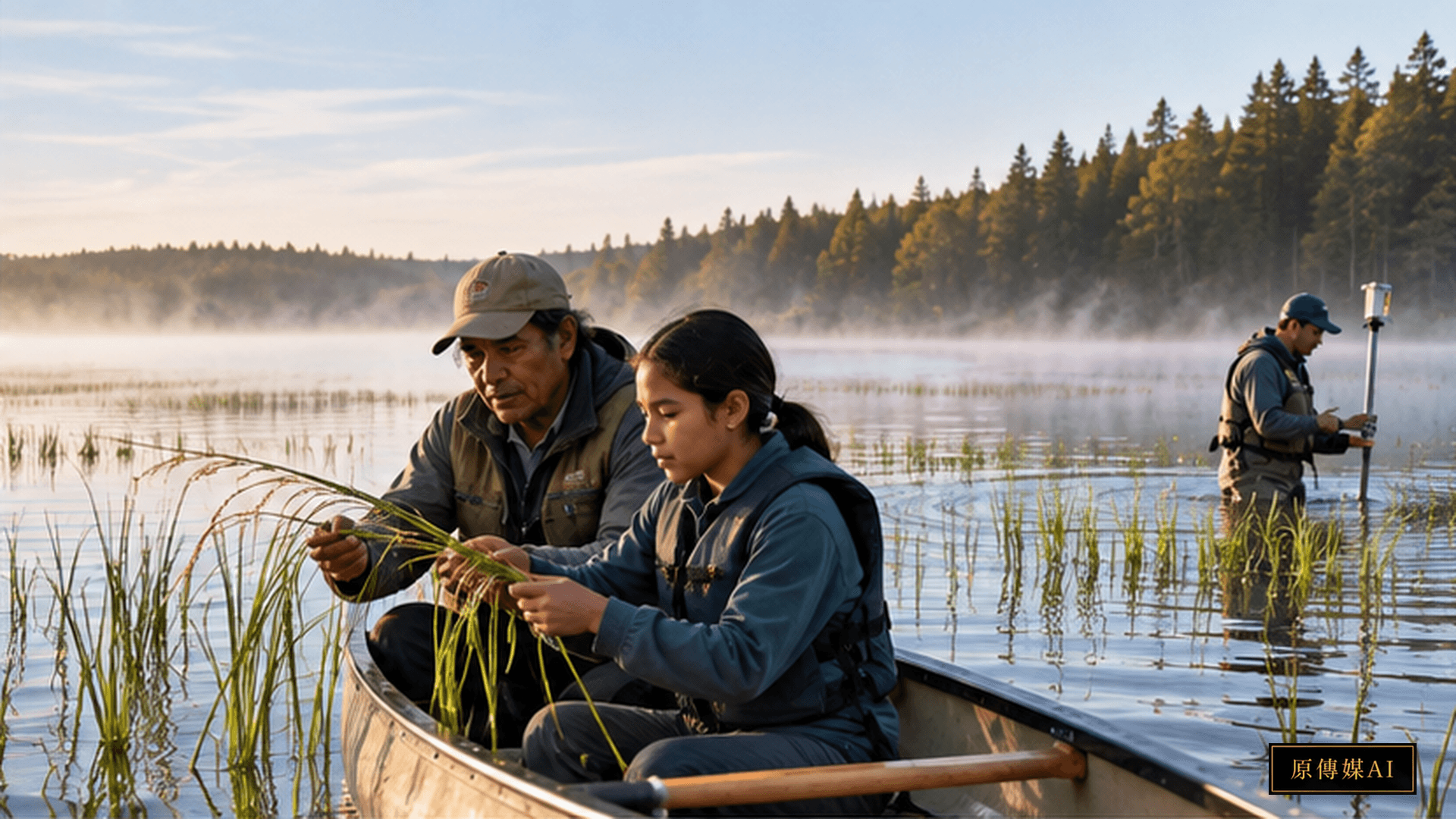
# Wait Until Manoomin Ripens, Then Harvest by Canoe: How Rice Chiefs, Harvest Windows and Restoration Quotas Protect the Next Season
By Two-Eyed Seeing Lab
This feature uses the approved primary sources to distinguish what a study or official rule can directly support from interpretation and local governance questions. The evidence concerns the approved topic; it should not be read as a universal outcome for every community, place or institution.
Establish what the evidence can actually say
A reliable reading begins with the population, time period, method and limits of the source. Measured patterns can guide questions, but they do not automatically settle causation, rights or the meaning of a change for people who live with it.
It is equally important to state what was not measured. A finding about one service, watershed, calendar practice or forest-management setting cannot by itself determine what should happen in another place.
Do not make one knowledge system speak for another
Scientific and administrative records can make some conditions visible. Local knowledge holders and frontline practitioners identify responsibilities, relations, changing conditions and boundaries that a dataset cannot infer. A responsible process lets both contributions remain distinct and open to correction.
This does not make evidence optional. It makes the question more precise: which observation supports which claim, who can challenge it, and what should happen when observations conflict?
Design data, consent and accountability together
Data collection needs a stated purpose, access rules, correction routes, retention limits and an explanation of who decides secondary use. Participation is not complete when a meeting is held; people affected by a decision must be able to influence it, challenge it and leave it where appropriate.
Participation also needs material support. Time, travel, translation, caregiving and follow-up work should be budgeted rather than quietly shifted to knowledge holders or frontline workers without compensation.
Do not turn an international case into a shortcut
Harvest rules and monitoring records make basic boundaries reviewable, but they cannot decide which waters hold particular family histories, responsibilities and restoration relationships. GLIFWC regulations sit within treaty-rights governance, while the University of Wisconsin account describes field monitoring with Tribal natural-resource staff. Neither source supports a one-line claim that wild rice is simply abundant or scarce.
Public maps also require care. Water levels, plant distribution and navigation conditions can support discussion, yet precise locations and harvest details may increase unmanaged access if published without limits. The responsible authority should decide which information is public, management-only or teaching-only, while recording dates, methods and gaps.
Begin the Taiwan discussion with governance
For Taiwan, the practical question is how to connect evidence with local authority, transparent responsibilities and a safe way to report error or harm. Technology can assist observation and documentation, but it cannot replace consent, field verification or accountable decision-making.
A workable pathway is to record an observed signal, invite local review, provide a responsible agency response and publish an appropriate explanation without exposing sensitive places or people.
Keep uncertainty inside the institution
For Taiwan's wetlands and mountain harvesting areas, outside hydrology, phenology or remote-sensing data can be useful alongside local observations of access, safety and care obligations. Collaboration should first state its purpose: understanding ecological change, improving safety, maintaining harvesting rights, or addressing pollution and development pressure. Each purpose calls for different evidence and disclosure limits.
Digital systems should assist recording and reporting, not automatically declare a harvest open or closed. Signals require field checking; families need understandable rules, named decision-makers and response times. Supporting young people to learn by boat and through appropriate teaching does not require publishing all knowledge online: knowledge holders decide the setting, record and audience.
Conclusion: place the verifiable beside the irreplaceable
The durable lesson is not a slogan. It is a process in which evidence, local observation and governance responsibility can correct one another, while rights holders retain meaningful control over disclosure, correction and participation.
Primary sources
AI use and content-safety disclosure
This English edition is an AI-assisted translation of the Chinese article, reviewed for source parity and evidence boundaries.