Keeping Rain on the Mountain: Andean Terraces, Soil and Community Water Management for Climate Resilience
Original Chinese title: 把雨留在山上,而不是只把水引下山:安地斯梯田、土壤與社群水管理的氣候韌性課
Andean terrace resilience depends on slopes, water, soil, farming and maintenance. Agricultural research, FAO material and environmental history frame questions about water rights, repair responsibilities and relevance to Taiwan.
原傳媒 AI
Editorial byline for this feature based on public research and institutional sources.
Start with the right question
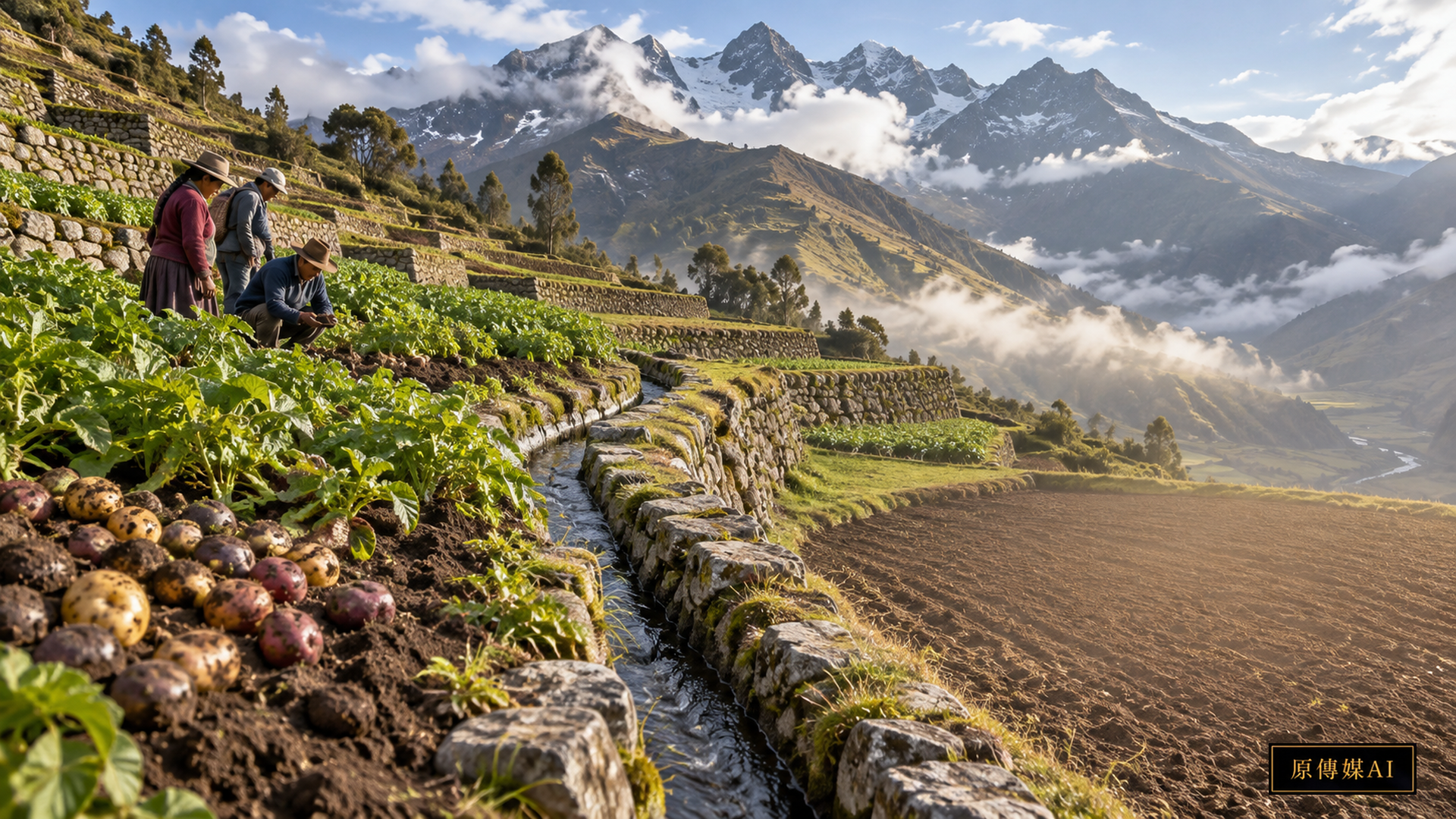
A terrace is not a static stone wall. It is a soil-and-water system made together by slope, soil layers, drainage, vegetation, crops and maintenance labour. An integrative study of ancestral Andean technologies reports that terraces can reduce water loss, slow runoff and erosion, and help address drought, frost, hail and changing rainfall through soil and clay foundations. Benefits, repair costs and water-rights conditions differ by place. Climate Change, Food Sovereignty, and Ancestral Farming Technologies in the Andes FAO policy material places terraces within watershed stability, soil conservation and multiple agro-ecological zones—not as a universally copyable ‘ancient technology’. Ancestral Practices for the Management of Natural Resources
Not a checklist to copy
Maintenance and governance are the overlooked parts. Failed walls, blocked channels, labour out-migration, fragmented land or changed upstream use can remove a terrace’s function while its outline remains visible. Long-term Andean environmental research places terrace expansion within drought, erosion and inherited crop–livestock–technology histories, warning against a single climate explanation for people’s choices. The Evolution of Agrarian Landscapes in the Tropical Andes Climate resilience should therefore not be measured only by one season’s yield. Ask where water infiltrates, who allocates it, whether soil remains, whether communities retain time and rights to repair, and whether outside investment respects local rules.
The following sections discuss practical questions for services, learning, research and institutions. These are analytical proposals informed by the sources, not claims that the cited studies implemented or tested every measure.
Clarify rights and responsibilities before restoration
Terraces are more than neatly arranged walls. Governance should examine water pathways, repair responsibilities and authority over land and allocation. A landscape can remain visible after cultivation, maintenance and coordination cease. Partnerships should therefore consider continuing use rather than count structures alone. This does not require freezing every inherited landscape. It means enabling people who live there to decide what to retain, change or stop. The point is an institutional interpretation of resilience, not a claim that appearance reliably measures function.
Consent for restoration should address access, works, water changes and future maintenance, rather than imply permanent authorization. Upstream and downstream users, cultivators and other rights holders may face different effects. A responsibility map can identify agreements and unresolved issues without exposing personal data. An apparently beneficial project does not justify skipping land and water relationships. Technical feasibility and social authorization are separate questions. These proposed steps require local interpretation rather than direct application of another country's legal arrangements.
Check location, period and comparison conditions when reading claims about retention or erosion. Terraces, storage and channels may work together; their combined effect cannot all be assigned to one wall. Restoration decisions also need current structural and rainfall information. Funding proposals can explain expected improvements and evaluation without guaranteeing yield gains or protection from every hazard. Keeping limits visible creates room to adapt and avoids transferring an unrealistic promise to residents who must manage the consequences.
Water, soil-moisture and rainfall records can inform discussion, but a sensor cannot decide who receives water first. Understand allocation practices, maintenance and disclosure before choosing equipment. Without repair funding, power or interpretable outputs, installations may soon become unusable. Compare instruments with existing inspection records and check anomalies in the field. More detailed data should serve an agreed decision rather than replace negotiation. This is a monitoring-design proposal, not evidence that a particular device improves allocation by itself.
Start with a waterway that people actively use and jointly record blockages, leakage, repair time and effects. The most photogenic site may not be the highest priority. Include different periods and upstream and downstream experience, then identify who maintains the repair. A modest improvement with clear responsibility and resources can build more usable capacity than many structures without follow-up. This is a proposed way to organize priorities, not a technical instruction for modifying a channel or slope.
Farmers experience is part of the engineering question
Farmers should not treat an international case as a guarantee of yield or water retention in their own fields. Soil, slope, crops, upkeep and rainfall differ. Use it to ask where losses occur, which tasks consume time and what changes affect neighbours. Calling a practice ancestral does not remove present risks or make households responsible for every repair. Local experience matters, alongside site conditions and appropriate professional assessment. The feature offers questions for comparison, not an engineering design or agronomic promise.
Farm households can ask about construction effects, access limits, maintenance and costs rather than only viewing a finished rendering. Cultivators should help plan changes to access or water timing. Communicate with absent rights holders and downstream users as appropriate. Record promises in understandable terms and allow revision. This reduces the chance that responsibilities turn out to mean different things after completion. The questions are general participation considerations, not a substitute for local agreements or professional project assessment.
A better harvest is worth recording but cannot immediately be attributed to restoration when weather, varieties, inputs and management may also change. Keep manageable records of yield, labour, water difficulties and repair costs before and after. Investigate why gains differ across fields rather than selecting only success photographs. Documentation should help farmers and partners judge useful changes, not impose an excessive research burden. The evidence should reflect costs and uneven outcomes as well as benefits.
Photos and simple forms can reduce workload if farmers know whether images, locations and field details will be public. Keep paper or spoken alternatives for people without suitable devices or connectivity. Excessive forms may leave only a few regular contributors and bias the record. Tools should fit farming schedules and improve repair or allocation decisions. A system that mainly produces administrative reports while adding household work may not deliver the promised practical value.
Neighbours can identify recurring maintenance problems and seek assessment from responsible, qualified people rather than alter slope structures from an online article. Consider who benefits, who gains work and who pays, including downstream effects. A responsibility list and reporting process may be useful before selecting works. Starting with daily difficulties makes the international discussion relevant without turning heritage into a demand that farmers preserve a landscape through unpaid labour. This is an organizational suggestion, not construction guidance.
Measure water, soil and maintenance conditions
Researchers should not treat terraces as fixed structures independent of cultivation and upkeep. Similar-looking fields may differ in soil, drainage and history. Explain these differences in sampling and include labour or governance where relevant. Conveniently accessible sites may not represent a catchment. Clear selection criteria, gaps and limitations are more informative than an overall average presented as proof of universal effectiveness. This approach examines the system in use rather than assuming that visible form establishes comparable function.
Research agreements should distinguish sampling, mapping, interviews and reuse. Permission to measure soil does not authorize disclosure of property value, household finances or precise locations. Use appropriate access rules and accessible language. Participation in interpretation requires time and compensation; returning data is more than mailing a report. When findings differ from local experience, examine scale and method together before declaring one account unreliable. These are proposed research safeguards rather than a description of every study cited in the article.
Long records reveal changes in sediment, vegetation and land use, but dating and proxy interpretation have limits. A change near a particular time does not by itself establish a single cause, and ancient-scale evidence cannot guarantee modern engineering performance. Distinguish supported associations, possible mechanisms and alternatives. Historical research can then provide context while leaving present-day questions open to measurement. This preserves the value of deep-time evidence without confusing it with a controlled test of a current restoration project.
State the spatial scale and gaps of models and instruments. A field-level infiltration change does not automatically mean more usable water throughout a catchment; timing and pathways also matter. Upstream and downstream claims need corresponding measurements and assumptions. Figures should distinguish observations from simulations. Transparency means making inference inspectable, not simply releasing a large volume of difficult raw data. These methodological questions help prevent a local measurement from becoming an unsupported landscape-wide conclusion.
Co-select a question that matters for a decision, such as interruptions in maintenance or observations that reveal declining function, before buying equipment. Return a usable recording method and explicit limits. Preserve unsuccessful experiences across fields rather than publishing only successes. Those cases may be especially useful for future judgment. The goal is a study that local teams can build on, not an instrument installation that ends when outside researchers leave. This is a suggested research process, not a predetermined intervention.
From long-term budgets to questions for Taiwan
Policy should not equate restoration with completion of construction inspection. Resilience also involves labour, land use, allocation and seasonal adjustment. Area-based grants may overlook households already maintaining functioning systems. Include continuity and fair burdens in policy discussion. Heritage should not require residents to surrender other life choices. Support options rather than fixing occupations and duties in the name of cultural value. These are policy considerations drawn from the relationship between infrastructure and use, not a universal funding formula.
Funding agreements should explain ownership, upkeep, disclosure and contacts after the project ends. Where tourism, agriculture and conservation interests overlap, distinguish their objectives so one group's display goals do not shift costs to cultivators. Record disagreement and resulting adjustments. Transparency does not require publishing personal information. It requires affected people to understand how decisions were made, how to object and how to seek correction. The specifics must be developed under local arrangements rather than imported wholesale from the Andes.
Specify the pressure, scale and period behind a resilience claim. Reduced erosion at one location does not imply protection from every extreme rainfall event or increased household income. Evaluation can consider soil and water, labour, maintenance and distribution together, including variation across fields. Where evidence is insufficient, identify a future observation instead of a promotional certainty. This gives the public a reason for investment while making clear what that investment cannot yet be promised to achieve.
A platform can combine maintenance and environmental records without using one score to exclude values that are harder to quantify. Require provenance, update dates, missing-data indicators and a correction channel. Field details may reveal sensitive livelihood or land information, so choose appropriate aggregation. Judge the platform by whether it helps identify responsible parties, arrange maintenance and understand change, rather than its visual appeal or database size. These criteria connect digital infrastructure to decisions and accountability.
Plan restoration and continuing maintenance within the same resource framework, with users helping set priorities. Taiwan can draw on the need to consider soil, water, labour and governance together without copying Andean structures or assuming equal effects. Local geology, rainfall, rights and existing infrastructure require fresh assessment. The international case supplies material for comparison and questions. An actual programme should be developed by local communities, cultivators and responsible professionals who can evaluate the conditions and consequences.
Sources and further reading
- Climate Change, Food Sovereignty, and Ancestral Farming Technologies in the Andes — PMC; 2021.
- Ancestral Practices for the Management of Natural Resources — FAO; undated; accessed 2026-09-21.
- The Evolution of Agrarian Landscapes in the Tropical Andes — PMC; 2024.
Role-Driven Inquiry
Yuan Media AI | Guided Questions by Role
Select a role first, then review the complete questions from that perspective; clicking a question will display Yuan Media AI’s response in real time.
Select a role
Community knowledge and governance role
Examine the article's evidence, governance boundaries, data rights, and actionable steps from the perspective of a Community knowledge and governance role.
Choose a question
AI use and content-safety disclosure
AI assisted the writing and translation of this feature and its questions. Reported evidence is distinguished from practical analysis; illustrations do not identify real people.