Fire Is Not a Single Switch: How Aboriginal Cultural Burning and Ecology Read Country Together
Original Chinese title: 火不是單一開關:澳洲原住民族文化燃燒如何與現代生態科學一起讀懂地景?
A species- and site-specific Australian study helps explain cultural burning, knowledge authority and ecological measurement. Fuel reduction is one outcome; local governance and long-term observation also matter.
原傳媒 AI
Editorial byline for this feature based on public research and institutional sources.
Start with the right question
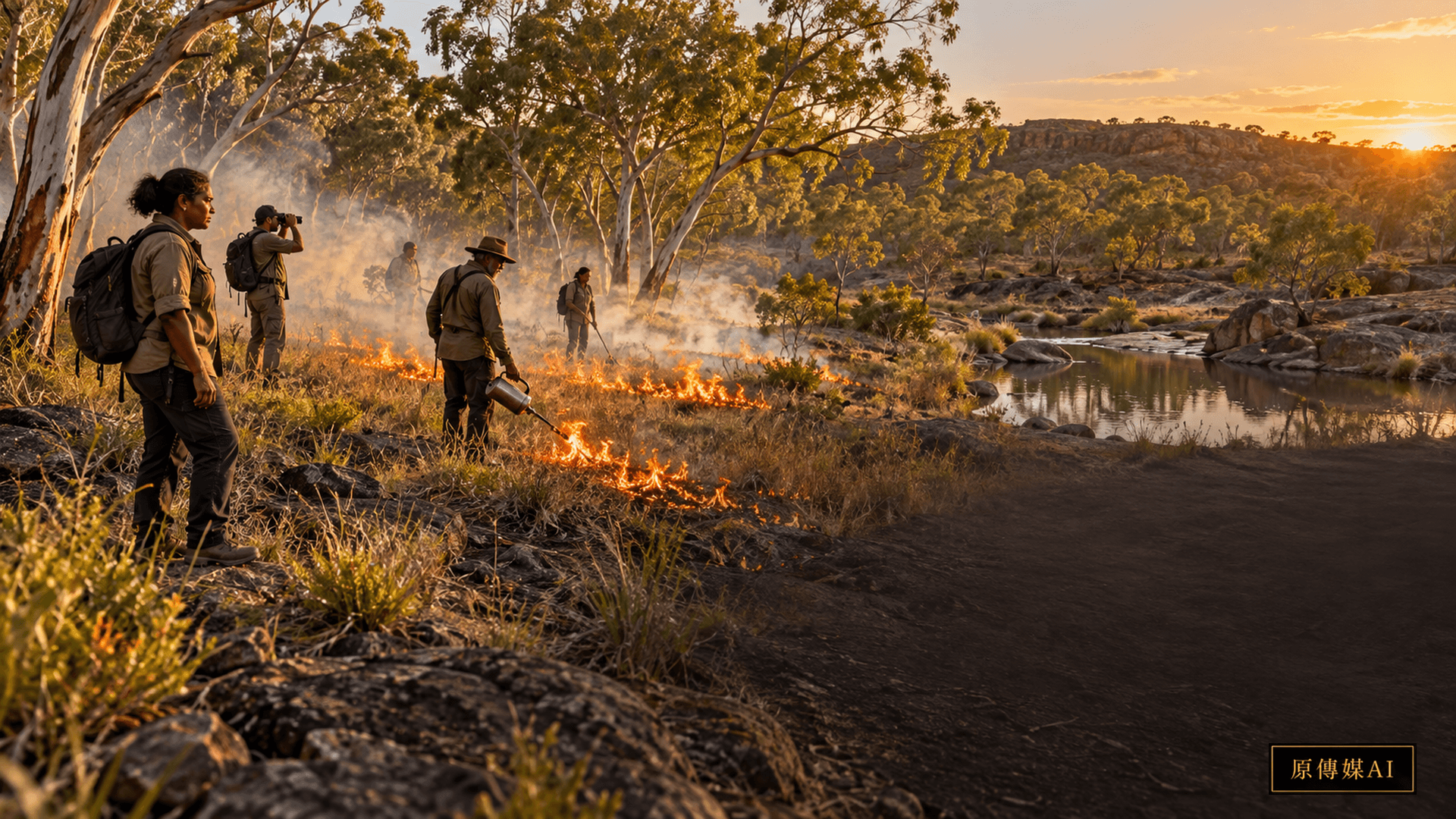
Cultural burning is not shorthand for ‘all fire is good’, and it must not be collapsed into generic hazard-reduction burning. Australia’s national science agency describes it as often smaller-scale and place-specific, serving habitat, cultural-site care, invasive-species, access and ceremonial purposes. It may reduce some risks, but fuel is not its only aim. Why hazard reduction burning is no smokescreen In a peer-reviewed, Indigenous ranger partnership involving a threatened plant, cultural burning had lower impact than wildfire while reducing fuel. That finding belongs to that species and place; it is not an Australia-wide law. Indigenous cultural burning had less impact than wildfire on the threatened Backwater grevillea while effectively decreasing fuel loads
Not a checklist to copy
Two-way science does not define the problem with satellites and models first, then invite Traditional Owners to supply ‘local information’. Better design lets cultural authority determine what sites, seasons, species and knowledge may be shared; fire-behaviour data, plant response, fuel measures and remote sensing become tools for joint inquiry. A western Australian collaboration connects small fires, rockholes, water, special plants and access, while acknowledging that colonial law restricted the right to light fire. Governance, consent and returning data matter as much as flame. Aboriginal fire knowledge in the Great Western Woodlands
The following sections discuss practical questions for services, learning, research and institutions. These are analytical proposals informed by the sources, not claims that the cited studies implemented or tested every measure.
Establish who has authority over burning
Cultural burning is not a label that legitimizes any ignition. Governance begins with authority over place, purpose and timing, including areas to leave unburnt and coordination with qualified local teams. Reduced fuel is only one possible outcome. It cannot replace attention to life cycles, cultural places and community responsibilities. If an outside agency measures only hectares completed, custodians need room to explain the mismatch and to postpone or decline work. This is a governance interpretation, not an operational burning instruction.
Consent should cover preliminary visits, monitoring, photography and later use, not merely attendance on the day. Sensitive coordinates may need protection, and convenient access does not grant research rights. Agree on map precision, identifiable imagery and data custody. Where land tenure or adjacent management responsibilities are complex, clarify authority before purchasing equipment. Unresolved institutional responsibilities should not be transferred to field staff. These proposed arrangements concern accountable research and do not imply that all cultural information should enter a public dataset.
Keep the species and location attached to the conclusion. Better survival under one treatment at one site does not establish a universal result for forests or fire intervals. A policy slogan loses the conditions that make the study useful. Separate observations, interpretations and questions needing follow-up, and record where custodians' observations support or extend measurements. This allows evidence to inform decisions without turning it into an instruction that overrides local judgment. The cited case remains a case rather than a national prescription.
Satellite imagery can compare conditions before and after fire, but it cannot automatically recognize cultural values. Start with the questions custodians want answered, then choose resolution, timing and disclosure rules. Very detailed maps may expose sensitive places; coarse images may miss small unburnt patches. The useful tool is one that answers an agreed question within permission boundaries and can be interpreted and corrected by people on the ground. More data alone does not establish better stewardship or safer decisions.
A first step can be a community-led observation record rather than expanding treated area. Decide which plants, landscape features and cultural places require attention, what may be public and what should remain unrecorded. Discuss feasible measurement with researchers. Preserve dates, conditions and observers so photographs are not detached from context. Review whether findings change care decisions. If collection changes nothing, reconsider the workload. This proposal supports learning and accountability without prescribing when or how a fire should be lit.
Bring local observation into shared learning
Residents should not interpret cultural burning as an activity without smoke or risk. Distinguish cultural purposes, ecological observations and public safety responsibilities. Qualified local authorities should provide operational information. Readers can ask about contact points, updates and impact assessment, but should not imitate a burn from this feature. The public value of the case is to make different management goals visible. It is not a field manual for households, visitors or groups without the necessary authority and expertise.
Neighbours may raise access, work and information needs without acquiring a right to restricted cultural knowledge. Separate general safety communication from material that custodians do not authorize for sharing. Meetings should accommodate translation and different ways of expressing concerns. Silence is not proof of agreement. Record concerns, responses and their effect on decisions. This approach aims to make necessary information accessible while avoiding a demand that knowledge holders reveal every practice or place to justify participation.
New shoots do not immediately demonstrate recovery of an entire ecosystem, just as a photograph of dead plants cannot settle the overall assessment. Mature plants, seedlings, seed reserves and habitat may respond differently over time. Ask how long monitoring continues and whether unburnt areas are compared. Local observations become more useful when dates, places and conditions are recorded. These questions move discussion beyond a simple good-fire/bad-fire division while keeping eyewitness knowledge and formal measurement in a productive relationship.
Public reporting tools should collect verifiable observations rather than ask untrained users to classify fire behaviour or ecological outcomes. They must not encourage approaching an active work area for photographs. Review sensitive location information before publication, and explain what happens to submissions. Uploading a photograph should not imply that someone has responded to a safety concern. Separate research records from official reporting channels. These are interface and communication principles, not instructions for assessing or approaching a fire.
A community can agree with managers on regular, accessible updates covering observed changes, unanswered questions and the next review. A photograph on the day is not continuing accountability. Include ways to reach people without internet access or research literacy. Participation need not turn every resident into a fire ecologist. It should make clear who receives questions, when responses can be expected and which decisions remain with cultural custodians. This is a communication proposal rather than evidence of an existing local programme.
Keep ecological measurements in context
Researchers should not treat cultural burning as one uniform intervention detached from place. Purpose, history, vegetation and authority can all shape the comparison. Record relevant conditions while respecting knowledge that cannot be published merely for analytical convenience. Cross-case work can explain differences rather than impose identical cultural categories. Scientific methods help make inference inspectable; they should not flatten practices into deceptively uniform fields. The case therefore raises both ecological and methodological questions about how comparisons are constructed.
Joint research should involve rangers and knowledge holders in framing questions, not only guiding visitors or supplying interviews. Agreements can address payment, authorship, access and interpretation, with time to review figures together. Restrictions on publishing particular observations are part of the method. If findings differ from expectations, examine that difference collectively rather than removing inconvenient accounts. These suggestions concern equitable study design and should not be mistaken for a claim that every cited collaboration used precisely the same agreement.
Preserve the timeline of disturbance, especially when a later wildfire affects all plots and changes the original comparison. Mature-plant mortality, seedling recruitment and reproduction are different outcomes. Describe plot allocation, observation intervals and uncontrolled conditions before interpreting effects. Stating limitations does not invalidate custodians' observations. It identifies what further monitoring might clarify. The useful conclusion is conditional and specific, rather than a claim that any single response variable captures the health of the whole landscape.
Compare remote sensing with field observations, particularly for small patches, understorey and obscured areas. Classification errors concentrated in one landscape type can bias interpretation. Preserve processing versions, image dates and uncertainty so later users can distinguish ecological change from analytical change. Local names and scientific categories can coexist without forced one-to-one translation. Technology adds an observational scale; it does not make knowledge invisible to a sensor irrelevant. These are general monitoring considerations applied to the feature's research question.
Future work can prioritize unresolved questions rather than repeatedly measuring the easiest variable. Recovery of reproduction, age structure and patches needing longer observation are examples for joint discussion. Decide what findings would change management deliberations before selecting instruments. This helps avoid data collected chiefly for publication. Return records in formats ranger teams can continue using after researchers leave. The suggested agenda follows from the limits of the case and is not a claim that the appropriate future treatment has already been established.
Policy tools and boundaries for Taiwan
Policy should not rank communities by area burnt. Landscape, objectives, weather and staffing differ, so completed area may reflect opportunity rather than quality. Funding can support sustained ranger work, training, transmission and monitoring, with room to explain outcomes that resist uniform comparison. Paying for the operation alone while excluding preparation and follow-up leaves essential work unpaid. This is a resource-design implication, not a claim that all jurisdictions currently use the same funding rules or performance measures.
Integration requires explicit boundaries between cultural rights and public responsibilities. A memorandum should not conceal differences behind broad language. Specify authority for research, ranger work, communication and operational decisions, with procedures for disagreement and revision. Keep reasons and responses when institutions differ. Durable cooperation needs a way to handle disagreement, not merely a photograph suggesting consensus. These are proposed institutional safeguards and do not establish legal authority for a particular place or activity.
A plant study cannot by itself prove nationwide disaster-risk reduction. Local ecological effects and landscape-scale risk require different evidence. Policy can support cultural governance and collaborative monitoring while acknowledging that protection against extreme events is not guaranteed by one case. Conflating those claims misleads the public and can unfairly expose communities to blame after a disaster. Keeping claims proportional is therefore both an evidentiary obligation and a condition for durable institutional cooperation.
Public platforms should show dates and scale so historical observations are not mistaken for operational updates. Obtain authorization for displaying cultural places, tenure information and sensitive species locations. Explain reuse limits when downloads are available. Full disclosure is not the only form of transparency: aggregated reporting can answer public questions without exposing precise places or individual knowledge holders. The platform's design should follow the agreed purpose and rights, rather than assume that every collected field belongs on a public map.
A constructive funding step is to cover monitoring and workforce development rather than only one-off events. Review whether communities retain decision space, results return, local personnel can continue working and unanswered questions have owners. In Taiwan, discuss local rights, ecology, regulation and public safety before considering any application. The transferable lesson is a method of shared decisions and evidence dialogue. Operational choices still belong to authorized, qualified people in the relevant place.
Sources and further reading
- Why hazard reduction burning is no smokescreen — CSIRO; 2021.
- Indigenous cultural burning had less impact than wildfire on the threatened Backwater grevillea while effectively decreasing fuel loads — International Journal of Wildland Fire; 2021.
- Aboriginal fire knowledge in the Great Western Woodlands — CSIRO; undated; accessed 2026-09-21.
Role-Driven Inquiry
Yuan Media AI | Guided Questions by Role
Select a role first, then review the complete questions from that perspective; clicking a question will display Yuan Media AI’s response in real time.
Select a role
Community knowledge and governance role
Examine the article's evidence, governance boundaries, data rights, and actionable steps from the perspective of a Community knowledge and governance role.
Choose a question
AI use and content-safety disclosure
AI assisted the writing and translation of this feature and its questions. Reported evidence is distinguished from practical analysis; illustrations do not identify real people.