No Instruments Does Not Mean No Science: How Pacific Island Wayfinders Weave Stars, Swell, Birds and Seasons into Ocean Knowledge
Original Chinese title: 沒有儀器,不等於沒有科學:太平洋島嶼航海者如何把星辰、洋流、海鳥與季節編成海洋知識?
Pacific wayfinding connects stars, wind, swells, embodied practice and intergenerational learning. UNESCO resources and navigation research show why transmission requires community governance, local distinctions and explicit uncertainty.
原傳媒 AI
Editorial byline for this feature based on public research and institutional sources.
Start with the right question
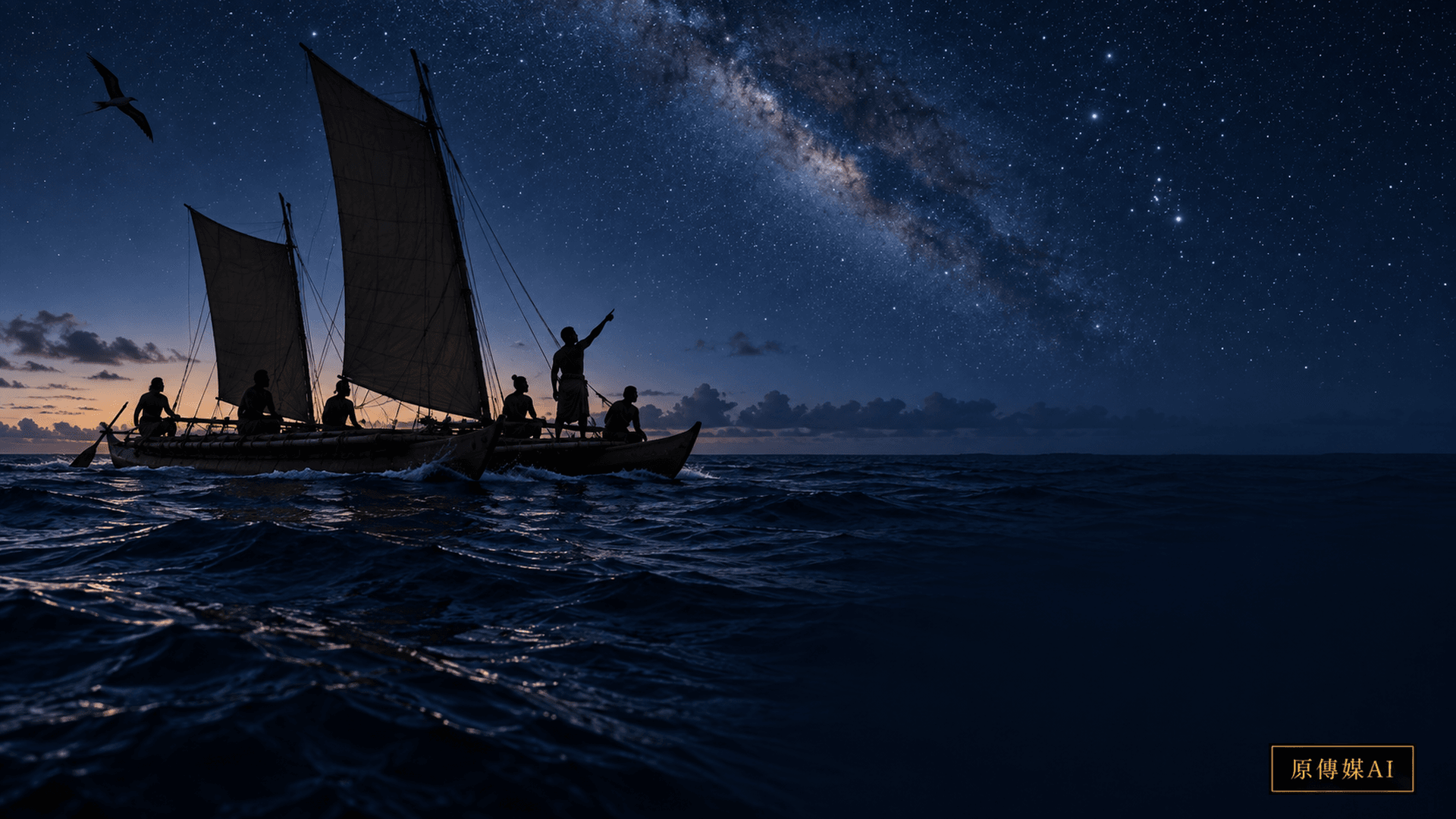
Pacific wayfinding is not a romantic collage of ‘nature clues’. UNESCO education and heritage material records navigation by stars, wind, waves, currents and the behaviour of birds, fish and whales. Some knowledge is held through families or specialist navigators, not as an open database for anyone to extract. The Canoe is the People – Indigenous navigation knowledgeCarolinian wayfinding and canoe making Recent scholarly synthesis explains how star compasses, dead reckoning, island effects on swell and currents, clouds and bird flight can provide redundancy. When one cue is unreadable, the system does not pretend uncertainty is absent; it changes its judgement through another readable cue. Navigating the Narrative: Integrating Traditional Knowledge and Embodied Practice within Computational Models of Ancient Seafaring
Not a checklist to copy
Calling this an Indigenous version of GPS is also distorting. GPS returns coordinates; a navigator’s judgement joins embodied perception, practice, memory, responsibility, season and social relation. Scientific collaboration can compare weather records, satellite data and observations aboard a canoe, but model accuracy is not permission to acquire knowledge. Better collaboration asks who may teach, what must not be placed online, how learners return benefit, and how safety is maintained in storms or equipment failure. Ocean governance and climate adaptation can learn the same lesson: information gains meaning through relationship and context, not downloadability.
The following sections discuss practical questions for services, learning, research and institutions. These are analytical proposals informed by the sources, not claims that the cited studies implemented or tested every measure.
Navigation knowledge needs governed transmission
Navigation knowledge should not be reduced to a star chart or mysterious intuition. Identify the island group, teaching lineage and tradition before deciding what can be public. Names, teaching sequences and responsibilities vary; sharing an ocean does not make them one culture. A partnership focused only on attractive stargazing images can overlook canoe construction, maintenance, apprenticeship and community support. Those conditions sustain the practice. This is an interpretive framework for reading the sources, not a claim to represent every Pacific tradition.
Permission for a lesson is not permission to upload every route or oral teaching. Distinguish introductory concepts, skills taught through apprenticeship and material that should not be recorded. Clarify translation, editing, commercial reuse and AI use. A later change of purpose may require renewed agreement. Control over sharing is part of the knowledge relationship itself, not an administrative step added after research begins. These are proposed permission categories, not a declaration of rules shared by all communities.
Ask whether a model addresses possible routes, environmental conditions or a historical event. A feasible simulated voyage does not prove that ancestors followed that path. Oral knowledge omitted by a model does not become irrelevant. Present the different scopes of archaeological, environmental and transmitted evidence, including unresolved differences. Precision in a drawn route should not be confused with certainty about history or authority over cultural interpretation. These distinctions help keep computational work useful without giving it more explanatory power than it has.
Digital resources can preserve public terminology and learning records without assuming that movement, rhythm and judgment aboard a canoe translate completely into text. Teachers can decide what belongs in video, in-person demonstration or a restricted index. Communities need access, revision and migration options so platform closure does not remove their materials. A tool designed for outside audiences but lacking permission controls for teachers does not adequately support transmission. This is a design recommendation, not a claim that digitization alone preserves a living practice.
Begin by identifying what teaching actually lacks: materials, repair space, teachers' time, apprentice support or safety arrangements. A new website may not be the priority. Funding cameras without enabling young people to remain in training can leave recordings without continuing practice. A modest project can support a complete learning cycle under teachers' direction. Not all outcomes need publication. Sustained relationships between teachers and learners may matter more than views, and should be discussed as a community-defined objective rather than imposed by a platform.
Learning navigation starts with respecting limits
Recognizing a few stars is not the same as being ready to navigate. Public resources introduce observation, while voyaging also involves the vessel, crew, conditions, experience and practice. Learners need to recognize what they do not yet know and follow qualified instruction. This feature is not a route guide or a reason to omit safety equipment. Respect for the tradition includes refusing to romanticize a demanding apprenticeship into a skill supposedly acquired from reading a single article.
Before interviewing an elder, students should explain the assignment, audience, recording and publication plans. A curriculum requirement does not entitle a class to restricted knowledge. Invite the person to choose an appropriate public topic and review its presentation. If they decline, respecting that boundary is still a meaningful learning outcome. The exercise can teach responsibility rather than reward extraction of unusual stories. These suggestions concern classroom practice and do not claim to replace the protocols of a particular teaching lineage.
Record observations separately from interpretations: what was seen, how it was understood and how a teacher later corrected it. One coincidence is not a universal rule, and initial incomprehension does not make knowledge mere legend. Use such records within supervised learning, not independent ocean trials. The aim is to understand how cues check one another and why their significance varies with place and season. This approach encourages careful inquiry without pretending that a notebook substitutes for competent instruction.
A simulator can teach relationships among direction and time without reproducing swell, fatigue or a vessel's response. Learners should know that simulated winds and currents are assumptions. Compare them with observations and distinguish classroom exercises from skills requiring supervised practice. Modern safety equipment does not invalidate traditional knowledge. A course can respect non-instrument navigation as a knowledge system while meeting contemporary responsibilities for real activities. The distinction is educational, not an instruction to attempt a particular voyage.
A beginner can start with low-risk observation from shore under an authorized teacher, learning to describe conditions without independently deriving a route. Reflect on evidence used, cues missed and any tendency to merge different cultures. Further learning requires qualified, community-recognized instruction. The next step is a continuing educational relationship, not a dramatic one-off experience or photograph. This recommendation deliberately separates accessible introductory learning from competence to undertake an ocean voyage.
Models must answer to lived navigation
Researchers should not assume that navigators are simply enacting a Western formula with their bodies. Comparison can examine environmental cues and position estimates while allowing different concepts, languages and teaching practices. Understand practitioners' descriptions before deciding what to model. If apprenticeship or responsibility is outside a model, identify that boundary rather than declaring those relationships irrelevant. A computational system can function successfully while still misrepresenting the practice it claims to explain. Methodological humility is therefore part of analytical quality.
Research consent should address model training, sharing and future reuse. A public interview does not automatically authorize unlimited processing, particularly when terms connect to specific routes, places or lineages. Agree on public methods, community-held detail and material not retained. Negotiate these choices before collection and provide a revision process. Communities should be able to understand how their information enters a model. A technically dense report alone does not establish informed participation or continuing control over the material.
Separate feasibility from occurrence. Reaching an island in a simulation establishes possibility under selected conditions, not a historical journey. Report starting conditions, vessel assumptions and the period represented by environmental data. Show sensitivity and unsuccessful scenarios instead of only an attractive route. When practitioners identify an omitted phenomenon, use that as an opportunity to revise assumptions. Excluding it simply because it is difficult to compute would weaken the interpretation rather than strengthen the model's explanatory credibility.
Evaluate how results change with data quality. Smooth current fields may omit local variation, while confident animation can falsely imply a reconstructed historical event. Visualizations should distinguish inputs, inference and unknowns with readable explanations. If community terminology is used, retain its language and permission context rather than erasing differences for a global audience. These recommendations concern transparent modelling and presentation. They do not establish that any one dataset accurately reproduces the conditions of an ancient voyage.
A next study can co-define a narrow question, such as how an openly shareable cue enters teaching and judgment. Do not frame an entire navigation tradition as material to digitize in one project. Teachers should be able to identify misinterpretations, add context or request removal of unsuitable presentation. Finding that some relationships should not be modelled can itself be useful. Clearly defining what a tool cannot answer is more credible than claiming to have finally decoded an ancient tradition.
Return educational resources to communities
Cultural policy should not equate safeguarding with completing a documentary. Canoe work, navigation and teaching require time, materials, places and people able to participate. Include learning opportunities and practitioners' working conditions alongside event counts. Communities may need different forms of support even when an international list groups practices together. Safeguarding concerns living relationships and skills, not fixing a culture into a display recognizable to outsiders. These are policy implications, not a description of a universal grant programme.
Before a school partnership, agree on teaching authority, payment and review of materials. Public student work raises separate questions about images, voices, names and locations; a standard school form may not cover cultural knowledge. Teach that sources belong to specific communities rather than a universal Indigenous navigation system. Permission is not an obstacle to learning. It creates opportunities to practise source checking, respect for difference and responsible public communication alongside the subject matter itself.
Learning outcomes need not be limited to memorizing star names or completing a performance. Consider whether students distinguish evidence from inference, identify cultural sources, understand sharing boundaries and recognize limits to their competence. Define outcomes with community teachers so external tests do not exclude important learning. A heritage listing or resource pack is an entry point, not proof that a particular curriculum works. Actual teaching should be evaluated in its own linguistic, educational and community setting.
Digital procurement can require export, revision, clear permissions and sustainable maintenance costs. Ask about offline use, elder review and accurate language support. AI-generated diagrams or explanations are not automatically trustworthy teaching materials and require qualified checking. Faster production makes provenance and responsibility more necessary, not less. These criteria help avoid locking cultural resources into one vendor or distributing errors at scale. They concern the management of educational tools rather than a recommendation to automate traditional teaching.
Support a modest, continuing course co-designed by a community and school, including teachers' time, materials and feedback. Check whether learners have another opportunity after the first event. Taiwan can learn from this partnership approach without transferring Micronesian terminology or techniques to different peoples. Discussion of local navigation should begin with local rights holders, histories and present safety conditions. International comparison is useful when it sharpens questions, not when it supplies a supposedly interchangeable cultural recipe.
Sources and further reading
- The Canoe is the People – Indigenous navigation knowledge — UNESCO; undated; accessed 2026-09-21.
- Navigating the Narrative: Integrating Traditional Knowledge and Embodied Practice within Computational Models of Ancient Seafaring — PMC; 2025.
- Carolinian wayfinding and canoe making — UNESCO Intangible Cultural Heritage; 2021.
Role-Driven Inquiry
Yuan Media AI | Guided Questions by Role
Select a role first, then review the complete questions from that perspective; clicking a question will display Yuan Media AI’s response in real time.
Select a role
Community knowledge and governance role
Examine the article's evidence, governance boundaries, data rights, and actionable steps from the perspective of a Community knowledge and governance role.
Choose a question
AI use and content-safety disclosure
AI assisted the writing and translation of this feature and its questions. Reported evidence is distinguished from practical analysis; illustrations do not identify real people.