Bumblebees Carrying Phages to Cherry Flowers: Can Targeted Tree Protection Safeguard Pollinators?
Original Chinese title: 讓授粉也成為精準護樹:大黃蜂攜帶噬菌體走進櫻桃花,果園防病如何兼顧作物與蜂群?
Controlled flower trials show bumblebees transferring phages and reducing a target bacterium. Orchard efficacy and pollinator safety still need field testing.
鄭淑禎|實踐大學專任助理教授;專家諮詢:陳振義博士|台東區農業改良場
An academic writing on local economies and agricultural value chains, with agricultural consultation credited in the source byline.
Look at the evidence before asking bees to carry a treatment
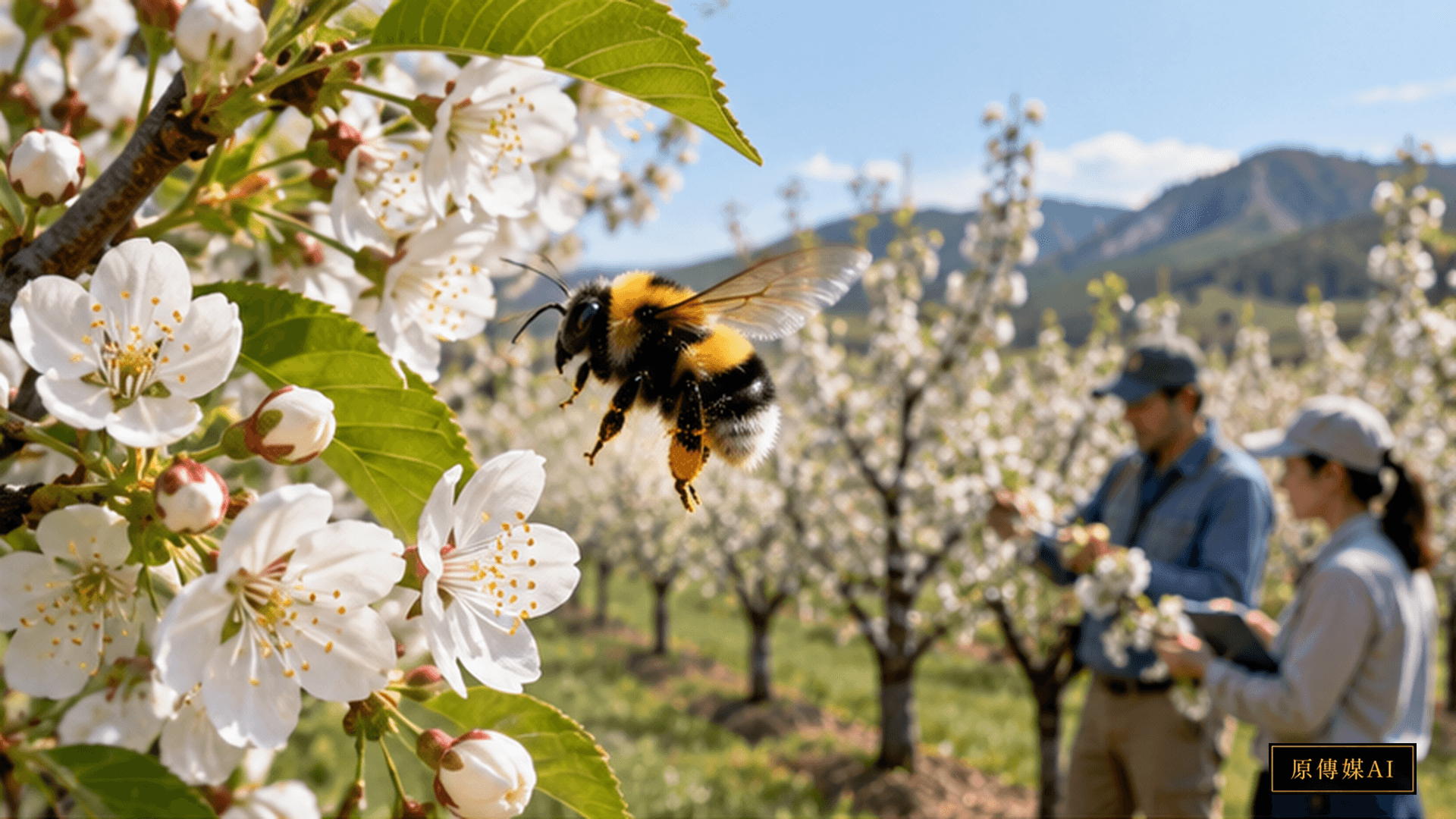
Cherry blossom offers a short window in which bacterial entry may matter. Warwick researchers asked whether bumblebees leaving a hive through a phage-powder passage could carry bacteria-infecting viruses to blossoms. Phages do not infect people or bees, but their target specificity must be measured for chosen bacterial strains. A general claim of no ecological effect does not follow automatically. The experiment treats pollination behavior as a possible delivery route.
What the reported percentage measures
In controlled trials with artificial and real cherry flowers, native British buff-tailed bumblebees carried phages from the hive passage. Warwick reports phage detection on up to 88 percent of flowers and reduced counts of an inoculated target bacterium. The paper describes sample numbers, timing and controls. Detection on flowers is not a measure of how many commercial trees avoided canker, survived or produced more fruit.
The pathogen and the orchard
The study targets Pseudomonas syringae pv. syringae, a cherry canker pathogen. Washington State University extension material places bacterial canker within wider conditions involving tree vigor, weather, wounds and management. Similar symptoms can have other causes. A phage effective against an experimental bacterial isolate still needs testing against local strains and actual infection routes.
The gap from a cage to a field
Researchers can control bee numbers, blossom spacing, phage dose and timing inside a cage. Commercial orchards add wind, rain, ultraviolet light, uneven bloom and other insects. Field trials must ask whether phages persist, reach enough flowers and remain active when disease pressure occurs. Treating the reported maximum delivery percentage as a disease prevention rate would confuse two different outcomes.
Bees are participants in the system
A delivery method is only useful if pollinators remain healthy. Passage design, powder carriers, foraging, return to the colony and possible exposure of wild insects all need measurement. Warwick describes grower pilots as a next step, which places the published work before routine orchard use. Monitoring the bees should be planned alongside monitoring the trees and pathogen.
One part of integrated management
Cherry canker management also involves planting material, varieties, pruning timing, drainage and wound risk. A successful phage treatment might complement these practices rather than replace them. Growers would need a comparison with current care, costs for bees and formulation, evidence about phage resistance and clear stopping rules when it fails.
Limits for Taiwan
Taiwan’s crops, climate, pathogen strains and available pollinators are not the same as the British trial. Plant pathologists, pollinator specialists, regulators and growers would first need to define a local problem and test strains and bee safety in controlled conditions. The British bumblebee subspecies should not be treated as a species to import automatically. The paper suggests research questions, not an immediately available orchard practice.
A responsible next trial
Predefined outcomes should include pathogen counts on flowers, actual disease, tree health, yields and bee colony condition. Current management and untreated comparisons are needed. Weather and blossom timing must be recorded, including days when delivery performs poorly. Negative findings can spare growers a costly intervention. Precision has value only when crop, pollinator and environmental outcomes are considered together.
Specificity must be tested again
A phage that works against one strain may fail against local pathogen populations. Bacteria can change and develop resistance. Strain sampling, formulation stability and effects on non-target microbes require continuing study. If cocktails are used, their components need separate compatibility checks. Natural origin is not a permanent certificate of safety.
The cost of a blossom window
Bee visitation varies with weather, colony condition and surrounding flowers. Keeping an effective dose in an orchard might require powder replacement and hive management. Trials must count materials, labor and loss risk alongside disease avoided. A treatment that lowers a laboratory bacterial count may still be uneconomic for growers.
Colony health is more than survival
Bees remaining alive immediately after exposure is a limited safety measure. Return rates, foraging, larvae, reproduction and disease state may be more sensitive. Formulation ingredients, passage friction and combined exposure to orchard chemicals also matter. Open-field work should track wild pollinators that contact the treatment.
Measure the whole chain
Phages reaching flowers, bacterial counts falling and trees developing less disease are distinct steps. Rain, timing, strains and tree condition can interrupt each one. Field studies need delivery, pathogen, symptoms and yield measures with comparisons. Detecting a phage on a blossom is not yet evidence of durable tree protection.
From trial to public service
Agricultural agencies could first identify gaps in local pathogen monitoring and pollination services with growers. Reports should disclose strain, bee, formulation, season and failure conditions. Movement of bees or materials between regions needs clear records and responsibilities. If the approach works only in high-input orchards, that limit should be reported.
Put safety and benefit on the same scorecard
Reducing chemical inputs is a possible goal, not an observed outcome of the controlled flower trial. A full-season comparison with current management is needed. If the method adds materials and hives without reducing disease or other inputs, an environmental benefit has not been shown. Trials should track disease, colonies, materials and transport costs against thresholds set with growers.
Growers need comparable answers
Growers need to know whether the method provides stable disease reduction during local bloom and pathogen pressure, enough to justify its cost without harming colonies. That requires comparison with current management across more than one flowering period. Wet weather, uneven bloom or different strains may change performance. Reporting those failures allows growers to decide whether a further trial is worthwhile.
Sources and further reading
Role-Driven Inquiry
Yuan Media AI | Guided Questions by Role
Select a role first, then review the complete questions from that perspective; clicking a question will display Yuan Media AI’s response in real time.
Select a role
Readers and families
Examine the article's evidence, governance boundaries, data rights, and actionable steps from the perspective of a Readers and families.
Choose a question
AI use and content-safety disclosure
AI assisted writing and translation. Direct evidence, interpretation and implications for Taiwan are distinguished.