Do Migratory Birds Remember Last Spring? Reading Hudsonian Godwit Tracking Alongside Wetland Observation
Original Chinese title: 候鳥會記得去年的春天嗎?哈德遜塍鷸改變北返時間,追蹤資料與濕地觀察如何共同解讀遷徙?
Tracking of one Alaskan breeding population found departure and arrival about six days later; timing alone cannot establish memory or adaptive benefit.
山海資料庫;全明正|布農族雙龍部落|文化與影像記錄者
A landscape data collective and a Bunun cultural and visual documentarian from Shuanglong.
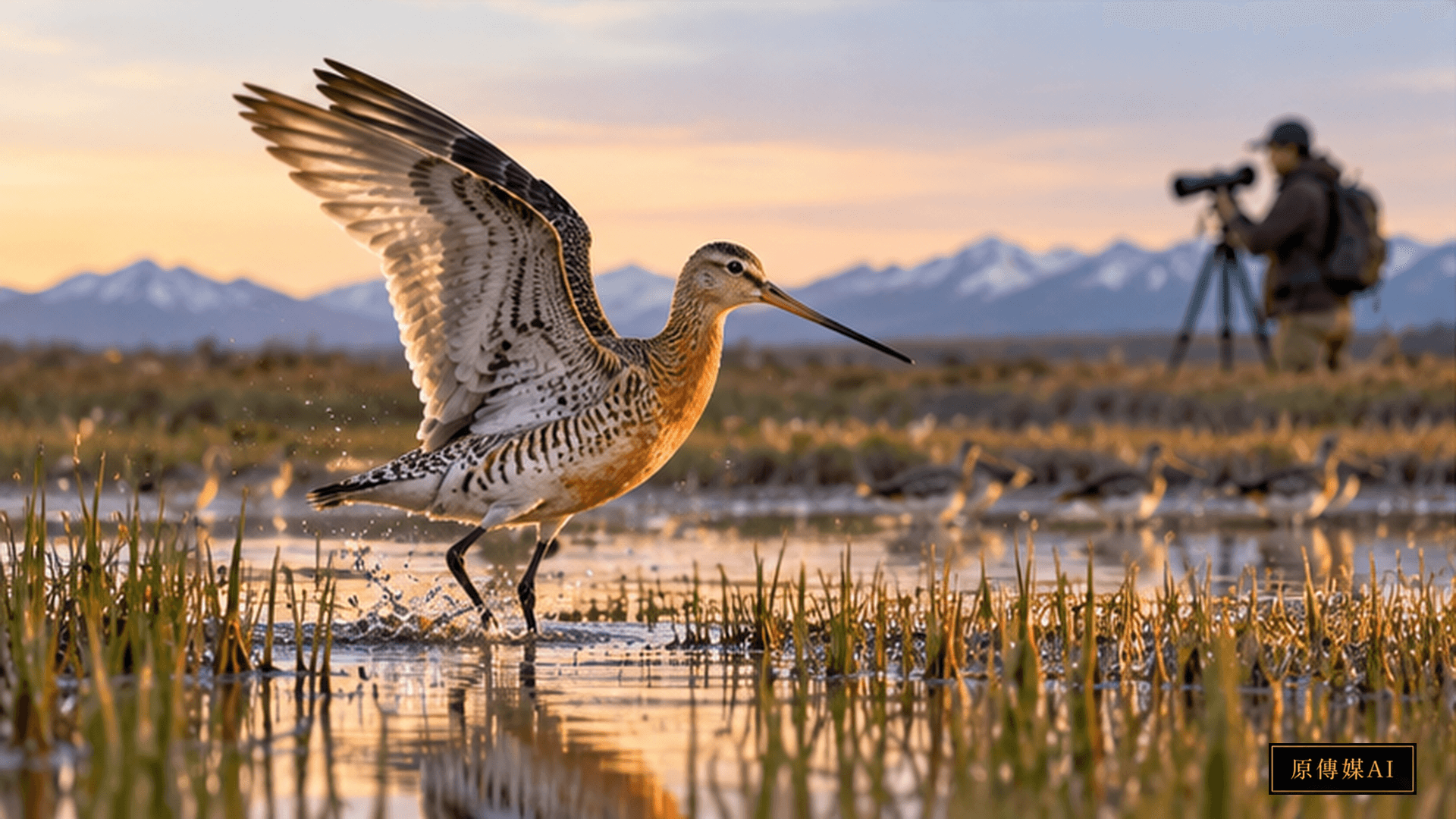
Did a godwit remember last spring?
The question is evocative, but the study did not directly measure a bird’s memory of an earlier spring. The Dryad dataset concerns one breeding population of Hudsonian godwits near Beluga, Alaska. It records departure from nonbreeding grounds, arrival at breeding grounds, trip duration and individual identifiers. Movement dates are not a readout of how a bird represents a previous year in its mind.
Where the six-day shift comes from
The study reports that departure and arrival moved about six days later from 2010 to 2023. Average migration duration remained about 24 days and no comparable sex difference in timing was detected. The authors therefore locate the shift mainly at later departure rather than a longer journey. Tracking came from two deployment periods and was compared with a historical predictive model. The estimate applies to this population and analysis, not every godwit worldwide.
Later is not necessarily better
A change in timing is easily called adaptation, but the birds arrived later than the historical model predicted. That raises a question about whether the response benefits them. Food, snow conditions, stopover sites, predation and breeding outcomes could matter. Departure and arrival dates alone do not establish greater survival or reproduction. The study’s cautious interpretation is more informative than a claim of adaptation success.
Tracking and local observation see different things
Light-level geolocators estimate journeys by individuals, while recovery of devices and location uncertainty constrain the sample. Wetland observers record when birds appear at a site and can also document water, habitat and disturbance. An absence on one survey is not evidence of population loss. Individual tracks, local occurrence and population trends should be kept distinct. Senner Lab supplies publication context; Cornell Lab supplies species identification and habitat background.
Wetlands connect a journey
Breeding grounds, nonbreeding grounds and feeding stops form one migratory route. Changes in water, prey or disturbance may impose costs at different points, but the six-day result cannot be attributed to one wetland project. Surveys should record date, tide, accessible area and effort as well as bird numbers. Otherwise a change in observer coverage can look like a change in migration.
What Taiwan can learn
The Alaskan study population is not a direct forecast for Taiwanese wetlands. Its methods are useful: maintain consistent times and sites, document identification and record tides and habitat change. Local observers hold valuable seasonal knowledge. Citizen-science records also require attention to changes in observer numbers, equipment and routes. More sightings can mean more watching rather than more birds.
Local knowledge and open data
Open data can make statistical work reproducible, yet sensitive stopover locations and local knowledge have different sharing conditions. Researchers and communities should discuss what locations can be public, what stays within conservation management and how contributors receive results. A downloadable table does not make every related account freely usable. Observations that disagree with a model merit investigation.
The next question concerns consequences
Assessing whether later departure helps birds requires repeated measures of body condition, habitat at arrival, nesting dates and breeding outcomes. Unusual weather in one year must be distinguished from longer climate trends. The dataset is valuable precisely because it separates a shift in timing from evidence of successful adaptation. Managers can preserve comparable records and investigate departures from expected patterns.
Individuals and populations
The dataset has individual identifiers, allowing within-bird timing to be distinguished from changing population composition. Recovered tags may overrepresent survivors or birds easier to recapture. A shifting population average should not be personified as every bird making the same decision.
A model is a benchmark
A historical model describes relationships in earlier data; it is not a calendar that nature must obey. Environmental or population change can weaken its predictions. Later-than-predicted arrival prompts study of condition and reproductive outcomes. Without these, discrepancy from a model is neither proof of crisis nor proof of successful adjustment.
Keep survey effort in the table
Observer numbers, weather, routes and tides affect how many birds can be seen. Comparing raw record totals across years without effort can mistake more watching for more birds. Simple consistent fields and notes on uncertain identification become valuable when later analysts investigate timing.
Management across seasons
A wetland may be managed around one season or recreational use, while migrants need different water depths and food at different times. Managers can put occurrence, tides, water levels and disturbance on one timeline. Changes to works or access should identify affected birds and places and be discussed with local users. Alaskan data do not set Taiwan’s optimal water level.
Use climate language precisely
A timing trend does not by itself apportion causes to climate change. Weather, food, population composition and nonbreeding conditions may also change. Attribution requires long comparable series and alternative explanations. Wetland protection need not wait for perfect causal certainty, but communication should separate observed timing from still-tested drivers.
Do not let one number replace a migration story
A six-day mean is memorable but hides individual variation, the proportion of early and late arrivals and what happens at each wetland. Graphs should show distributions and years where data permit, with sample and location uncertainty. Local observations add another time scale, provided survey effort is recorded. Evidence at different scales should be compared without forcing one causal story.
The role of local observers
Daily wetland observations can fill detail around an individual tracking route. Experienced observers know which sites are available at high tide and when construction changes visibility. Missing records need not mean absent birds. Local knowledge does not replace tracking, and tracking does not make local observation redundant. Agreed conditions for recording, use and feedback make future timing comparisons stronger.
Sources and further reading
Role-Driven Inquiry
Yuan Media AI | Guided Questions by Role
Select a role first, then review the complete questions from that perspective; clicking a question will display Yuan Media AI’s response in real time.
Select a role
Readers and families
Examine the article's evidence, governance boundaries, data rights, and actionable steps from the perspective of a Readers and families.
Choose a question
AI use and content-safety disclosure
AI assisted writing and translation. Direct evidence, interpretation and implications for Taiwan are distinguished.