Do Extra Chromosome Sets Guarantee Alpine Adaptation? Transplant Experiments, Plasticity, and Local History
Original Chinese title: 多一套染色體就更能適應高山嗎?阿爾卑斯山移植實驗如何拆解基因、可塑性與地方適應?
Alpine transplantation and population history show local adaptation cannot be reduced to chromosome number or treated as a universal climate advantage.
莊溪|認識植物網站作者|教育奉獻獎得主
Author of the Know Plants website, recipient of an Education Contribution Award, and a long-term contributor to plant knowledge, nature observation, and botanical education.
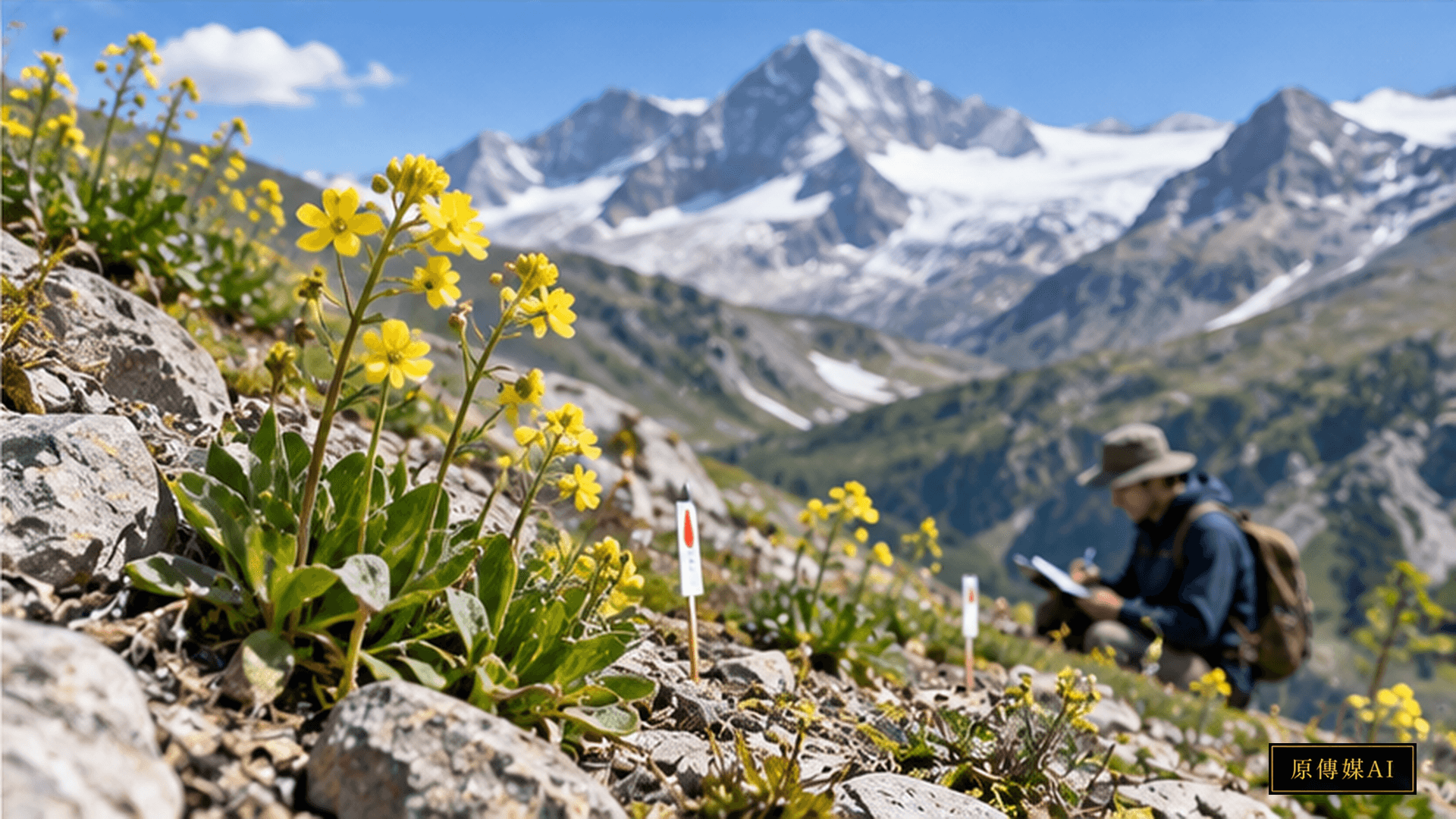
An extra chromosome set is not a climate guarantee
Polyploid plants carry more than two chromosome sets. Duplication can change dosage, variation, and reproduction, while also creating challenges in meiosis, regulation, and genetic load. The presence of tetraploids in alpine habitat does not prove that whole-genome duplication caused cold tolerance. Selection may have preceded duplication, and range history, gene flow, and chance can shape present distributions. Common environments are needed to separate genetic background, plasticity, and local adaptation.
How transplantation separates origin and environment
A University of Vienna record describes seedlings from sixteen foothill and alpine Arabidopsis arenosa populations across four mountain regions transplanted to one low- and one high-elevation site. One region was diploid and three were tetraploid. Survival, flowering, height, above-ground biomass, and other traits were recorded across two growing seasons. An origin-by-environment advantage can support local adaptation, but not every trait must agree and common-garden performance is not the whole lifetime of a wild population.
Parallel local adaptation, not a ploidy victory
The study found similar elevational responses among the four regional pairs for survival, flowering plants, height, and biomass, while other traits were more region-specific. Ploidy had minor effects on the recorded fitness proxies. Selection and migration analyses pointed to contrasting selection at low and high elevations together with limited gene flow. The result supports repeated local adaptation, not universal tetraploid superiority. With only one diploid region, geography and ploidy also cannot be fully separated.
Plasticity and genetic difference appear through interaction
A source population changing across sites demonstrates environmental plasticity. Persistent differences among sources at the same site suggest genetic differentiation. Local adaptation demands a relative fitness advantage, not merely an alpine appearance. Height, leaf number, or flower number are proxies rather than complete lifetime success. Two seasons improve on a single snapshot, yet extreme years, seed output, recruitment, and competition could change conclusions.
Biscutella's ice-age history adds a warning
A University of Bern repository copy of the New Phytologist study combines niche, spatial-genetic, and coalescent models for seventeen diploid and nineteen tetraploid Biscutella laevigata populations. Diploid structure reflected glacial refugia; tetraploids likely arose from southern high-elevation diploids, expanded after glaciation, and admixed with diploids. The authors argue that tetraploids may have inherited high-elevation adaptation rather than gaining it through duplication. Wider distribution therefore does not identify duplication as the sole cause of success.
Taxonomy and distribution do not replace mechanism
Kew's Plants of the World Online recognizes Biscutella and provides taxonomy and native distribution. That authoritative record verifies identity and geography, not adaptation, ploidy origin, or climate resilience. Each source answers a different question: taxonomy states what and where; historical models reconstruct population formation; transplantation compares performance across environments. Evidence can connect without becoming interchangeable.
Climate change is more complex than two elevations
Alpine warming changes snow duration, frost, drought, competitors, pollinators, and soil communities, not only mean temperature. Two transplant sites test one contrast, not every future combination. Polyploidy may help under some conditions and constrain populations under others through load, mating, or demography. Conservation priorities should consider within-population variation, origin, connectivity, current threats, and accessible microclimates rather than ranking plants by chromosome number.
What Taiwan can borrow without copying the Alps
Taiwan's monsoons, typhoons, isolation, warming, and species histories differ from the European Alps. The transferable element is design: determine ploidy and provenance, establish gardens across elevations or microclimates, follow survival, flowering, seed, and recruitment across years, and interpret results with gene flow and environment. Collection and transplantation require conservation safeguards. Assisted movement should begin with small, reversible tests rather than predictions based on a polyploid label.
Deaths in a transplant experiment are also data
Alpine gardens face transplant shock, herbivory, lost labels, and extreme weather. Analysing only final survivors can inflate apparent performance, while unrecorded replacement changes the comparison. Denominators should be retained from sowing and germination through transplanting, winter, flowering, seed, and recruitment. Operational mortality should be distinguished from environmental selection, with microclimate recorded at each site. Rare plants may require limited seed, non-destructive measures, and seed-bank propagation.
Conservation should not retain only one winning source
A population that performs best at one site may not be best under every future climate or disease. Expanding only that source could lose rare variants and alternative responses. Conservation can retain several provenances, record ploidy, limit uncontrolled crossing, and build stratified seed collections. Provenance mixing and assisted migration also require evaluation of gene flow, outbreeding depression, pollination compatibility, and community effects. Diversity preserves options; it is not proof that one ploidy will win.
Statistical significance is not automatically conservation significance
Large samples can make small average differences statistically detectable, while rare species may lack power even when a difference matters for persistence. Studies should report effect sizes, intervals, population distributions, and missing data rather than a binary result. Conservation interpretation must also consider population size, generation time, seed banks, and extreme events. Decision thresholds can be set in advance for stopping a transplant or requiring more monitoring, preventing a significance test from becoming the only judge.
Returning chromosome number to evolutionary history
The evidence does not support the rule that more chromosomes mean better climate adaptation. Local adaptation emerges from selection, gene flow, plasticity, population history, and ploidy background. In the transplant study, origin and elevation were more informative than a simple ploidy effect; the Biscutella history suggests inheritance and postglacial expansion. Conservation should retain provenance and genetic variation, measure several life stages, and test each species on its own history.
Sources and further reading
Role-Driven Inquiry
Yuan Media AI | Guided Questions by Role
Select a role first, then review the complete questions from that perspective; clicking a question will display Yuan Media AI’s response in real time.
Select a role
植物演化遺傳研究者
Examine the article's evidence, governance boundaries, data rights, and actionable steps from the perspective of a 植物演化遺傳研究者.
Choose a question
AI use and content-safety disclosure
AI assisted writing and translation. Source-supported facts, editorial interpretation, and implications for Taiwan are distinguished.