Why Were Gravid Antarctic Krill Near the Dark Seafloor? Hydrothermal Habitat and the Limits of a New Observation
Original Chinese title: 懷卵磷蝦為什麼下潛到黑暗海底?深海熱液活動如何改寫南極漁業的棲地地圖?
Reproductive female Antarctic krill were observed and sampled near deep hydrothermal habitat, but spawning was not directly observed and universality is unknown.
山海資料庫;共同作者:李文驤|天主教達人高中地理老師
Co-authors: ["李文驤
Shanhai Database focuses on urban landscapes, spatial data, nature observation, and public governance.
A discovery that extends the habitat map downward
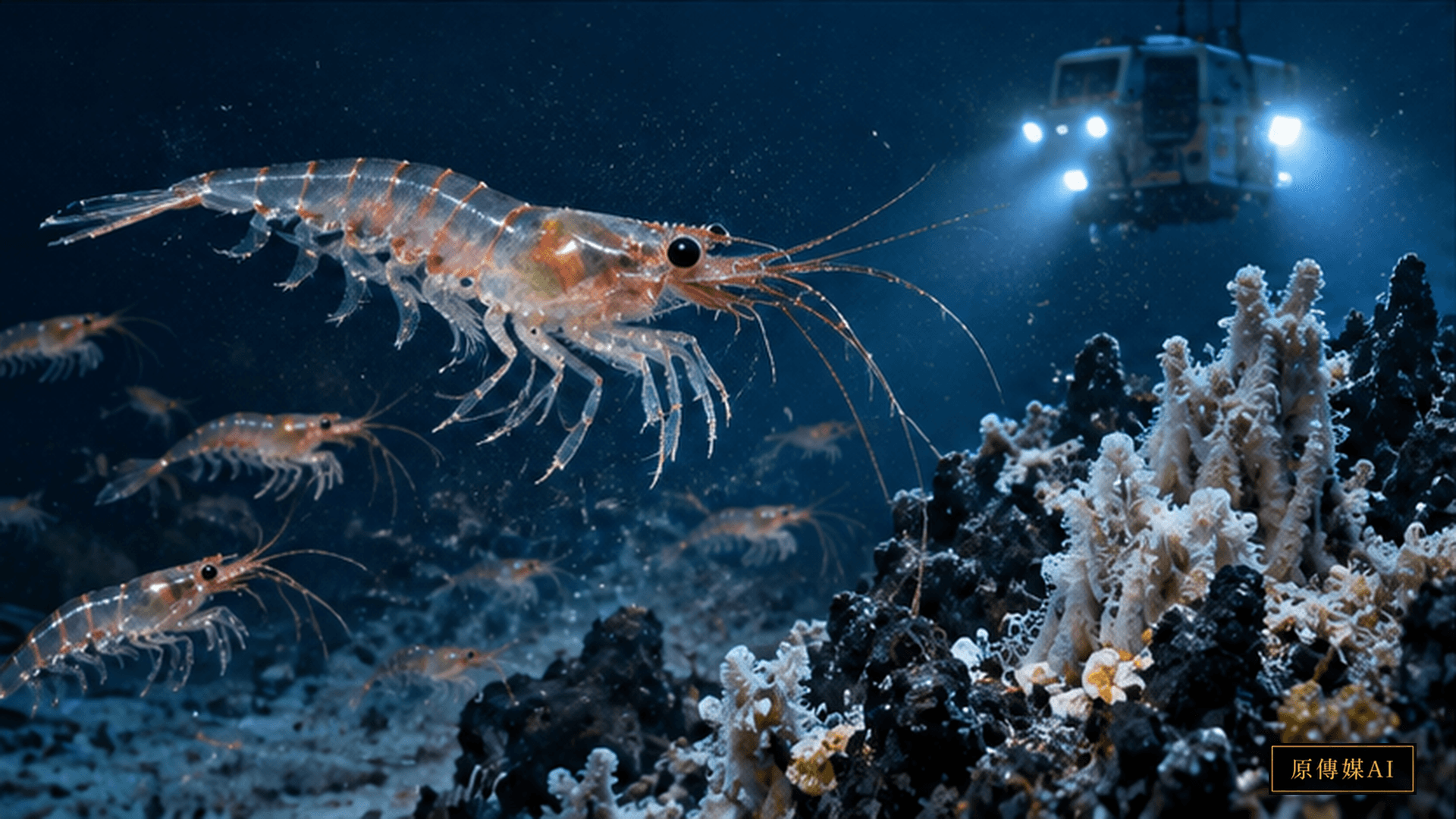
Antarctic krill are usually discussed through surface waters, sea ice, and phytoplankton. A National Geographic Society account reports that an ROV observed and collected reproductive females near hydrothermal activity more than 3,000 feet deep in the Weddell Sea, recording aggregation and feeding. The direct result is that adult krill use a deep habitat that earlier work rarely sampled. It does not establish that all populations descend this far or complete a universal spawning map.
What ROV footage and specimens each contribute
ROV footage supplies depth, location, behavior, and environmental context. Physical specimens allow checks of sex, reproductive condition, and feeding evidence. Together they are stronger than an image alone, but the observation remains limited by cruise, dive, field of view, sampling gear, and season. Without tagging, time series, and repeated observations across sites, it cannot show residence time, visit frequency, or how much of the population behaves this way.
Gravid females are not observed spawning
Gravid describes females in reproductive condition. The report presents the seafloor finding as a reason to rethink where eggs may be released and says that spawning location remains a key question. The team did not claim to have watched eggs being released. A gravid animal could be feeding, pausing, migrating, or nearing spawning. Turning reproductive females near vents into a confirmed, widespread spawning ground would convert a testable hypothesis into a conclusion.
A hydrothermal habitat is more than hot vent fluid
NOAA explains that hydrothermal vents form where volcanism drives heated water through the seafloor and that chemosynthetic microbes can support local food webs. Krill near such a system are not necessarily living in the hottest or most toxic fluid. The relevant question is how chemical energy, microbes, and food become available across strong spatial gradients. Habitat use requires measurements of distance, diet, oxygen, chemistry, and the balance between resources and risk.
The life cycle already connects surface and depth
The Australian Antarctic Program explains that eggs released near the surface can sink for about seven days to depths around 1,000 meters before hatching, after which larvae swim upward. This known cycle shows that depth is not absent from krill biology, but sinking eggs do not prove that gravid adults spawn on the bottom. The new observation adds adult reproductive use of a deep habitat to questions that must remain distinct from established egg descent.
Why fisheries governance cannot see only surface density
Antarctic krill support fish, seabirds, seals, and whales and are also a major Southern Ocean fishery target. If reproductive females or particular life stages use deep habitat, surface-centered surveys and catch maps may miss part of the risk. One observation cannot draw a new closure by itself. Management needs depth, season, reproductive state, fishing activity, and predator demand in the same adaptive monitoring framework.
Climate, sea ice, and vents are not one causal story
Sea ice affects winter food and shelter for young krill, while temperature and ocean chemistry can influence early survival. Hydrothermal activity has different geological dynamics. The finding suggests that these systems may intersect in a life cycle, not that climate change has already forced krill downward. Sea ice, currents, water masses, food, reproductive state, and deep conditions must be measured together to separate seasonal behavior from long-term change.
Taiwan can borrow a three-dimensional habitat perspective
Taiwan does not govern the Antarctic krill fishery, so the Weddell Sea result should not be assigned to local species. The methodological lesson is that one organism may connect surface waters, slopes, seafloor topography, and chemical environments across life stages. Marine education can use the case to distinguish images, samples, and inference. Development and fisheries assessments can also state which depths and seasons their data do not cover.
From one deep site to comparative surveys
Tests of generality need comparisons among active-vent, non-vent, and different seafloor settings, repeated before and after reproductive periods. ROV observations should be integrated with acoustics, water masses, environmental DNA, stomach contents, or stable isotopes. Dive effort and absences matter as much as successful footage. Light, thrusters, and bait may alter behavior and should be evaluated. Because deep-sea surveys are costly, primary questions and minimum data standards should be set before a cruise.
Protected areas and fishing rules need an updateable chain of evidence
If repeated data show that reproductive females depend on particular benthic habitats, managers still need threat, season, and scale information before selecting closures, buffers, or survey rules. Failure to replicate would not erase the first observation; it could still reveal a sampling blind spot. Credible governance records how each new result changes models, thresholds, and monitoring priorities and sets a date for review rather than turning a discovery into an immediate final policy.
Images should also state what was not filmed
Deep-sea footage is powerful and can make a short aggregation sequence feel like a complete habitat or life cycle. News, museum, and classroom media should state depth, date, duration, editing, sample size, and that spawning was not directly observed. Captions must distinguish raw footage, illustration, and inferred movement. Policy discussions should connect an image back to methods and the paper rather than treating visual impact as evidence of occurrence rate, range, or population trend.
A new answer creates more precise questions
The strongest conclusion is that researchers directly observed and sampled reproductive Antarctic krill near a deep hydrothermal habitat and obtained evidence of feeding and habitat use. They did not establish observed spawning, universal use, duration, or a quantified population effect. Clear boundaries strengthen the next tests: repeat visits across seasons and sites, chemical and food-web analysis, and incorporation of deep observations into Southern Ocean management.
Sources and further reading
Role-Driven Inquiry
Yuan Media AI | Guided Questions by Role
Select a role first, then review the complete questions from that perspective; clicking a question will display Yuan Media AI’s response in real time.
Select a role
極地海洋與磷蝦研究者
Examine the article's evidence, governance boundaries, data rights, and actionable steps from the perspective of a 極地海洋與磷蝦研究者.
Choose a question
AI use and content-safety disclosure
AI assisted writing and translation. Source-supported facts, editorial interpretation, and implications for Taiwan are distinguished.