Farmers Are Not the Last Stop of an Experiment: Testing Reduced Tillage, Cover Crops, and Biochar on Working Farms
Original Chinese title: 農民不是試驗最後一站:減耕、覆蓋作物與生物炭,為何必須在真實農場共同驗證?
Five Kentucky farm trials compare reduced tillage, cover crops, and biochar; first-season differences remain preliminary and farmer participation is central.
鄭淑禎|實踐大學專任助理教授、關注產業轉型、農業價值鏈、地方經濟與科技應用的專題作者;專家諮詢:陳振義博士|台東農業改良場
鄭淑禎 is a full-time assistant professor at Shih Chien University focused on industrial transition, agricultural value chains, local economies, and technology; agricultural consultation for this feature was provided by 陳振義 of the Taitung District Agricultural Research and Extension Station.
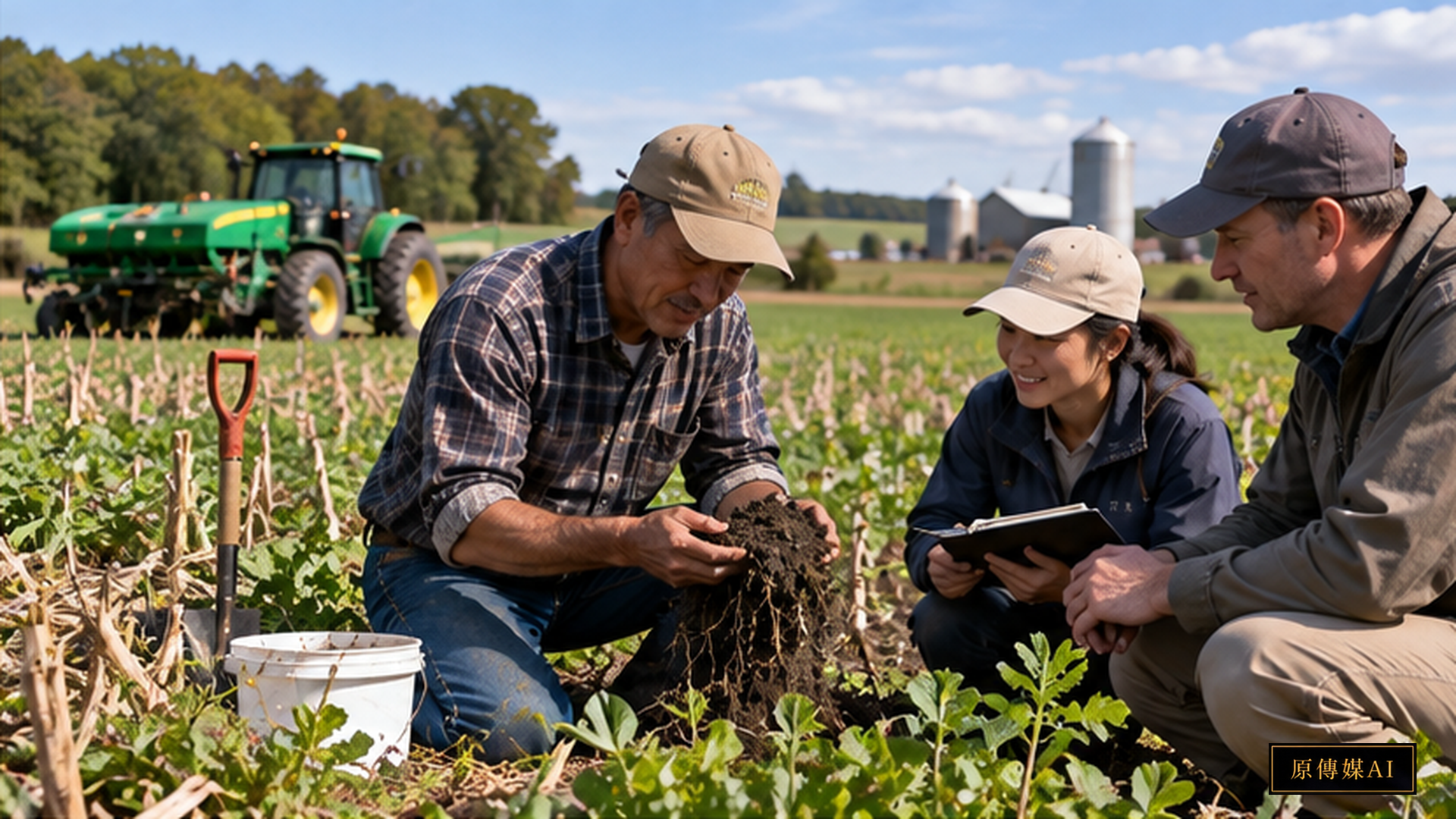
Moving from demonstration plots to working farms
Regenerative agriculture is often reduced to a before-and-after image, while farmers manage weather, equipment, labor, tenure, cash flow, and rotations as one system. Kentucky State University's project places comparisons on partner farms in five counties. On-farm trials do not eliminate bias, but they bring operational limits that research stations may miss into the evidence. Farmers are not merely land providers: they can identify useful questions, adoption costs, and whether an average difference matters in practice.
The trial is not testing one regenerative recipe
Researchers compare conventional and reduced tillage, cover crops, and biochar while tracking crop and soil responses. These practices work through different pathways. Tillage changes disturbance; cover crops involve roots, cover, and rotation timing; biochar outcomes depend on feedstock, production, dose, and soil. A common label helps communication but cannot predict results. Each site still needs records of its baseline soil, crop, rainfall, fertility, operations, and unit of comparison.
A first full season produces preliminary results
Kentucky State reported roughly 3.8 percent higher corn yield and 4.6 percent higher soil carbon under reduced tillage than conventional tillage in the first complete season. The researchers explicitly called for continued monitoring and warned against judging the transition by year one. These are site- and season-bound differences, not guarantees for every crop, soil, or climate. Weather and field variability affect yield, while sampling depth, bulk density, method, and spatial variation affect soil-carbon estimates.
Soil health must become measurable functions
USDA NRCS defines soil health through the continuing capacity of soil to function as a living ecosystem, including water regulation, filtration, nutrient cycling, habitat, and plant growth. Evaluation should therefore not select only one favorable indicator. Infiltration, aggregate stability, organic carbon, nutrients, yield, input costs, and labor can be tracked together, with primary and exploratory outcomes named before results are known.
Participation is more than attending a field day
Western SARE requires producer involvement from planning and design through implementation and outreach. That turns participation into an allocation of authority. Farmers should be able to challenge the question, stop unsafe or impractical operations, receive their own results, and help interpret differences. Institutions should retain controls and report treatments that did not work. Data rights and identifiability must be clear before farm data influence funding, insurance, or marketing.
Costs, risks, and transition periods belong in the evidence
Reduced tillage can require different planting or weed management. Cover crops add seed, planting, and termination decisions. Biochar creates quality, transport, and application questions. A practice may improve one soil measure and still be infeasible because labor, machinery, or cash flow do not fit. Trials should record hours, fuel, inputs, failure risks, and learning costs. Stop conditions should be explicit rather than treating every adverse outcome as a reason to wait indefinitely.
Extension translates methods rather than selling products
Extension and conservation services add value by diagnosing a land concern before selecting a practice. Advisers should explain the soils, climates, and crops behind the evidence and identify what remains experimental. Useful support helps establish a baseline, set up comparable strips, sample consistently, and interpret multi-season trends. A decision not to adopt can reveal a technology or policy barrier rather than farmer resistance.
Taiwan needs smaller, durable comparisons
Taiwan's farm scale, tenancy, typhoons, irrigation, crop intensity, and labor differ from Kentucky. The transferable element is the co-design process: farmers define the problem, extension staff select a small set of indicators, comparable treatments are retained, and costs and risks are recorded across seasons. Biochar also requires local checks on feedstock, contaminants, production quality, and regulation. Cooperative equipment may help, but use of individual farm data still requires consent.
Preventing field differences from becoming treatment effects
Working farms are heterogeneous. Slope, drainage, previous crops, fertility history, and texture can influence both where a treatment is placed and the outcome. Paired or randomized strips, baseline measurements, fixed sampling locations, and records of weather and protocol deviations can reduce confusion. Safety-driven changes should be documented rather than deleted. Results should show variation among farms instead of only a pooled average, because useful knowledge includes the conditions under which a practice fails or costs too much.
The speed of data return sustains partnership
A final academic report arrives too late for in-season decisions. Short field summaries after sampling can state the measurements, comparison, and what cannot yet be inferred; annual meetings can review trends together. Individual farms should not be ranked publicly without consent, and anonymization of pooled data should be explained. Before funding ends, partners need a plan for records, instruments, and advice. The product of participatory research is also a knowledge service that farmers can continue to use and correct.
Before scaling, ask who will be excluded
Pilot partners often have stable tenure, equipment, and time, while results are later promoted to farms with fewer resources. Scaling should compare tenants, part-time farmers, crops, and irrigation systems and determine who can absorb transition risk. Carbon or sustainability labels can also impose measurement and verification costs that exclude small farms. Cooperative services and tiered support are testable options, but beneficiaries and non-participants must be visible. Equity should be measured from recruitment through data access and assistance, not added as a final slogan.
Returning farmers to the center of knowledge production
The case does not prove that reduced tillage universally raises yield or stores carbon. It shows why farm conditions and farmer judgment belong in research design. Preliminary differences merit follow-up, not a promise. Publishing baselines, comparisons, multi-season changes, costs, and negative outcomes lets farmers judge applicability. Co-produced research does not lower scientific standards; it subjects questions, measurement, and interpretation to practical scrutiny.
Sources and further reading
Role-Driven Inquiry
Yuan Media AI | Guided Questions by Role
Select a role first, then review the complete questions from that perspective; clicking a question will display Yuan Media AI’s response in real time.
Select a role
小農與農場家庭
Examine the article's evidence, governance boundaries, data rights, and actionable steps from the perspective of a 小農與農場家庭.
Choose a question
AI use and content-safety disclosure
AI assisted writing and translation. Source-supported facts, editorial interpretation, and implications for Taiwan are distinguished.