Before Agricultural Aid Enters Communities, Who Decides What Counts as Need? Cross-Sectoral Indigenous Farming and Fishing in the Philippines
Original Chinese title: 農業援助進入部落以前,誰決定什麼才叫需要?菲律賓 Indigenous farming 與 fishing 的跨部門合作
The Philippine Department of Agriculture and NCIP deepen partnership under the 4K Program. Examining livelihood resilience, traditional polyculture, and digital data sovereignty, this analysis probes how aid policies can genuinely respect community self-determination.
鄭淑禎|實踐大學專任助理教授
鄭淑禎 is a full-time assistant professor at Shih Chien University focused on industrial transition, agricultural value chains, local economies, and technology.
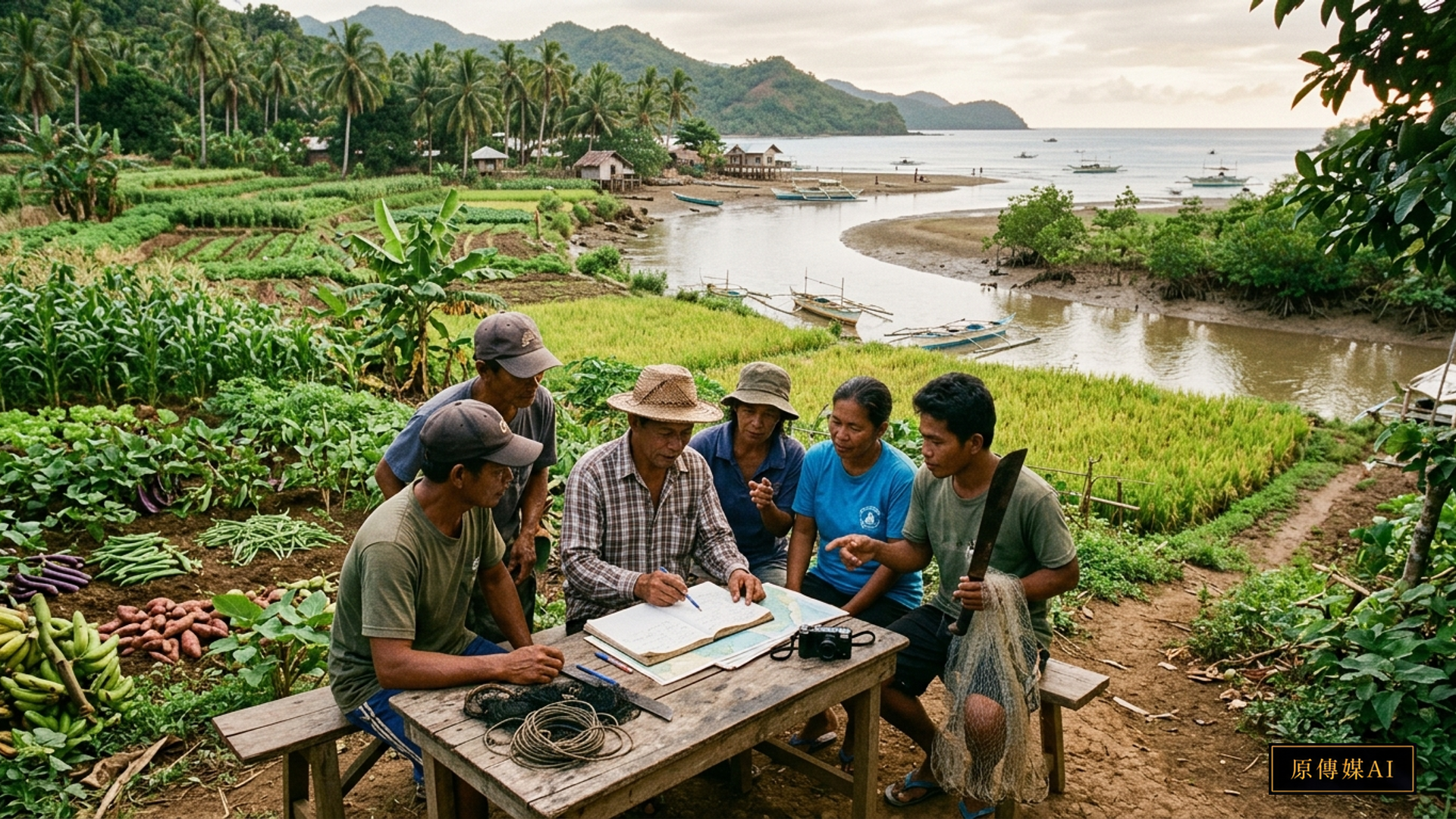
Stripping the Label of Unilateral Aid: Whose Development Metrics?
State-led rural development programs targeting Indigenous communities have long fallen prey to a top-down, technology-transfer mindset. Bureaucrats and agricultural extension specialists often arrive in tribal villages with predefined notions of progress: distributing high-yielding hybrid seeds, subsidizing synthetic fertilizers, constructing standardized greenhouse facilities, and signing purchase contracts for monoculture cash crops. Performance indicators routinely focus on yield per hectare, commercial grading standards, and short-term monetary revenue. Yet on biodiverse ancestral lands, this rigid industrial blueprint repeatedly triggers soil degradation, native seed loss, and the erosion of community self-reliance.
On September 17, 2026, the Philippine Department of Agriculture (DA) and the National Commission on Indigenous Peoples (NCIP) signed a landmark memorandum of understanding, officially announced on September 22, to transform agricultural and fisheries development across Indigenous Cultural Communities/Indigenous Peoples (ICCs/IPs) through the Kabuhayan at Kaunlaran ng Kababayang Katutubo (4K Program). While outwardly an administrative pact, viewed through the lens of industrial governance and knowledge equity, it poses a fundamental question: when governments knock on village doors with capital and equipment, who defines the community's deficit, and who determines what meaningful livelihood development entails?
The central significance of this collaboration lies in breaking down long-standing bureaucratic silos between agriculture and ancestral domain governance. Under the Indigenous Peoples' Rights Act (IPRA, Republic Act 8371), Indigenous peoples hold self-determination and the right to Free, Prior and Informed Consent (FPIC) over their ancestral domains. Historically, conventional agricultural interventions often bypassed tenure realities and cultural protocols, resulting in abandoned facilities and internal conflict. The renewed partnership establishes community-defined priorities as the indispensable starting point, requiring development plans to originate from community councils rather than centralized desks.
Reassessing Polyculture and Foraging: Ecological Resilience Over Monoculture
Conventional agricultural science frequently dismisses Indigenous traditional farming as low-productivity and technically backward. Yet contemporary agroecology and food systems research increasingly demonstrate that Indigenous agro-ecosystems represent sophisticated, climate-tested risk diversification networks. In typhoon-prone tropical zones and drought-prone mountain slopes, uniform monocultures are fragile; a single severe typhoon or pest outbreak can eradicate an entire harvest, forcing smallholders into predatory debt cycles.
In contrast, Philippine Indigenous household livelihoods are woven from multiple ecological niches. Homes are surrounded by diverse homegardens cultivated with root crops, legumes, and medicinal plants; forested margins support rotational swidden farming that revitalizes soil microbiota; and adjacent streams or intertidal flats yield seasonal catches and foraged greens. Family labor shifts flexibly across seasonal cycles. When market prices collapse or storms damage specific plots, wild vegetables, resilient grains, and aquatic resources safeguard household nutrition, supported by kinship mutual aid and informal redistribution networks.
This livelihood architecture, grounded in ecological resilience and autonomy, cannot be captured by narrow tonnage and cash profit metrics. When agricultural aid programs force communities to clear native woodlands for uniform commercial fruits or highland vegetables, they replace intergenerational climate buffers with short-term cash vulnerability. The profound merit of the 4K initiative lies in recognizing the cultural integrity of Indigenous agro-fisheries production, redirecting institutional support from displacing traditional practices toward strengthening diverse ecological foundations.
Infrastructure and Contextual Suitability: Rooting Technology in Reality
Field visits across rural communities frequently reveal multi-million-peso government-subsidized rice mills, automated drip irrigation pipes, dryers, and commercial cold storage units standing abandoned and rusted. This does not stem from farmers resisting technology, but from equipment being introduced completely disconnected from local geography, transit, and social structures. In remote mountain settlements lacking stable electrical grids or spare-part supply lines, complex imported machines become useless upon their first breakdown. If arterial farm-to-market roads are regularly severed by monsoon landslides, maximizing field yields merely causes harvested produce to rot in transit, saddling farmers with crippling packaging and transport losses.
Effective cross-sectoral collaboration demands that hardware investments be tethered to real local bottlenecks. In coastal and riverine communities, fishers often need safer conditions during extreme weather and decentralized, low-energy drying and cold-chain facilities rather than larger commercial nets. In forested uplands, farmers need lightweight machinery capable of clearing access roads after typhoons and upgraded rodent-proof traditional granaries rather than high-maintenance drones.
Agricultural engineers and extension agents must approach communities with the humility of apprentices, consulting elders regarding microclimates, seasonal winds, and hydrological dynamics. Every technological intervention must evaluate energy self-sufficiency, maintenance accessibility, labor divisions, and the central role of women in post-harvest processing. Only when technology aligns with local cultural geography and environmental rhythms can modern infrastructure become an enduring asset rather than a transient subsidized exhibition.
Digital Technology and Data Sovereignty: Guarding Against Algorithmic Extraction
As precision agriculture, remote sensing, and mobile applications accelerate their presence across rural landscapes, agricultural workflows are translated into massive datasets. Farmers' mobile logs, uploaded pest imagery, soil elemental assays, seed phenology, and microclimate records constitute high-value digital repositories. This introduces pressing ethical and legal questions: who owns the agro-ecological data nurtured by generations of Indigenous stewardship?
Commercial agribusinesses and research institutions frequently extract field imagery and landrace performance data under the guise of free diagnostic apps or national agricultural clouds. Without robust data sovereignty protocols, these datasets can be deployed for unauthorized genomic sequencing, patent filings, or proprietary commercial algorithms. Contributing Indigenous smallholders receive at best a temporary free mobile account, while external corporations monopolize intellectual property over drought-resistant or pest-tolerant traits, enacting a digital form of biopiracy.
Instituting agricultural AI or mobile tools requires erecting clear data sovereignty guardrails. Philippine and international Indigenous advocacy networks emphasize that field and phytosanitary repositories must follow the CARE Principles and OCAP® framework. Systems must explicitly tag community provenance and rights boundaries, prohibiting the unrestricted open-access release of data concerning traditional crop genetics, wild food geographies, and sacred harvesting sites. Data platforms must serve local decision-making and seed conservation rather than acting as one-way extraction conduits.
Lessons for Taiwan Indigenous Agro-Fisheries Value Chains
The cross-sectoral integration and systemic reflections of the Philippine 4K Program offer valuable lessons for Taiwan's tribal agricultural policy. Taiwan's indigenous regions have long navigated fragmented ministerial jurisdictions: the Ministry of Agriculture, Taiwan promotes precision farming and traceability schemes, the Council of Indigenous Peoples, Taiwan focuses on tribal economic development and cultural transmission, and the Forestry and Nature Conservation Agency advances forest understory economies. Each agency operates distinct subsidy thresholds and reporting requirements, leaving grassroots cooperatives exhausted by administrative compliance rather than cultivating long-term economic resilience.
In recent years, Taiwan's indigenous communities have demonstrated remarkable vitality in revitalizing traditional crops such as foxtail millet, red quinoa (djulis), pigeon pea, sorghum, and native cinnamon. Young farmers returning to ancestral villages collaborate with elders to restore terrace waterways and practice chemical-free agroecology. Yet when interfacing with commercial retail chains, tribal producers face steep hurdles: mainstream retail channels demand rigid uniformity and destructive price competition, discounting the ecological conservation costs and climate risks borne by friendly tribal farming.
Taiwan can draw two vital insights from the Philippine experience: first, constructing integrated support policies centered on composite agro-forestry-fishery livelihoods rather than single-crop subsidies, acknowledging overall ecological stewardship and cultural heritage as legitimate performance metrics; second, implementing community-owned participatory guarantee systems (PGS) alongside accessible digital logs. Enabling farmers to govern their cultivation records and seed registries empowers indigenous cooperatives to reclaim bargaining power and narrative authority across market value chains.
Toward Co-Governance: Diversity as the Strongest Climate Shield
Confronting escalating climate crises and vulnerable food supply chains, global society increasingly realizes that reliance on industrial monocultures and petrochemical inputs is unsustainable. The agricultural knowledge, ecological ethics, and polyculture practices nurtured by Indigenous peoples over centuries represent an irreplaceable reservoir of planetary climate adaptation solutions.
Authentic development does not mean coercing all landscapes into high-yield industrial factories; it means safeguarding the diversity and sovereignty of living choices. When state bodies, technology developers, and research institutions engage Indigenous farmers and fishers as equal partners and territory stewards, agricultural support ceases to be a patronizing subsidy cycle and transforms into an enduring force anchored in ecological health and cultural dignity.
Sources and Further Reading
Role-Driven Inquiry
Yuan Media AI | Guided Questions by Role
Select a role first, then review the complete questions from that perspective; clicking a question will display Yuan Media AI’s response in real time.
Select a role
農業與農村發展政策規劃師
Examine the article's evidence, governance boundaries, data rights, and actionable steps from the perspective of a 農業與農村發展政策規劃師.
Choose a question
AI use and content-safety disclosure
AI assisted writing and translation. Source-supported facts, editorial interpretation, and implications for Taiwan are distinguished.