Fire Is Not a Disaster: The Forest Remembers Who Burns It Properly
Original Chinese title: 一把火不是災難:森林其實記得誰會正確地燒它
Modern dogmas of total fire suppression have ironically accumulated fuel loads for catastrophic megafires. From northern Australia's WALFA initiative and Native American cultural fire practices to Taiwan Bunun alpine understory clearing and swidden wisdom, this feature examines how low-intensity cool burns restore forest resilience, quantify carbon offsets, and realize local stewardship across energy transitions and low-carbon supply chains.
全明正|布農族雙龍部落|文化與影像記錄者|長期關注能源轉型、材料科技、低碳供應鏈、產業政策與地方環境治理
A Bunun cultural and visual documentarian from Shuanglong community whose work covers energy transition, materials, low-carbon supply chains, industrial policy, and local environmental governance.
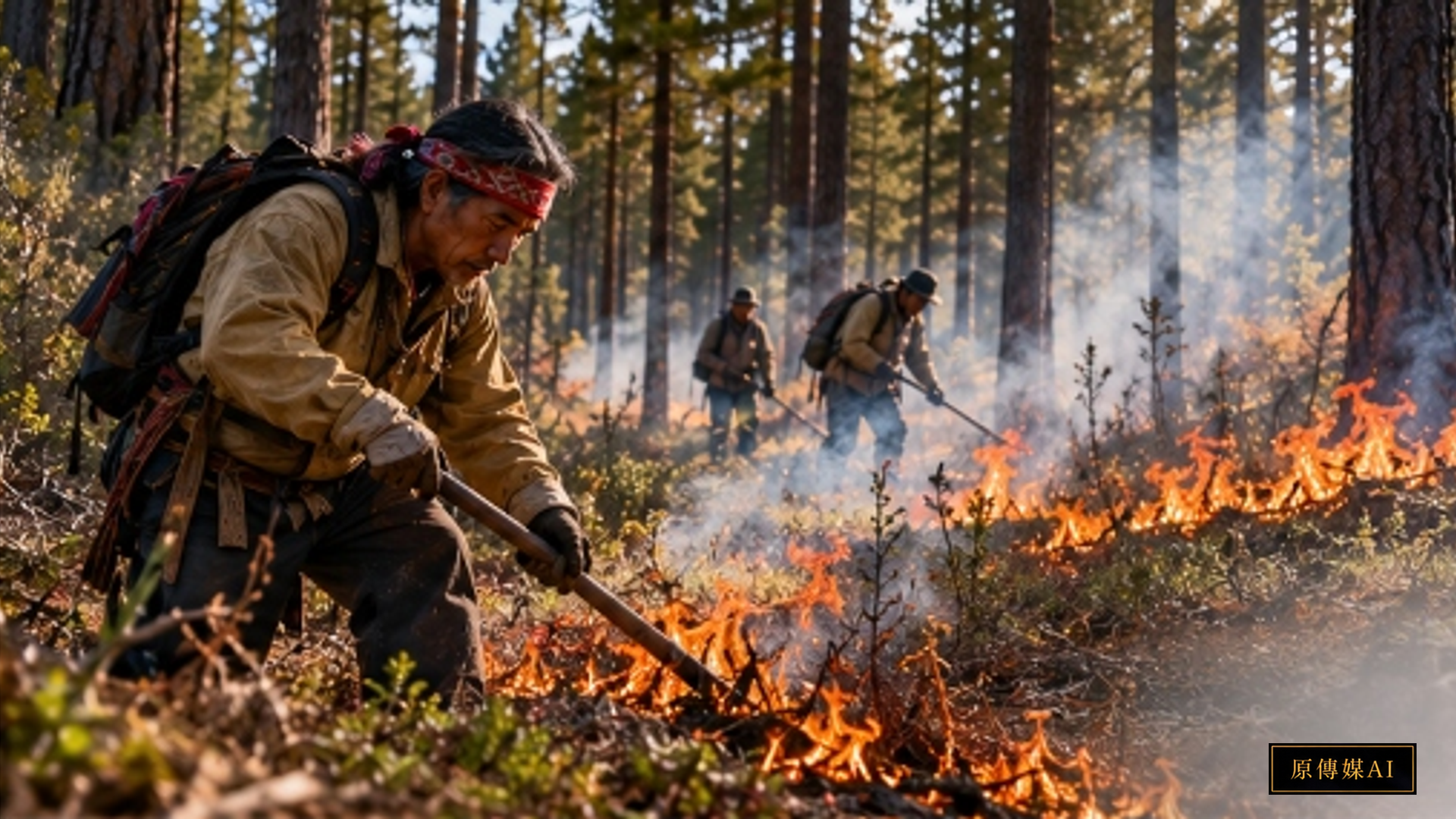
Extinguishing Every Ember Cultivated Catastrophic Firestorms
Throughout a century of modern forestry and firefighting doctrine, fire has been universally cast as the mortal enemy of the forest. From the early twentieth-century United States Forest Service 10:00 AM policy—which mandated that every wildfire report be completely extinguished by ten o'clock the following morning—to punitive penal codes worldwide that criminalize forest fire ignition, bureaucratic institutions have operated under an unshakeable conviction: if fire is excluded entirely, woodlands will remain permanently pristine. Yet over the past two decades, this seemingly rational policy of absolute fire suppression has triggered an unprecedented ecological backlash.
From California and Mediterranean coastal ranges to the Australian continent, contemporary megafires have broken historical records in thermal intensity, spread velocity, and destruction radius. Traditional water tankers and aerial water bombers stall helplessly before crown fires soaring dozens of meters into the sky. Ecologists have finally been forced to confront an uncomfortable paradox: a century of dogmatic fire suppression severed the natural combustion cycles of forest ecosystems. Dead branches, leaf litter, cured grasses, and dense understory thickets have accumulated unchecked across forest floors year after year, converting once-open, fire-resilient timber stands into ticking time bombs primed for lightning strikes or stray sparks.
Forests on Earth, however, never evolved in the total absence of fire. Numerous ancient tree species possess serotinous seed coats that require heat to open and germinate, such as American longleaf pines and Australian eucalypts. Regular, low-intensity surface fires rapidly convert dead organic debris into nutrient-dense biochar ash that enriches topsoil, purges fungal pathogens and wood-boring insects, and maintains open foraging corridors for herbivores. Forests remember the rhythmic cadence of fire; what they fear is not burning itself, but forgetting who knows how to burn with proper timing, gentle temperatures, and reverent craftsmanship.
Cultural Burning: The Ecology and Evolutionary Memory of Cool Fire
Unlike modern fire response systems that classify all combustion as an unmitigated catastrophe, Indigenous peoples across the globe regard fire as a sacred and highly sophisticated stewardship responsibility. In the traditional wisdom of Australian First Nations, Pacific Northwest tribes (such as the Yurok, Karuk, and Klamath), and high-mountain Indigenous communities in Taiwan, these intergenerational practices are known as Cultural Burning.
The foundational principle of cultural burning is the deployment of cool burns or low-intensity fires. Unlike devastating hot fires that exceed 800 degrees Celsius and generate violent convective updrafts engulfing canopies, cool burns remain strictly controlled between 200 and 400 degrees Celsius, with flame lengths hovering around ankle or knee height. Experienced Indigenous fire practitioners initiate burns in the early dry season, early mornings when dew still dampens vegetation, or late afternoons as winds subside. Flames creep slowly along the forest floor with gentle breezes, licking and consuming only dry fine fuels while sparing the thick bark of mature trees and leaving shading overhead canopies unscorched. Insects and small mammals have ample time to retreat into subterranean burrows or migrate into adjacent unburned patches.
This patch-mosaic burning creates an intricate mosaic of microhabitats across the forest landscape: freshly burned plots sprout protein-rich grasses within weeks, drawing deer and avian foragers; moderately burned sectors sustain diverse berry-producing shrubs; and unburned patches provide deep nesting cover. Crucially, these periodic black-and-grey ash corridors act as living, impassable firebreaks. When late-season dry lightning ignites a wildfire, the flames subside naturally upon reaching cultural burn plots devoid of ground fuel, failing to transition into uncontrollable crown infernos.
The WALFA Model: Transforming Cultural Burning into Global Low-Carbon Supply Chain Assets
Beyond reshaping forest ecology, cultural burning has unlocked a transformative, market-driven governance mechanism within global climate mitigation and energy transition. The West Arnhem Land Fire Abatement (WALFA) project in northern Australia serves as an international exemplar of converting Indigenous cultural fire practices into rigorously accredited carbon offset assets.
Across the vast tropical savannas of Arnhem Land, allowing wildfires to ignite untamed during the late dry season (September to November) unleashes intense wildfires that consume colossal amounts of biomass, venting massive volumes of methane (CH₄) and nitrous oxide (N₂O)—greenhouse gases whose global warming potentials are dozens to hundreds of times greater than carbon dioxide. Since 2006, Aboriginal rangers and Traditional Owners reclaimed land governance leadership, reviving the ancestral practice of extensive cool burns throughout the early dry season (April to July).
By shifting the burning window forward to months with higher relative humidity and mild winds, WALFA cut late-season fire extents nearly in half, abating an average of more than 100,000 metric tons of CO₂ equivalent annually. Demonstrating institutional innovation, the project integrated Indigenous ground practice with satellite remote sensing and carbon accounting to formulate the internationally recognized Savanna Burning Methodology endorsed by the Australian government and the United Nations.
Multinational energy corporations and global enterprises fulfilling Scope 3 supply chain decarbonization commitments purchase these high-integrity Australian Carbon Credit Units (ACCUs). Rather than vanishing into intermediary consultancy overhead, revenues flow directly into Aboriginal trust funds, financing full-time ranger salaries, Indigenous language immersion schools, traditional ecological field documentation, and sacred rock-art conservation patrols. This architecture demonstrates that Indigenous burning techniques are not relics of poverty, but premier, high-integrity Nature-based Solutions (NbS) within global biodiversity and carbon finance.
Dispelling the Stigma of Swidden: The Renaissance of Understory Wisdom in Taiwan Indigenous Territories
Returning to Taiwan, the historical relationship between fire and forests carries a painful legacy of official criminalization, misunderstanding, and suppression. For generations, Japanese colonial forestry authorities and post-war forestry bureaus condemned Indigenous rotational swidden agriculture (commonly disparaged as slash-and-burn) as environmental destruction that caused soil erosion, burned valuable timber, and represented primitive backwardness. Mountain forests were expropriated into state timber reserves, forbidding Indigenous villagers from carrying fire into ancestral lands and severing centurions-old metabolic bonds maintained by the Atayal, Bunun, and Tsou peoples.
Contemporary ethnobiology and forestry research have illuminated historical reality: traditional alpine fire use among the Bunun and Atayal was an exceptionally rigorous system of precision ecological engineering. In the Bunun community of Shuanglong, for example, preparing rotational agricultural plots or clearing hunting grounds required family elder councils to scrutinize seasonal prevailing winds, atmospheric moisture, and leaf-litter dryness. Before striking a flame, all adult men constructed firebreaks (*Sinsin*) three to five meters wide, scraping topsoil clean of all combustible debris down to bare mineral earth.
During ignition, hunters never lit indiscriminate blazes; senior elders ignited backfires against the prevailing wind, compelling flames to creep inward toward the center and self-limit in intensity. Residual wood ash rich in potassium, calcium, and phosphorus rapidly neutralized the severe acidity of high-mountain red soils, allowing native millets to thrive without synthetic chemical fertilizers. After two to three years of cultivation, families voluntarily fellowed the plot, moving to another rotation while the fallowed land transitioned naturally into nitrogen-fixing pioneer stands of Formosan alder (*Alnus formosana*). This dynamic rotation sustained alpine biodiversity while keeping combustible fuel loads in mid-to-high elevation pine stands (such as *Pinus taiwanensis* and *Pinus morrisonicola*) at remarkably safe minimums.
In recent years, the Forestry and Nature Conservation Agency has advanced understory economies and joint forest stewardship, yet deregulation of cultural burning remains hesitant. Periodic severe forest fires across Dasyueshan, Alishan, and Lishan often ignite precisely because decades of fire exclusion have accumulated dense carpets of highly resinous pine needles. When prolonged droughts intersect with discarded cigarette butts or accidental sparks, catastrophic blazes erupt. If forestry policy remains wedded to helicopter water drops and ground digging while ignoring the preventative wisdom of fighting fire with fire, Taiwan mountain forests will remain trapped in recurring cycles of wildfire disaster.
New Pathways of Governance for Energy Transitions and Low-Carbon Supply Chains
Within the contemporary context of global net-zero mandates and rigorous Scope 3 supply chain carbon auditing, cultural burning and understory biomass management offer immense cross-sectoral synergies.
First, low-carbon supply chains and forest byproduct utilization must reappraise the role of biomass energy. In healthy understory fuel reduction, thinned small-diameter timber and pruned branches should not be discarded as waste. Instead, mobile low-temperature pyrolysis units can convert this material on-site into premium biochar. Applying biochar across alpine orchards, tea plantations, or understory mushroom cultivation permanently sequesters carbon in soils for centuries to generate durable carbon removal credits, while enhancing soil moisture and nutrient retention during extreme droughts.
Second, local energy autonomy and mountain disaster preparedness can form a closed-loop system. Remote Indigenous villages in Taiwan remain vulnerable at the extremities of centralized electrical grids, facing road washouts and prolonged blackouts after major typhoons. Partnering with autonomous tribal ranger squads to implement community-based cultural thinning and low-carbon fuel recovery can convert surplus forest fuels into decentralized biomass gasification power or dense heating pellets. This dual-purpose strategy mitigates wildfire hazards prior to dry seasons while providing autonomous thermal and electrical energy for village emergency shelters during typhoon seasons.
Most fundamentally, this represents a conceptual revolution in environmental governance: Indigenous peoples are no longer passive victims of climate catastrophes or regulated obstacles to conservation, but certified ecological engineers commanding ancestral technologies and evolutionary memories essential for planetary mitigation.
Conclusion: Entrusting the Right People to Return Proper Fire to the Forests
Fire is not inherently evil; blind fear and institutional arrogance are. When modern civilization attempts to sanitize nature into a sterile laboratory through concrete barriers, administrative decrees, and absolute bans, it merely postpones crises, ensuring that eventual retaliations are vastly more devastating.
The forest has a memory. It remembers the awakening of soil microbes beneath cooling ashes; it remembers ancient giants shedding suffocating parasitic vines under the gentle caress of cool flames; and it remembers the quiet footsteps of hunters who pray to mountain spirits and understand the temperaments of every shifting breeze.
Facing escalating heatwaves and prolonged droughts brought on by climate change, humanity must abandon the conceit of conquering nature. Rebuilding forest resilience requires humble institutional inclusion rather than more high-pressure water cannons. Let Bunun elders lead youth back into ancestral forests; let the fragrant blue smoke of cultural burning rise gently once more into morning mists. Within the warm, soft glow of that cool fire, we will discover a path of ecological rebirth uniting ancestral heritage, scientific rationality, and a sustainable future.
Sources and Further Reading
Role-Driven Inquiry
Yuan Media AI | Guided Questions by Role
Select a role first, then review the complete questions from that perspective; clicking a question will display Yuan Media AI’s response in real time.
Select a role
森林生態與野火動力學研究員
Examine the article's evidence, governance boundaries, data rights, and actionable steps from the perspective of a 森林生態與野火動力學研究員.
Choose a question
AI use and content-safety disclosure
AI assisted writing and translation. Source-supported facts, editorial interpretation, and implications for Taiwan are distinguished.