Slopes Are Not Sliced into Grid Plots, but a Thousand-Year-Old Climate Machine
Original Chinese title: 山坡不是被切成一格一格的田,而是一台千年前的氣候機器
Alpine stone terraces are far more than farmed hillsides: they are ancient climate machines operating through thermal inertia regulation, hydraulic energy dissipation, and seed domestication. From Andean Andenes and the Moray agricultural laboratory to Taiwan indigenous stone-step terraces and irrigation canal networks, this feature analyzes ancient thermodynamic wisdom through the lenses of disability accessibility and local environmental governance, offering profound lessons for contemporary extreme climate adaptation and information equity.
山海資料庫;共同作者:劉展瑞|台灣身心障礙人福利促進協會|泰雅族|以地方環境、公共服務與無障礙觀點整理氣象知識、關注原鄉生活經驗、風險溝通與資訊可近性
Co-authors: ["劉展瑞, 公共服務與無障礙觀點整理氣象知識, 關注原鄉生活經驗, 風險溝通與資訊可近性"]
Focuses on organizing meteorological knowledge from the perspectives of local environments, public services, and accessibility, attending to Indigenous community experiences, risk communication, and information accessibility, exploring how traditional landscape wisdom transforms into accessible adaptation guidelines for all.
Visual Misconceptions: When Landscapes Are Flattened into Steps
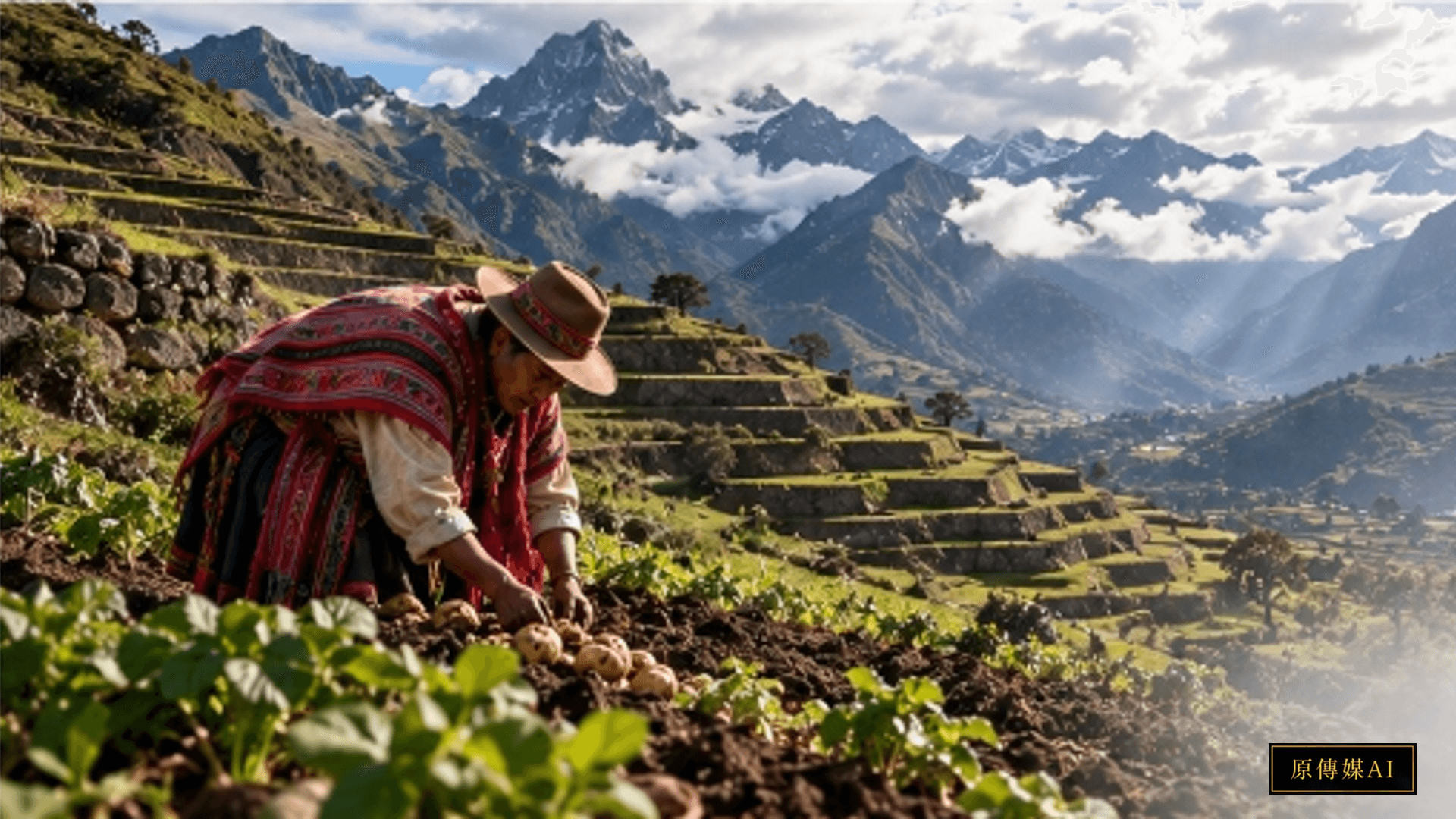
Through the aerial lenses of tourists and urban photographers, high-mountain terraces carved along ridgelines are often framed with pastoral romance: elegant stone-walled curves sweeping along contours, transforming rugged slopes into geometric green amphitheatres. Yet in the eyes of agricultural engineers and Indigenous farmers, this scenery represents an entirely different order of reality. Interpreting terraces merely as flat soil steps constructed because hillsides were too steep is the most impoverished misreading of montane geography perpetuated by lowland mechanized agriculture.
Across the South American Andes at elevations exceeding 3,000 meters, high-altitude environments pose life-threatening challenges to living organisms: intense equatorial solar radiation heats ground surfaces past thirty degrees Celsius by day, while thin mountain air triggers severe nocturnal long-wave radiative cooling, plunging temperatures below freezing within hours. Catastrophic frosts routinely settle like ghosts in mountain valleys; a single unshielded dawn freeze ruptures plant cell walls, annihilating entire fields of seedlings.
Yet on these alpine precipices judged exceptionally fragile by modern agronomists, the Inca Empire and precursor civilizations sustained millions of citizens through ancient stone terrace systems known as Andenes, domesticating over three thousand cold-adapted varieties of potatoes, quinoa, and Andean maize. This was not simple soil retention, but an ancient microclimate-regulating machine engineered with thermodynamic and hydraulic precision across centuries.
Thermal Inertia and Energy Dissipation: Thermodynamics Within Stone Walls
Unlocking the operational secrets of this climate machine requires inspecting its vertical cross-section. A standard Andean agricultural terrace is not a simple dirt embankment; it is an engineered multilayer composite material system.
First is the thermodynamic regulation of dry-stone retaining walls. Terrace facades are constructed from unmortared dark basalt, granite, or andesite stones fitted snugly together. These dark rocks possess high volumetric heat capacity and thermal conductivity. During cloudless daytime hours, they absorb intense direct and diffuse solar shortwave radiation, locking heat deep into the wall core; as night falls and air temperatures collapse, the stones steadily radiate long-wave infrared heat into surrounding soils and crop root zones.
Even more ingenious is the localized convective airflow induced by stone walls. Gentle convective thermals rising from stone faces form a warm-air buffer over planting platforms, disrupting nocturnal temperature inversions that settle cold air into valley bottoms and keeping surface temperatures three to five degrees Celsius above freezing. This crucial temperature cushion preserves plant cellular membranes from freezing rupture.
Second is the internal multilayer hydraulic filtration and energy dissipation architecture. Behind stone walls, Inca engineers laid deep beds of coarse gravel and rubble, topped with medium-grain sands, and capped with fertile topsoil enriched with alpaca manure and humus. During cloudbursts or glacial snowmelt, this inverted gradation filters excess water downwards within seconds, preventing surface runoff from scouring topsoils into gully erosion while protecting crop roots from waterlogged hypoxia.
Between terrace tiers, micro-canals carved at gentle grades guide water downward. As runoff cascades across stone steps, kinetic energy is dissipated tier by tier, transforming destructive storm torrents into gentle streams that irrigate each level. This structure unifies soil conservation, deep-seated translational landslide prevention, and groundwater recharge into a single agricultural landscape.
The Moray Circular Laboratory: Stepped Gradients and Seed Domestication
If sprawling hillside Andenes are the standard modules of this climate machine, the concentric circular terraces of Moray in Peru's Sacred Valley represent the Inca civilization's national agricultural laboratory and germplasm breeding center.
Constructed within natural limestone sinkholes (*dolines*), the largest Moray complex descends twelve concentric stone tiers thirty meters below the ground surface. Microclimatologists and agricultural scientists deploying micro-sensors discovered an extraordinary physical phenomenon: owing to terrace depth, circular sheltering from winds, differential solar angle reflection, and vertical convective thermal stratification, the temperature differential between Moray's lowest tier and uppermost rim reaches up to fifteen degrees Celsius!
Within a diameter of a few hundred meters, Inca agronomists engineered a micro-simulation of complete vertical ecological zones—from subtropical warm valleys and temperate plateaus to high alpine punas.
Inca savants brought wild potato accessions and maize landraces from across the empire to Moray, moving cultivars upward tier by tier. In each micro-temperature step, they observed leaf thickness, cuticular wax development, and cold-shock protein responses. Through multi-generational selection and gradual acclimatization, they domesticated river-valley crops into cold-tolerant staples capable of high yields in alpine extremes. This ancient installation fulfilled all core capabilities of contemporary research phytotrons and seed gene banks.
Atayal Stone Terraces and Irrigation Canals: Taiwan Alpine Water and Soil Philosophy
Across the Pacific, Taiwan's high-mountain terrain bears equally sophisticated Indigenous engineering that transformed steep slopes into stable ecosystems. In the gorges of the Snow Mountain and Central Mountain ranges, traditional settlements of the Atayal, Bunun, and Tsou peoples developed refined soil and water stewardship guided by ancestral Gaga law and land ethics.
In traditional Atayal settlements of Hsinchu and Miaoli, villagers preparing agricultural slopes never clearcut entire ridgelines for monocultures. Instead, they preserve ridgetop sacred protection forests (*Qhuniq Utux*, trees of the ancestral spirits) for watershed protection, wind reduction, and rockfall buffering. On steep slopes, villagers stacked flat river boulders and slate slabs along natural contour lines to build low dry-stone terraces (*stone-step terraces*).
These stone terraces exhibit remarkable hydrological resilience. Without mortar or cement, stones interlock mechanically through dry-masonry craftsmanship. During routine weather, porous seams absorb moisture to sustain soil dampness; during torrential typhoons dropping hundreds of millimeters of rain, unmortared gaps function as high-capacity weep holes, rapidly releasing deep pore-water pressure and eliminating the hydraulic trigger for deep-seated landslides.
Equally remarkable are Atayal alpine bamboo canal networks (*aqueducts*). Splitting giant bamboo culms and hollowing out internal nodes, villagers suspended channels across rock gullies to convey pristine mountain streams to cultivate taro and millet. During winter-spring cold snaps, flowing water forms a protective thermal film across paddy surfaces. Because of water's high specific heat capacity, water temperatures drop far slower than exposed dry soil during freezing nights, shielding endemic crop germplasm from frost damage. This practice proves that Taiwan Indigenous landscapes have long functioned as precision ecological defense machines.
Disability Perspectives and Extreme Climate Risk Communication: Accessible Survival Science
Translating the operational principles of this ancient climate machine into contemporary public policy requires introducing a dimension long neglected by technological elites and engineering bureaucracies: disability perspectives and information accessibility.
In an era of intensifying climate disruption, impacts are never distributed equally. When debris-flow red warnings are issued, roads wash out, and mountain settlements become isolated, tribal elders, persons with mobility disabilities, and Deaf or visually impaired individuals face the highest existential risks. Standard governmental alerts rely on complex topographic contours, technical hydrology terms (such as effective accumulated rainfall and duration curves), and dense warning codes, constructing an exclusionary cognitive barrier.
Examining ancient terraces reveals that premier engineering is inherently intuitive and tangible. Terrace stone walls, water velocities, and crop frost markings are direct physical indicators visible to any villager's eye and touchable by any hand.
Advancing modern climate risk communication requires establishing an accessible extreme climate intelligence platform: converting mountain geotechnical data and microclimate telemetry into high-contrast, screen-reader accessible visual guides and plain-language summaries; producing sign-language interpretation videos in Indigenous languages for Deaf community members; and crafting tactile 3D maps of local slope gradients and runoff channels for visually impaired residents.
Critically, persons with disabilities and elders must be integrated into co-designing tribal evacuation routes and microclimate shelter nodes. Ancient terrace systems endured across millennia because maintenance was a collective responsibility shared across all community members. During extreme weather emergencies, this climate machine fulfills its ethical purpose only when vulnerable members access danger alerts barrier-free, comprehend slope changes, and reach sheltered spaces safely.
Conclusion: Rediscovering Earth's Wisdom Amid Concrete Ruins
Contemporary engineering civilizations idolize rebar, concrete, and heavy machinery. We spray shotcrete across collapsed slopes and drill steel ground anchors tens of meters into bedrock, seeking to bind mountains with brute rigidity. Yet beneath typhoon torrents, cracked and flaking grey shotcrete faces and twisted steel beams silently mock human technological hubris.
Stepping into the stone tiers of the Andes or walking among the stone-step terraces of Taiwan Indigenous mountain lands reveals a different philosophy: not resisting gravity, but guiding it; not fighting cold, but storing the warmth of the sun in living rock; not carving land into fragmented parcels, but weaving entire mountainsides into self-sustaining climate machines.
Confronting the climate crisis, humanity's most urgent need is not the fantasy of extraterrestrial colonization, but the humility to bend down and touch ancient stones that have weathered millennia. Within steps woven of soil, rock, water, and human sweat resides a timeless algorithm of thermal balance, hydraulic harmony, seed resilience, and inclusive accessibility. That generational covenant of survival awaits our renewed understanding.
Sources and Further Reading
Role-Driven Inquiry
Yuan Media AI | Guided Questions by Role
Select a role first, then review the complete questions from that perspective; clicking a question will display Yuan Media AI’s response in real time.
Select a role
農業水利與微氣候工程研究員
Examine the article's evidence, governance boundaries, data rights, and actionable steps from the perspective of a 農業水利與微氣候工程研究員.
Choose a question
AI use and content-safety disclosure
AI assisted writing and translation. Source-supported facts, editorial interpretation, and implications for Taiwan are distinguished.