Wind Power Is Green, but Migration Routes Can Still Be Fragmented: Sámi Herders Warn Against Reading Energy Transition Only Through Carbon Maps
Original Chinese title: 風機是綠色的,牠的遷徙路卻可能被切碎:Sámi 馴鹿牧民提醒能源轉型,不能只看減碳地圖
This feature examines wind power is green, but migration routes can still be fragmented: sámi herders warn against reading energy transition only through carbon maps while keeping evidence, cultural context and editorial analysis distinct.
邱俐瑜 Liyu Chiu|公民科 x AI資訊科技媒體素養教案獎得主|AI教育學院。FB粉絲專頁|快樂鯉魚秋老虎:運算思維與程式設計;共同作者:阿將伊崮喜瀾
Co-authors: ["阿將伊崮喜瀾"]
Liyu Chiu is an award-winning civic science and AI media-literacy educator focused on AI education, computational thinking, programming and media literacy.
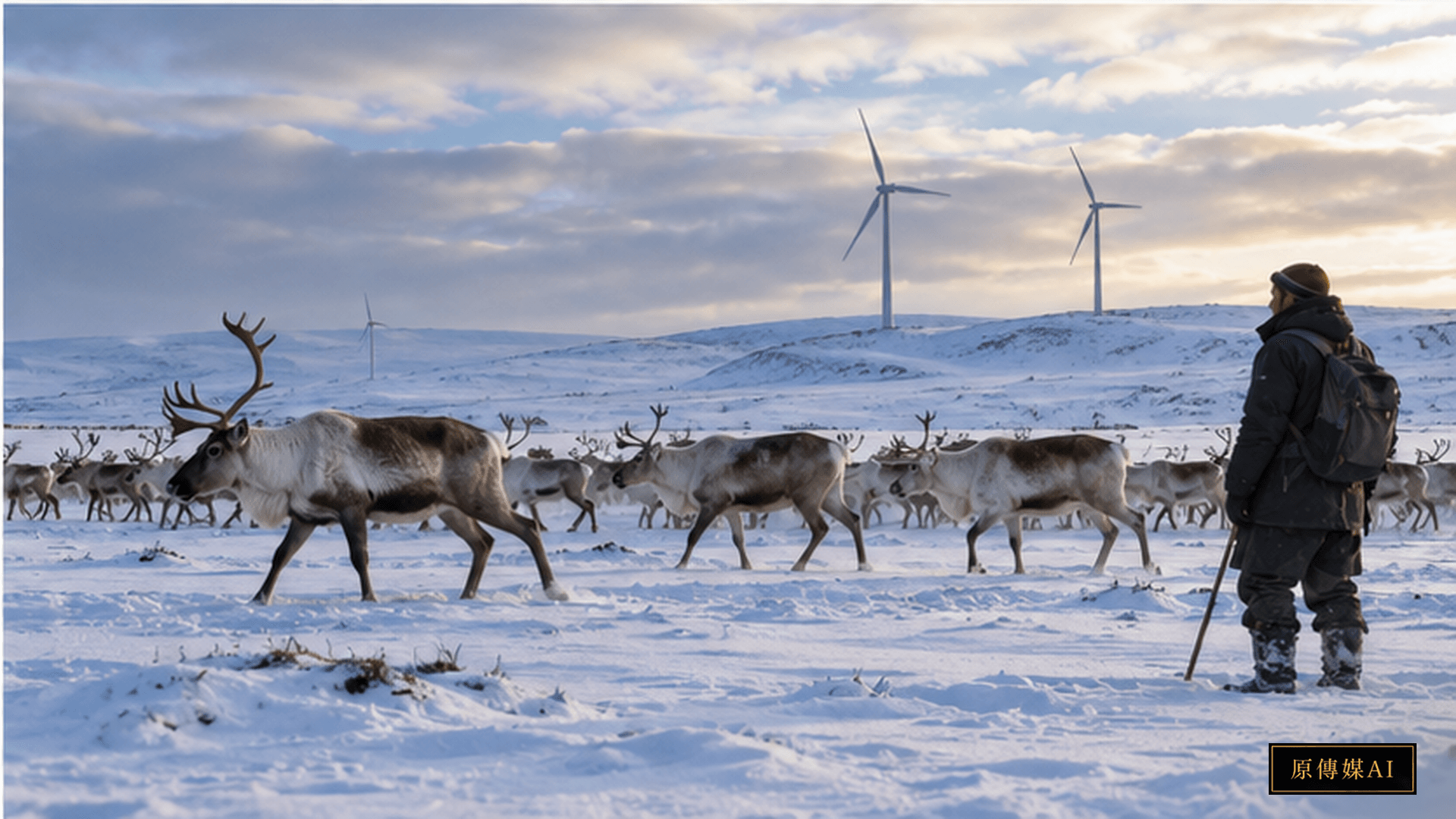
# Wind Power Is Green, but Migration Routes Can Still Be Fragmented: Sámi Herders Warn Against Reading Energy Transition Only Through Carbon Maps
Author: 邱俐瑜 Liyu Chiu
This feature asks how scientific modelling, digital systems and Indigenous/place-based knowledge and Two-Eyed Seeing can correct one another without flattening their differences. It treats evidence, cultural context and editorial analysis as separate layers and avoids presenting one knowledge system as the final judge of another.
Chapter 1 — Why Can a Green-Energy Map Miss a Reindeer Route?
This chapter starts from the documented evidence: A 2026 Ambio study used participatory workshops with Sámi and Finn reindeer herders to analyse a polycrisis. It argues that meaningful influence over land-use governance and secure land access can respond together to pressures from the green transition, geopolitics, inequality and climate change. A five-year Ecology and Society study examines how Northern Sweden Sámi pastoralists build strategic alliances across scales; a Septentrio report describes árbediehtu as living relational knowledge transmitted through practice, language and community institutions. The goal is not to rank scientific and Indigenous knowledge, but to identify the different scales, relationships and blind spots each method can reveal.
Chapter 2 — Árbediehtu Records Routes, Snow, Lichen and Time
Knowledge is more than an extracted data point. Who observed something, where and when it applies, why the observation matters, what risks are attached to error, and who has authority to revise the interpretation can all be part of the knowledge itself.
Chapter 3 — Polycrisis: Climate, Forests, Mining and Wind Power Are Not Four Separate Maps
Disagreement between models and place-based observations should be investigated rather than automatically resolved in favour of one side. Spatial resolution, temporal scale, missing variables, sampling design and research purpose all matter.
Chapter 4 — When Local Experience Must First Be Translated into ‘Acceptable Evidence’
Evidence boundaries are essential. The evidence cannot support the claim that all wind power harms reindeer or that Sámi oppose clean energy. The Septentrio item is a seminar/report, not a causal field experiment; the other studies are also participatory and social-ecological research. They support the importance of land access, cumulative impacts, governance and knowledge power, not a predetermined verdict on every energy project. Generative AI should preserve uncertainty rather than invent culturally plausible details that are not supported by sources.
Chapter 5 — Back to Taiwan: Do Not Copy Sámi Institutions; Start with a Cumulative-Impact Map
For Taiwan, the transferable lesson is method rather than cultural content: co-define the question, preserve provenance and permissions, return results for local validation, and keep versions and uncertainty visible.
Yuan Media AI editorial note
A trustworthy Indigenous knowledge system needs more than a large vector database. It should preserve provenance, permission, place, time, community authority, version history and uncertainty. The system must also be able to say “we do not know” when sources do not support a claim.
Evidence boundaries
The evidence cannot support the claim that all wind power harms reindeer or that Sámi oppose clean energy. The Septentrio item is a seminar/report, not a causal field experiment; the other studies are also participatory and social-ecological research. They support the importance of land access, cumulative impacts, governance and knowledge power, not a predetermined verdict on every energy project.
How to read this evidence
Readers should separate direct observations, modelled scenarios, cultural context and editorial analysis. A network or map can make relationships visible, but its lines do not by themselves prove causation or establish that every community will experience the same outcome.
A local knowledge system should begin with permissions, provenance, versioning and community authority rather than with a demand to collect every available name or recording. Searchability is not the same as consent, and a complete dataset is not the same as preserved relationships.
Any Taiwan application should start with a small, reversible question defined with affected people. The process should record who may correct the data, who may restrict access, how uncertainty is displayed and what happens when the proposed interpretation fails.
The case is therefore useful as a method for asking better questions, not as a universal template. Its public value depends on keeping differences among places, institutions, languages and histories visible.
Methods for traceable digital knowledge
For each research fact, preserve a source identifier; for each cultural explanation, preserve community and context fields; and for each editorial inference, mark analysis. Keep prior versions and dates when sources change, and use access levels so public, research and community versions can differ.
A traceable system should keep the original source, the date of review, permission status, local validation and revision history visible to the people who govern the knowledge.
When a source changes or a community corrects an interpretation, publish the change as a new version instead of silently overwriting the earlier record.
Sources
Role-Driven Inquiry
Yuan Media AI | Guided Questions by Role
Select a role first, then review the complete questions from that perspective; clicking a question will display Yuan Media AI’s response in real time.
Select a role
Sámi or Indigenous land, livelihood and cultural worker
Examine the article's evidence, governance boundaries, data rights, and actionable steps from the perspective of a Sámi or Indigenous land, livelihood and cultural worker.
Choose a question
AI use and content-safety disclosure
AI assisted formatting and translation. Source-supported facts, cultural context and editorial analysis are distinguished.